 Leif Andersen
Welp, I'm going to be unemployed in about 2 weeks...unless I can find some work. :(

@ckfinite
- 34 Followers
- 93 Following
- 88 Posts
@[email protected] Yes, local = on your computer here.
@[email protected] If it's a locally saved version then it won't put any additional extra load on their servers. Don't worry too much about it, though, a couple of manual requests isn't going to make much difference one way or another.
@gsuberland At least to me, I read it more cynically than that. Scraping Twitter is not a great way to build up ML datasets, since it's too slow. There are third parties with the firehose if you want to do that.
My suspicion is that user acquisition dropped dramatically and that this is a kneejerk reaction to try and get more accounts registered from "freeloaders."
@BillySmith I have a few friends who work on stationary and mobile kitesail control and it's only like... the last 5-10 years that flying them truly automatically became realistic in my opinion. Even then I don't think that they'll work in "the real ocean" because the real world hates your clever control algorithm and will hit you with the worst wind at the wrong time and goodbye sail.
A few papers I liked
* https://www.researchgate.net/profile/Richard-Leloup/publication/269695472_Kite_and_classical_rig_sailing_performance_comparison_on_a_one_design_keel_boat/links/57bebe1e08aeda1ec3864a33/Kite-and-classical-rig-sailing-performance-comparison-on-a-one-design-keel-boat.pdf
* https://www.jstor.org/stable/pdf/44725651.pdf
* https://www.mdpi.com/2077-1312/11/1/117
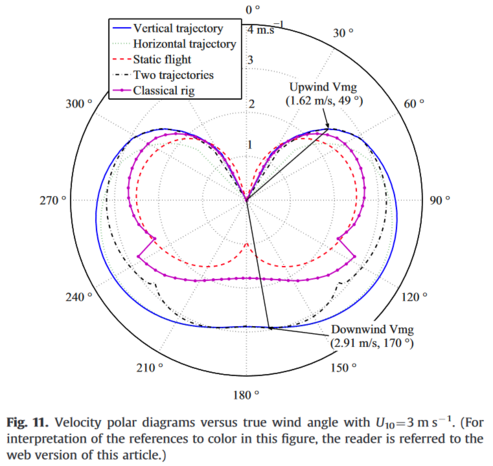
@BillySmith Kitesails are great on paper - you're looking at like 30-40% more power generation vs. a wingsail even. There's even complete memes like the SP80 high speed sailboat that wants to hit 80kts that use them.
They work great for sporting or for one-off demos, the problem is then using them at sea, for a long time, in poor weather. The kite isn't cheap and if it crashes you're probably not getting it back - so a lot is riding on the flight controller to keep it around.
@sortius That's because America's Cup rules prohibit them from being used. A couple of teams flew them around in 2002/2003 (e.g. https://www.sail-world.com/Australia/Kite-Sails-For-Americas-Cup/-8770) and the rules were changed to keep them out.
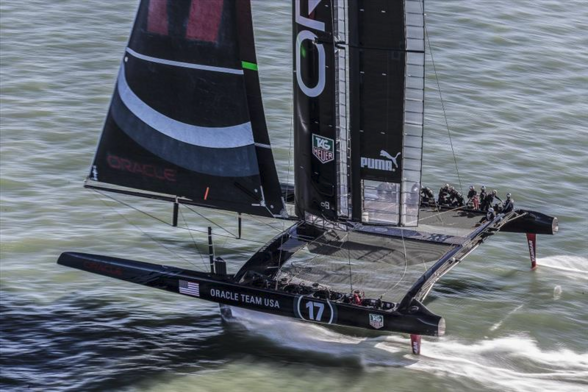
Wingsails, sails that are directly attached to the boat but have airfoil geometries, have been used extensively in yacht racing, as in this AC72 class racing yacht whose mainsail uses a rigid airfoil geometry.

Kite Sails For America's Cup
The 2003 America's Cup regattas brought the world's best and fastest high tech sailing yachts to compete in New Zealand, but none more exotic than the USA team's yacht which flew a kite sail spinnaker designed by KiteShip USA during the Louis Vuitton Cup trials, to prove once and for all that regulation designed kite sails could be a decisive advantage in the America's Cup.
@sortius The benefit is coming from being lifting and from the additional movement of the kite in the wind. The kite then can realize the efficiency benefits of a wingsail on top of seeing a straight-up higher actual air velocity. You can then use this to go faster or to sail more upwind.
The best comparison to a kitesail is the wingsail, which really arose in the 60s. Kitesails have been of interest since the 90s (https://www.jstor.org/stable/pdf/44725651.pdf) but have been cripplingly unreliable.
@sortius It's dramatically more efficient than a spinnaker and can work over a much wider range of wind-relative headings. Sure, it's a sail for sure, it just works by very different principles compared to conventional rigging. You can't sail faster than the wind with a spinnaker, for example, but you can with one of these. SP80 wants to go 80kts with one.
The main problem is not efficiency, per se, so much as "keeping the kite from falling into the sea when the sky decides it hates it."
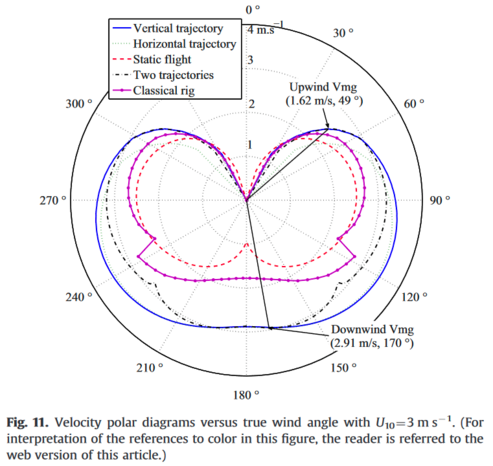
@[email protected] This paper https://www.researchgate.net/profile/Richard-Leloup/publication/269695472_Kite_and_classical_rig_sailing_performance_comparison_on_a_one_design_keel_boat/links/57bebe1e08aeda1ec3864a33/Kite-and-classical-rig-sailing-performance-comparison-on-a-one-design-keel-boat.pdf gives a direct comparison of a kite rig vs. a classical rig under real conditions that shows the performance improvements that can be realized from using a kite rig with good trajectory planning.