 Daniel Lakens
If you use equivalence testing (and which frequentist who follows best practices doesn't nowadays!) check out this new preprint by @arcaldwell49 https://psyarxiv.com/ty8de/ He has taken the TOSTER #Rstats package to a whole new level. Equivalence tests for ANOVA's, much nicer functions and plots for t-tests, directly comparing standardized mean differences - a whole lot of goodies!

Christer
@chaplin
- 9 Followers
- 25 Following
- 14 Posts
Part-time biostatistician at Sahlgrenska uni hospital in Gothenburg, mostly in orthopedics.
 Jack Wilkinson
I am currently leading an NIHR-funded project to develop a tool for identifying ’problematic’ studies in systematic reviews. ‘Problematic’ = those subject to data fabrication/falsification, or other serious research integrity issues. This does not mean poor methodology. Interested in connecting with people with interest, experience, or expertise in this area. #researchintegrity #researchintegrityandpeerreview
 Lisa DeBruine 🏳️🌈
Data visualisation using R, for researchers who don't use R by @emilynordmann, @mcaleerp, Wil Toivo, @HelenaPaterson & @debruine
In this tutorial, we provide a practical introduction to data visualisation using R, specifically aimed at researchers who have little to no prior experience of using R.
https://psyteachr.github.io/introdataviz/
https://doi.org/10.1177/25152459221074654
 Miguel Hernan
Upgrade your #causalinference arsenal.
A revision of our book "Causal Inference: What If" is now available
👇
https://hsph.harvard.edu/miguel-hernan/causal-inference-book/
Thanks to everyone who suggested improvements, reported typos, and proposed new citations and material.
Enjoy the #WhatIfBook.
Also, it's free.


 Eugen Rochko
Hey, so, we've hit 1,028,362 monthly active users across the network today. 1,124 new Mastodon servers since Oct 27, and 489,003 new users. That's pretty cool.
 Cédric Scherer
Hello 🌍, hello 🦣.
I am Cédric, an independent data visualization designer, Consultant and instructor for engaging and effective graphical storytelling 👋
Over the last years, I have shared lots of open-source #dataviz, mostly generated in #rstats with #ggplot2.
I am looking forward to interacting with you and sharing the knowledge here on Mastodon as well!
 Aral Balkan
Here’s an idea: let’s call people “people” on the fediverse instead of “users” whenever we can.
Compare:
“There are 42 users on this instance.”
vs
“There are 42 people on this instance.”
Which acknowledges our humanity more?
Language matters. We don’t need to perpetuate mainstream technology’s othering/colonial framing of “us” – designers/developers/other “clever folks” – and “them” – the users (usually one step removed from “dumb user” and usually the ones who get used).
 Open Science Feed
Prevalence of questionable research practices, research misconduct and their potential explanatory factors: A survey among academic researchers in The Netherlands. #ScientificNorms #PeerReview #PublishOrPerish
https://journals.plos.org/plosone/article?id=10.1371/journal.pone.0263023
https://www.reddit.com/r/Open_Science/comments/syp8ws/prevalence_of_questionable_research_practices/?utm_source=ifttt
https://journals.plos.org/plosone/article?id=10.1371/journal.pone.0263023
https://www.reddit.com/r/Open_Science/comments/syp8ws/prevalence_of_questionable_research_practices/?utm_source=ifttt

Prevalence of questionable research practices, research misconduct and their potential explanatory factors: A survey among academic researchers in The Netherlands
Prevalence of research misconduct, questionable research practices (QRPs) and their associations with a range of explanatory factors has not been studied sufficiently among academic researchers. The National Survey on Research Integrity targeted all disciplinary fields and academic ranks in the Netherlands. It included questions about engagement in fabrication, falsification and 11 QRPs over the previous three years, and 12 explanatory factor scales. We ensured strict identity protection and used the randomized response method for questions on research misconduct. 6,813 respondents completed the survey. Prevalence of fabrication was 4.3% (95% CI: 2.9, 5.7) and of falsification 4.2% (95% CI: 2.8, 5.6). Prevalence of QRPs ranged from 0.6% (95% CI: 0.5, 0.9) to 17.5% (95% CI: 16.4, 18.7) with 51.3% (95% CI: 50.1, 52.5) of respondents engaging frequently in at least one QRP. Being a PhD candidate or junior researcher increased the odds of frequently engaging in at least one QRP, as did being male. Scientific norm subscription (odds ratio (OR) 0.79; 95% CI: 0.63, 1.00) and perceived likelihood of detection by reviewers (OR 0.62, 95% CI: 0.44, 0.88) were associated with engaging in less research misconduct. Publication pressure was associated with more often engaging in one or more QRPs frequently (OR 1.22, 95% CI: 1.14, 1.30). We found higher prevalence of misconduct than earlier surveys. Our results suggest that greater emphasis on scientific norm subscription, strengthening reviewers in their role as gatekeepers of research quality and curbing the “publish or perish” incentive system promotes research integrity.
 Phil McAleer
Our new #PsyTeachR #preprint is out today: "Embedding Data Skills in Research Methods Education: Preparing Students for Reproducible Research". In this paper we discuss the importance of #teaching relevant #dataskills including wrangling and visualisation, as well as analysis, throughout #undergraduate #ResearchMethods programmes, to help develop #reproducible research in the future. Whilst we use #rstats, the most important aspect is teaching key skills, not software.
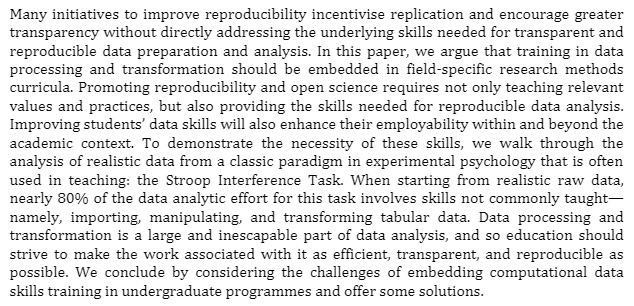
I'm so excited to announce the #preprint of our #PsyTeachR paper, "Embedding Data Skills in Research Methods Education: Preparing Students for Reproducible Research". The team has been working on this for years.
We cover why and how to teach reproducible data preparation and analysis, with concrete examples in #rstats and #python.
Team: @mcaleerp, Niamh Stack, Heather Cleland Woods, @debruine, @HelenaPaterson, @emilynordmann, Carolina Kuepper-Tetzel, and Dale J. Barr