Projeto Céu Profundo

23 Followers
35 Following
31 Posts
Divulgação da #Astronomia e #Educação Científica com a Mão na Massa.
Acessando dados de telescópios robóticos na superfície e em órbita para divulgar a Astronomia.
#openscience
#openskies
#spacetelescopes
Websitehttp://www.ceuprofundo.com
Twitterhttps://www.twitter.com/ceuprofundo
Instagramhttps://www.instagram.com/ceuprofundo
YouTubehttps://www.youtube.com/ceuprofundo
Slightly out of focus Southern Cross, to emphasize different star colors.

Astronomers Find a Rare "Einstein Cross"

Astronomers use powerful gravitational lenses to peer farther into the Universe than they could with their telescopes alone. A foreground galaxy acts as a natural lens for a more distant galaxy, magnifying it and often splitting its light into several versions. When the alignment is almost perfect, the light is split four ways into an "Einstein Cross." Only a few of these have ever been discovered, and now astronomers have found a new one using the Dark Energy Spectroscopic Instrument. It's both beautiful and scientifically valuable for studying the distant Universe.

#desi #gravitationallens #einsteincross

http://arxiv.org/abs/2307.12470

DESI-253.2534+26.8843: A New Einstein Cross Spectroscopically Confirmed with VLT/MUSE and Modeled with GIGA-Lens

Gravitational lensing provides unique insights into astrophysics and cosmology, including the determination of galaxy mass profiles and constraining cosmological parameters. We present spectroscopic confirmation and lens modeling of the strong lensing system DESI-253.2534+26.8843, discovered in the Dark Energy Spectroscopic Instrument (DESI) Legacy Imaging Surveys data. This system consists of a massive elliptical galaxy surrounded by four blue images forming an Einstein Cross pattern. We obtained spectroscopic observations of this system using the Multi Unit Spectroscopic Explorer (MUSE) on ESO's Very Large Telescope (VLT) and confirmed its lensing nature. The main lens, which is the elliptical galaxy, has a redshift of $z_{L1} = 0.636\pm 0.001$, while the spectra of the background source images are typical of a starburst galaxy and have a redshift of $z_s = 2.597 \pm 0.001$. Additionally, we identified a faint galaxy foreground of one of the lensed images, with a redshift of $z_{L2} = 0.386$. We employed the GIGA-Lens modeling code to characterize this system and determined the Einstein radius of the main lens to be $θ_{E} =2.520{''}_{-0.031}^{+0.032}$, which corresponds to a velocity dispersion of $σ$ = 379 $\pm$ 2 km s$^{-1}$. Our study contributes to a growing catalog of this rare kind of strong lensing systems and demonstrates the effectiveness of spectroscopic integral field unit observations and advanced modeling techniques in understanding the properties of these systems.

arXiv.org
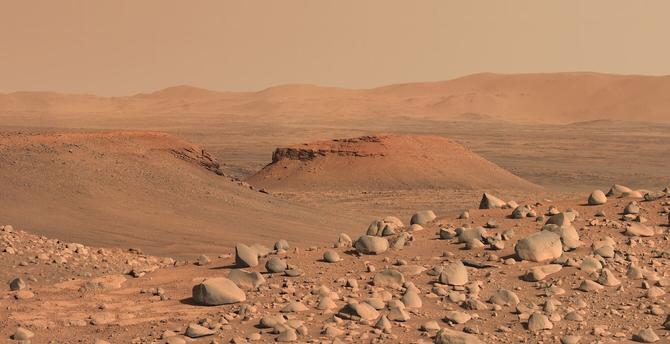
The Perseverance Rover just got a view back to the Kodiak mesa after a recent drive. Processed using images taken with the Mastcam-Z camera on Sol 753.
.
NASA/JPL-Caltech/ASU/Kevin M. Gill
.
#Mars #Mars2020 #MarsPerseverance #Space #Science

Southern Ring, a planetary nebula featured as one of the first images released after JWST launched. Subtracted much of the blue light out of the center of my version.

https://flic.kr/p/2oqdGEW

#astronomy

Southern Ring

Flickr

Starts With A Bang podcast #92 – Type Ia supernovae

New podcast, featuring Dr. Ken Shen!

For decades, we thought that they were exploding white dwarfs that crossed over the Chandrasekhar limit.

Here's why we don't think that anymore.
https://bigthink.com/starts-with-a-bang/type-ia-supernovae/

Starts With A Bang podcast #92 - Type Ia supernovae

When white dwarfs explode, they create a type Ia supernovae. After decades of following the leading theory, here's the complete overhaul!

Big Think

Everyone's got that photobombing friend 🙄

Our all-sky camera monitors weather and clouds over the entire sky to help scientists with observations. But sometimes, it gets to monitor the local wildlife!

Right now, the all-sky camera is used for observations with the Auxiliary Telescope (and photos of birds, of course). Once Rubin is online, the all-sky camera's continuous cloud-mapping will help our automated survey software pick the best spot to point the telescope next!

Check out those views! 😎

It's always a treat to open the observatory dome—and not just for our staff who get these views firsthand!

...even our commissioning camera friend gets a peek 👹

📷:
(1, 2, 4):
@ChrisWalter/Duke Univ./DOE
(3): E. Serrano/Rubin Obs/NSF/ @AURA

#astronomy #Astrodon #observatory

RT @[email protected]

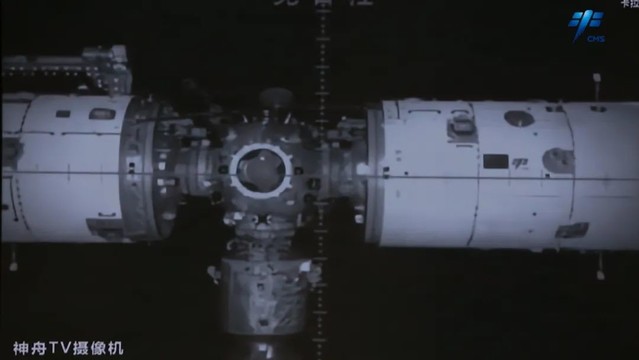
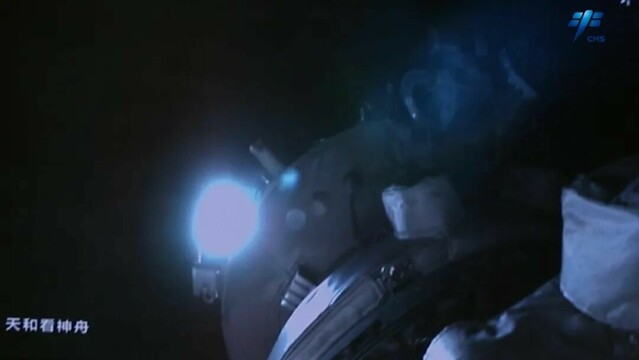
Shenzhou-15 docked at Tiangong space station just over 15 minutes ago, at 2142 UTC, China's human spaceflight agency has just announced. https://mp.weixin.qq.com/s/RQG_JYgUiAHOTFun5HD65w

🐦🔗: https://twitter.com/AJ_FI/status/1597711890976997376

If you missed the opening plenary session of the #A4ESymposium , you can now watch it back on YouTube: https://www.youtube.com/watch?v=BybDwH8tpI8 . Feel free to comment, and we'll try to address comments and answer questions.
A4E Symposium 2022 - Day 1 - Opening Plenary

YouTube

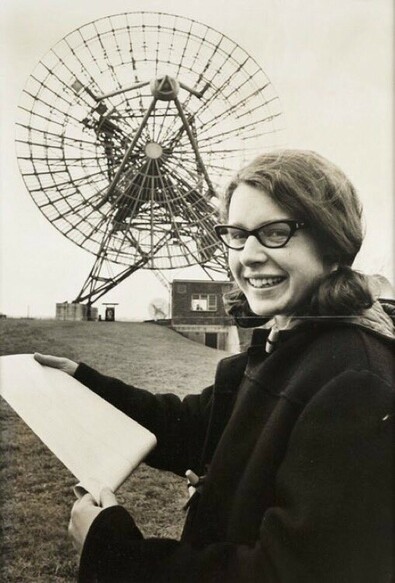
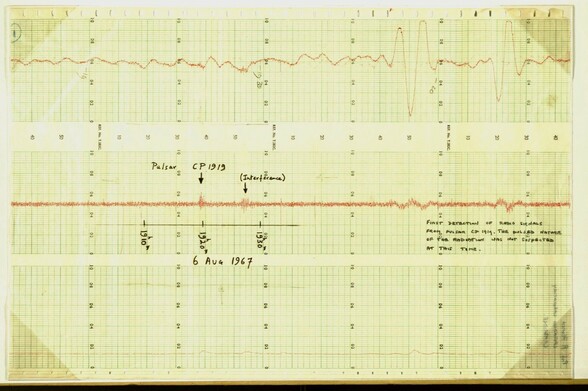
Jocelyn Bell Burnell transformed astronomy #OTD in 1967 when she made the first observation of a pulsar.

She and advisor Antony Hewish initially dubbed the object LGM-1 (“Little Green Men”) for its regular signal, but soon identified it as a rotating, magnetized neutron star.

#astronomy #pulsars #neutronstars #JocelynBellBurnell