Astronomers Find a Rare "Einstein Cross"

Astronomers use powerful gravitational lenses to peer farther into the Universe than they could with their telescopes alone. A foreground galaxy acts as a natural lens for a more distant galaxy, magnifying it and often splitting its light into several versions. When the alignment is almost perfect, the light is split four ways into an "Einstein Cross." Only a few of these have ever been discovered, and now astronomers have found a new one using the Dark Energy Spectroscopic Instrument. It's both beautiful and scientifically valuable for studying the distant Universe.

#desi #gravitationallens #einsteincross

http://arxiv.org/abs/2307.12470

DESI-253.2534+26.8843: A New Einstein Cross Spectroscopically Confirmed with VLT/MUSE and Modeled with GIGA-Lens

Gravitational lensing provides unique insights into astrophysics and cosmology, including the determination of galaxy mass profiles and constraining cosmological parameters. We present spectroscopic confirmation and lens modeling of the strong lensing system DESI-253.2534+26.8843, discovered in the Dark Energy Spectroscopic Instrument (DESI) Legacy Imaging Surveys data. This system consists of a massive elliptical galaxy surrounded by four blue images forming an Einstein Cross pattern. We obtained spectroscopic observations of this system using the Multi Unit Spectroscopic Explorer (MUSE) on ESO's Very Large Telescope (VLT) and confirmed its lensing nature. The main lens, which is the elliptical galaxy, has a redshift of $z_{L1} = 0.636\pm 0.001$, while the spectra of the background source images are typical of a starburst galaxy and have a redshift of $z_s = 2.597 \pm 0.001$. Additionally, we identified a faint galaxy foreground of one of the lensed images, with a redshift of $z_{L2} = 0.386$. We employed the GIGA-Lens modeling code to characterize this system and determined the Einstein radius of the main lens to be $θ_{E} =2.520{''}_{-0.031}^{+0.032}$, which corresponds to a velocity dispersion of $σ$ = 379 $\pm$ 2 km s$^{-1}$. Our study contributes to a growing catalog of this rare kind of strong lensing systems and demonstrates the effectiveness of spectroscopic integral field unit observations and advanced modeling techniques in understanding the properties of these systems.
arXiv.org
@fraser that's amazing, I just love learning new things about the universe.
@geographile It's so cool to see. Only a handful have ever been discovered before.
@fraser I really love the name they were given.
@fraser Here's what it looks like in the DESI Legacy Imaging Surveys:
https://www.legacysurvey.org/viewer/?ra=253.2535&dec=26.8843&layer=ls-dr9&zoom=16
Legacy Survey Sky Browser

@dstndstn Nice sleuthing. I wonder if there's a way to find them automatically in the data?
@fraser I tried feeding it to George Stein's "similarity search" galaxy finder, but the central galaxy isn't in the data set
https://georgestein-galaxy-search-streamlit-app-o7accj.streamlit.app/
@dstndstn @fraser Dustin you also helped make astrometry.net, right? Could you try to find matching hashes to various Einstein cross configurations?
@jwuphysics @fraser Hah, that's a fun mash-up of two different projects of mine :)
@jwuphysics @fraser The problem would be, I expect, that they're too close together, so unlikely to all be indexed as part of the same hash!
@fraser In this case, we have the central galaxy and all four images in the catalog, so one could imagine building a geometric search
@dstndstn @fraser That's totally a shape that you could train a CNN to detect, but you'd have to make a boatload of synthetic images to train it properly.
@simonbp @dstndstn There aren't many. Maybe you could simulate them and then search for them that way.
@fraser @dstndstn Yeah, that's how you'd want to do it anyways so that you can calibrate your detection efficiency. That's what we do with KBO detections.
@simonbp @fraser Honestly, for such a simple configuration as an Einstein cross, where you *understand* what it looks like and the five objects are resolved and catalogued, I would ("just") write an algorithm to detect them in catalog space, rather than training a ML model.
@dstndstn @simonbp I suspect the more of these you can find, the more the astronomers would be grateful.
@fraser The thing I *really* love about these, as if they weren’t cool enough, is that in some of those situations we are viewing the distant galaxy at different times in its history (Don’t @ me, I know this is a simplistic view of time 😊). I'm thinking in particular of this supernova:
https://www.nature.com/articles/s41550-021-01450-9
A gravitationally lensed supernova with an observable two-decade time delay - Nature Astronomy

The discovery of a multiply imaged, probably of type Ia, supernova in a galaxy at redshift 1.95 enables a time-delay measurement with an uncertainty of <1%. The prediction that a new image will appear in the year 2037 ± 2 allows the use of this system as a cosmological probe.

Nature
@MichaelPorter Oh yeah, when you get the light taking different paths, it's almost like being able to see into the future. You know where the supernova will be visible so you can actually watch it explode.
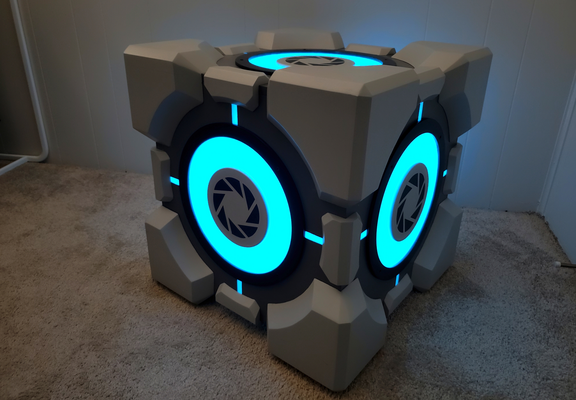
@fraser Are we sure that it's not just one illuminated face of a giant Portal Storage/Companion Cube‽😏😜