
 Cindy Milstein (they)
I read a book recently (“Pirate Care” on @plutopress, gifted to me by @aundtse) that highlighted a crucial element of solidarity: vulnerability. Without being vulnerable—without facing or opening oneself up to harm or injury (the Latin noun “vulnus” means “wound”) and taking risks—one stays in the realm of charity, aka upholding the brutal status quo.
It doesn’t mean that all who engage in solidarity are equally vulnerable. Rather, we’re side by side in tending to what wounds each other in a world (dis)order that feels one foolhardy fascist move away from destroying us all.
Such solidarity is sometimes large—like the @globalsumudflotilla—and often small—like a solidarity kitchen. Yet all shapes and sizes point to a sea change in what’s possible when we stretch vulnerability beyond and against borders.
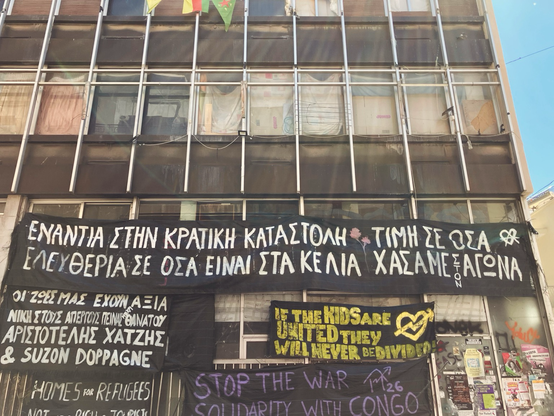
It takes a small risk, of course, to publicly paint a lengthy solidarity banner (pictured here at the top, and reading “Against state repression. Freedom for those in prison. Honor to those we have lost in the struggle,” made for Kyriakos, Marianna, Dimitra, the Sudanese boys [@50outofmany], and others who can’t safely be named here in Greece) on a grubby sidewalk in Athens outside a squat that’s home to and self-managed by migrants and refugees, and balance on a ladder to hang it high up; to do so in a language that isn’t anyone’s first tongue; to ask consent beforehand from the squat’s assembly and hope the banner’s message resonates in the wounded hearts of those to whom it’s directed; and put up a second banner (left-hand side of photo), made by others, in solidarity with @saveprosfygika and the two hunger strikers Aristotelis Chantzis and Suzon Doppagne.
But these fascistic days, even words are being deemed illegal. The freedom to move, to house oneself, to forge community, to resist … so much is illegal. We are shoulder to shoulder, arm in arm, in breaking laws aimed at breaking us, breaking solidarity, breaking life.
Solidarity is our best—and most tender—weapon.
 Sumana Harihareswara
 Working Class History
 MikeDunnAuthor
 ProPublica
 Qasim Rashid, Esq.
 she hacked you
 Street Art Utopia
 fulanigirl