The small #Latour appreciation is out in SSS in the amazing company of Madeleine Akrich, Donna Haraway and others. #sts
https://journals.sagepub.com/home/sss
https://journals.sagepub.com/home/sss

Abstract. Over the last decade, the Anthropocene has overrun the discourses of the humanities and social sciences. Remarkably, two of the most astute commentators, the cross‐disciplinary theorist Barbara Herrnstein Smith and the unorthodox philosopher Isabelle Stengers, find inspiration for grappling with these issues in the same apparently odd place: the work of the Polish microbiologist and comparative epistemologist Ludwik Fleck. The first part of this essay explores the role of Fleck's radical constructivism in Smith's analyses of perplexing Anthropocene realities and Stengers's arguments for slowing down science and learning to “compose with Gaia.” In conjunction, they generate a pattern of speculative, conceptual, practical, and political motifs for dealing with changing climates. The second half of the essay uses those insights to test a divergent series of proposals for how to conceive science, politics, theory, and environmental relations in the Anthropocene.

In the days after Bruno Latour passed away, many scholars celebrated his life by sharing lists of their favourite pieces of his. These primarily featured his newer works and well-known books, but almost none of the minor writings that first enamoured
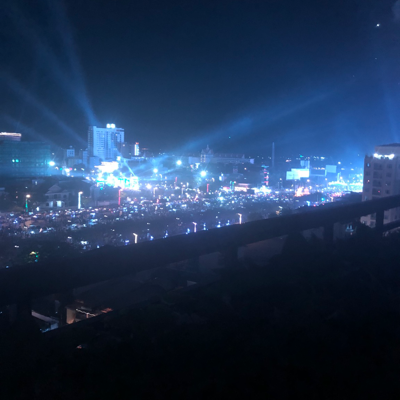
Jakkrit Sangkhamanee and I puts various ideas from #sts and anthro together with urban studies and weird fiction to try to figure out what kind of an entity #Bangkok is by a lateral comparison of #rewilding in Benjakitti Urban Forest Park and the youth #protests taking place across the city since 2020. The city appears overlapping critical zones where cascades of relations, always prone to spin out of control, create #cosmoecological openings.
Urban ecologies of megacities like Bangkok have been described as microcosms of global environmental change. But it is not so clear what kinds of microcosms they are, how to construe their many problems, and how to proceed. We explore these questions
Via @mohacska
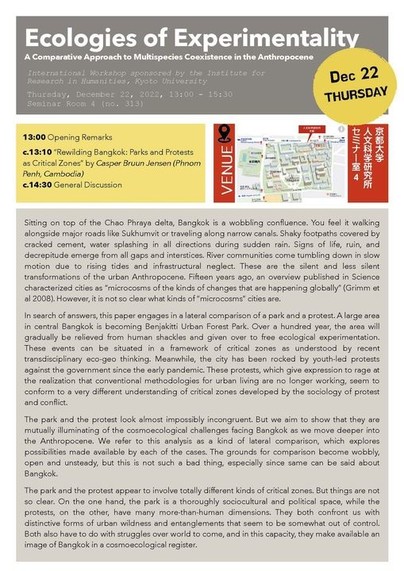
In our series on Ecologies of Experimentally, tomorrow at the Institute for Research in Humanities at Kyoto University, Casper Bruun Jensen will talk about a #rewildingding project in the heart of #Bangkok. Everyone is welcome to join, no registration required.
明日、12月22日(木曜日)、実験性を問い続けるシリーズの次回の研究会を開催します。京都大学の人文科学研究所でCasper Bruun Jensen を迎えて、バンコクの中心で進められている再野生化(rewilding)プロジェクトについての発表となります。ご関心のある方、ふるってご参加ください。事前登録は不要です。
Bruno Latour (1998) once insisted that “To Modernize or to Ecologize?” is the primary political question today. While scholars of actor-network theory (ANT) have tackled many different problems associated with environmentalism and climate change, the
 Shannon Mattern
 Matt Stine
 Christopher Kelty