
Cathy McKenzie

128 Followers
212 Following
185 Posts
Consultant pharmacist, and Hon Assoc Professor, wife, mummy of 3 amazing young people. Views mine. Editor in Chief, Critical Illness (www.medicinescomplete.com). Research in PKPD, sedation, delirium, opioids in critical illness. Love-life generally, hate Brexit and how refugees are treated. Am recovered from CRPS and feel pretty lucky in that regard.
💊10 reasons for the presence of pharmacy
professionals in #ICU
1️⃣ may improve patient & clinical outcomes
2️⃣ expertise in pharmacovigilance improves #ptsafety
3️⃣ medication optimisation
4️⃣ drug dosing in MOF & TDM
5️⃣ medication reconciliation at transitions of care
6️⃣ pharmacy technicians support nurses & contribute to sustainable healthcare
7️⃣ adequate drug delivery & stock supply
8️⃣ drug use research
9️⃣ education and delivery of evidence‑based pharmacotherapy
🔟 cost–benefit
🔓 https://rdcu.be/dvfZV
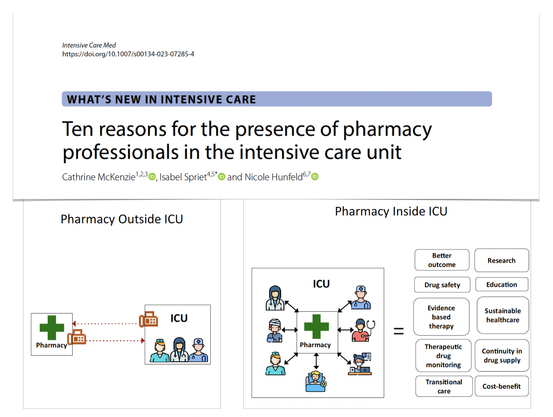
Ten reasons for the presence of pharmacy professionals in the intensive care unit

Last year

I am seeking 2 new research team members (a Research Assistant and a Postdoctoral Research Associate) to join our programme of work investigating the role of innate immune cells in acute inflammation. If this sounds like you, or you know someone who might be interested, please do take a look & get in touch:

https://www.jobs.cam.ac.uk/job/43571/

https://www.jobs.cam.ac.uk/job/43550/

Post-doctoral Research Associate (Fixed Term) - Job Opportunities - University of Cambridge

Post-doctoral Research Associate (Fixed Term) in the Department of Medicine at the University of Cambridge.

Does our own #mindset hinder implementation of evidence-based practices such as low sedation or early mobilisation #ICUrehab?

Survey among critical care clinicians (n=401) asking "would you like to be sedated"? Shockingly more than half (59%) answered yes!

There were no differences among professions but we found several differences in attidude

🖇️ https://www.sciencedirect.com/science/article/pii/S0964339723001957?dgcid=author

Current insight article on #physiotherapy interventions to prevent, treat & rehabilitate patients with pressure injuries in ICU
✅education
✅positioning
✅strengthening
✅functional retraining
✅ambulation
#ICUrehab

📎https://www.sciencedirect.com/science/article/pii/S0964339723002008

Scheduled intravenous opioids | Intensive Care Medicine time to start considering about the IV opioid either scheduled or continuous infusions we give our Intensive Care Unit (ICU) patients. #lessismore #ivopiods https://link.springer.com/article/10.1007/s00134-023-07254-x
Scheduled intravenous opioids - Intensive Care Medicine

SpringerLink

The Relationship Between #Cognitive Decline and All-Cause #Mortality Is Modified by Living Alone and a Small #Social Network: A Paradox of #Isolation

Loneliness ≠ Isolation ≠ Small network

#Aging #Loneliness #Geriatrics
https://academic.oup.com/psychsocgerontology/article/78/11/1927/7277421?rss=1

The Relationship Between Cognitive Decline and All-Cause Mortality Is Modified by Living Alone and a Small Social Network: A Paradox of Isolation

AbstractObjectives. Although cognitive decline is a well-known mortality risk, it has not been adequately investigated, whether social relationships modify the

OUP Academic
The Challenges of Using and Measuring Thiamine in Critical Care. In our letter we discuss PKPD in septic shock, dosing and quantitative detection of IV thiamine and delirium screening tools . #bepartofresearch https://www.atsjournals.org/doi/epdf/10.1164/rccm.202309-1641LE
Scheduled intravenous opioids | Intensive Care Medicine time to start considering about the IV opioid either scheduled or continuous infusions we give our Intensive Care Unit (ICU) patients. #lessismore #ivopiods https://link.springer.com/article/10.1007/s00134-023-07254-x
Scheduled intravenous opioids - Intensive Care Medicine

SpringerLink
https://link.springer.com/article/10.1007/s11096-023-01614-9 . Well done to Rebekah Eadie for her Predoctoral Research on opioids and sedatives in ventilated patients. Almost 90% received an opioid infusion, with 46% for >5 days increasing likelihood of iatrogenic withdrawal syndrome.
Opioid, sedative, preadmission medication and iatrogenic withdrawal risk in UK adult critically ill patients: a point prevalence study - International Journal of Clinical Pharmacy

Background Iatrogenic withdrawal syndrome, after exposure medication known to cause withdrawal is recognised, yet under described in adult intensive care. Aim To investigate, opioid, sedation, and preadmission medication practice in critically ill adults with focus on aspects associated with iatrogenic withdrawal syndrome. Method One-day point prevalence study in UK intensive care units (ICUs). We collected ICU admission medication and/or substances with withdrawal potential, sedation policy, opioid and sedative use, dose, and duration. Results Thirty-seven from 39 participating ICUs contributed data from 386 patients. The prevalence rate for parenteral opioid and sedative medication was 56.1% (212 patients). Twenty-three ICUs (59%) had no sedation/analgesia policy, and no ICUs screened for iatrogenic withdrawal. Patient admission medications with withdrawal-potential included antidepressants or antipsychotics (43, 20.3%) and nicotine (41, 19.3%). Of 212 patients, 202 (95.3%) received opioids, 163 (76.9%) sedatives and 153 (72.2%) both. Two hundred and two (95.3%) patients received opioids: 167 (82.7%) by continuous infusions and 90 (44.6%) patients for longer than 96-h. One hundred and sixty-three (76.9%) patients received sedatives: 157 (77.7%) by continuous infusions and 74 (45.4%) patients for longer than 96-h. Conclusion Opioid sedative and admission medication with iatrogenic withdrawal syndrome potential prevalence rates were high, and a high proportion of ICUs had no sedative/analgesic policies. Nearly half of patients received continuous opioids and sedatives for longer than 96-h placing them at high risk of iatrogenic withdrawal. No participating unit reported using a validated tool for iatrogenic withdrawal assessment.

SpringerLink