Pawel Burkhardt

116 Followers
84 Following
58 Posts

Group Leader
Michael Sars Centre, University of Bergen, Norway

When and how did the first neurons & nervous systems evolve? How did this key event led to the vast marine biodiversity we see in today’s oceans?

#choanoflagellates | #sponges | #ctenophores | #multicellularity | #animal #origins | #evolution | #neuroscience | #neurons | #synapse

LAB WEBSITEhttps://www.uib.no/en/michaelsarscentre/114773/burkhardt-group
YOUTUBEhttps://www.youtube.com/channel/UClA6LQB3qnHhQesTJD7x9qg
ORCIDhttps://orcid.org/0000-0001-9826-057X
GOOGLE SCHOLARhttps://scholar.google.com/citations?user=cqYOjG0AAAAJ&hl=en
Thrilled to see #choanoflagellates on the cover of Science Advances 🤩. Our latest work "Electrical signaling and coordinated behavior in the closest relative of animals" out now. Link: https://www.science.org/doi/10.1126/sciadv.adr7434
Work supported by @MSarsCentre, @UiB, #evolution #neuron #multicellularity 👏👏👏 Jeffrey Colgren
The choanoflagellate Barroeca monosierra on the cover of
@mbiojournal 🤩. Our work shows that this large colonial choano from Mono Lake harbors live bacteria. Beautiful picture by @Kayley_Hake #choanoflagellates
https://journals.asm.org/doi/10.1128/mbio.01623-24
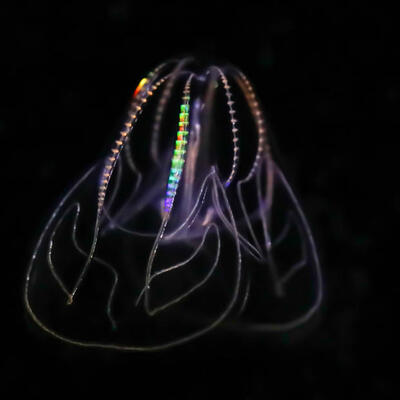
Thrilled to see our latest work on ctenophore reverse development featured on the cover of @PNASNews 🤩 Work supported by @MSarsCentre, @UiB, @ERC_Research #ctenophores #evolution #rejuvenation👏👏👏@JoanJSoto & stunning 📸 from @Alexandre4_Jan
https://www.pnas.org/doi/10.1073/pnas.2411499121

Our brief report on a remarkable feature of #ctenophores out now in PNAS: Reverse development in the ctenophore Mnemiopsis. We show that Mnemiopsis is capable of reversal from mature lobate to early cydippid🤩. @MSarsCentre @UiB #rejuvenation

https://www.pnas.org/doi/10.1073/pnas.2411499121

Very excited to be at the 4th Nordic Neuroscience Meeting in Copenhagen today. Will talk about "The deep evolutionary origins of synapses and neurons" in the symposium: New Frontiers in Synapse Biology organized by Cordelia Imig and Alexander Walter #NNM2024
https://eventsignup.ku.dk/4th-nordic-neuroscience-meeting/conference
4TH NORDIC NEUROSCIENCE MEETING 2024

We are hiring and have a 4-year PhD position available at the Michael Sars Centre at the University of Bergen. Topic: Functional characterization of ctenophore neurons. Boosts highly appreciated!

https://www.jobbnorge.no/en/available-jobs/job/256205/phd-research-fellow-in-functional-characterisation-of-ctenophore-neurons

PhD Research Fellow in Functional characterisation of ctenophore neurons (256205) | University of Bergen

Job title: PhD Research Fellow in Functional characterisation of ctenophore neurons (256205), Employer: University of Bergen, Deadline: Saturday, February 3, 2024

Jobbnorge.no

Did neurons evolve twice? Our work on the ctenophore syncytial nerve net and the beautiful work from Darrin Schultz, Sebas Najle, Arnau Sebe-Pedros & many others covered in Scientific American. With comments from Detlev Arendt, Max Telford & Leslie Babonis.

https://www.scientificamerican.com/article/did-neurons-evolve-twice/

Did Neurons Evolve Twice?

Tracing the history of the earliest animals offers clues to whether the birth of the neuron was a one-time event

Scientific American

Interested in the evolution of multicellularity and cell differentiation?

Núria Ros-Rocher, James Gahan and I are organizing a symposium in Helsinki at @EED2024 next year! Abstract deadline at the end of January!

tinyurl.com/EEDHelsinki

Omnidirectional propulsion in a metachronal swimmer.

"The ctenophore body plan enables a high degree of maneuverability and agility, and may be a useful starting point for future bioinspired aquatic vehicles.

https://journals.plos.org/ploscompbiol/article?id=10.1371/journal.pcbi.1010891

Omnidirectional propulsion in a metachronal swimmer

Author summary Metachronal swimming—the sequential, coordinated beating of appendages arranged in a row—exists across a wide range of sizes, from unicellular organisms (micrometers) to marine crustaceans (tens of centimeters). While metachronal swimming is known to be scalable and efficient, the level of maneuverability and agility afforded by this strategy is not well understood. This study explores the remarkable 3D maneuverability of ctenophores (comb jellies), and the appendage control strategies they use to achieve it. Ctenophores have eight rows of appendages (instead of the one or two found in crustaceans and other organisms). This higher number of appendages, their distribution along the body, and the independent frequency control between paired rows enables near-omnidirectional swimming and turning performance, placing ctenophores among the most maneuverable swimmers. We use experiments and mathematical modeling to explore both the real and theoretical performance landscape of the ctenophore body plan, and show that ctenophores are capable of executing tight turns at high speeds in nearly any plane. This omnidirectional swimming capability gives insight into the ecology and behavior of an important taxonomic group, and shows the potential of metachronal swimming as a source of design inspiration for robotic vehicles (particularly those that must navigate complex environments).

Registration for the 4th Nordic Neuroscience Meeting is open until Dec 15, 2023.

Link: www.nordicneuroscience2024.dk