 Severin
From the Norwegian Consumer Council: „The Enshittificator“ https://vimeo.com/1168468796 — make it shitty 😭




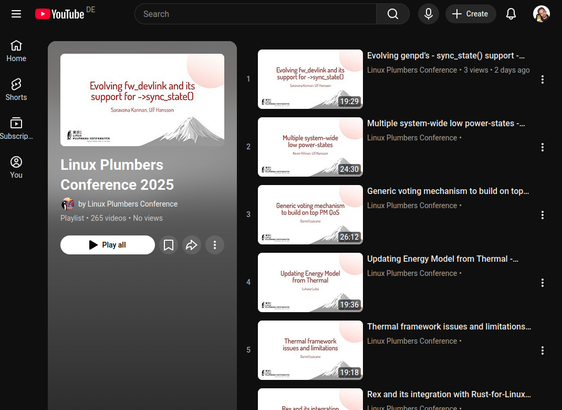
Recordings from last week's @linuxplumbersconf 2025 are now available.🥳
You have two options to find the ones you might be interested in:
* Look through this YouTube-Playlist (https://www.youtube.com/playlist?list=PLVsQ_xZBEyN3-ZbrEgTiCpm1-Sg_ihLVF)
* Find and open interesting talks via the Schedule Overview (https://lpc.events/event/19/timetable/#all) or the Detailed Schedule (https://lpc.events/event/19/timetable/?view=lpc), as the individual talk descriptions link to the videos. And as a bonus, they besides the summary usually contain links to the slides shown, too.
#Linux #kernel #LinuxPlumbersConference #LinuxPlumbersConference2025 #eBPF #BPF

I compared #curl today vs curl 8 years ago on malloc count + memory use to download a single 512MB file over cleartext HTTP:
129 mallocs, which is exactly the same.
Maximum allocated now: 135566. 17,681 bytes *less* than eight years ago.
Not everything has to go bloat over time I suppose.
And here's the old blog post: https://daniel.haxx.se/blog/2017/04/22/fewer-mallocs-in-curl/

Today I landed yet another small change to libcurl internals that further reduces the number of small mallocs we do. This time the generic linked list functions got converted to become malloc-less (the way linked list functions should behave, really). Instrument mallocs I started out my quest a few weeks ago by instrumenting our memory … Continue reading Fewer mallocs in curl →
 Joe Groff (1M Context)
 CCC
CCC
 Philip
 Thorsten Leemhuis (acct. 1/4)
 Loki
Loki
 Florian A.
 Xe
Xe 

 Jonathan Corbet
 daniel:// stenberg://