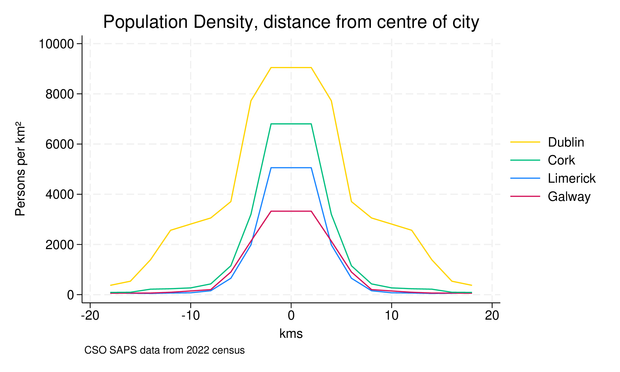
I saw this on Reddit, and having the data to hand, I thought I'd replicate it:
https://www.reddit.com/r/europe/comments/1s61cou/how_european_cities_stack_up_in_density/#lightbox
Sociologist in Limerick
Mostly playing with unrealistic computer models of real world processes
Emacs, Stata, Shiny & Rstats, Julia, Python
Linux on the desktop since about 1997
tootfinder searchable
| Web | https://teaching.sociology.ul.ie/bhalpin/index.html |
| Blog | https://brendanhalpin.net/blog/ |
I saw this on Reddit, and having the data to hand, I thought I'd replicate it:
https://www.reddit.com/r/europe/comments/1s61cou/how_european_cities_stack_up_in_density/#lightbox
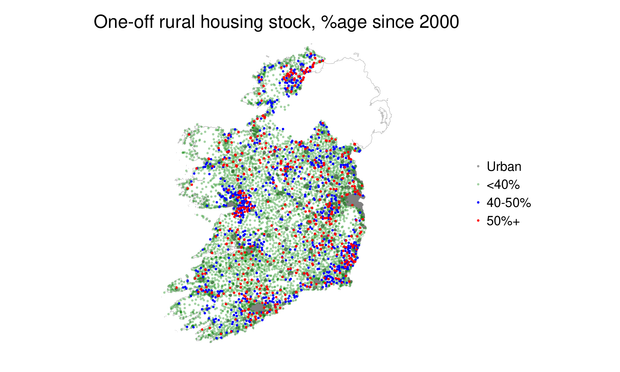
I've been wondering if "one-off rural housing" can be described as ultra-low density suburbanisation. I've been looking at data: Census Small Area statistics, in fact.
Result, this map:
Rural Census Small Areas with >40% of housing stock build in the period 2000-2022 (bulk in 2000-2008, 2nd phase of Celtic Tiger). Huge patterns of ultra-low density suburbanisation in some areas (Galway city environs) but not others. What's going on east of the M11, SE coast?
Interesting article on fertility in Ireland
https://www.irishtimes.com/your-money/2026/01/29/the-economic-forces-behind-older-motherhood-and-what-makes-ireland-different/
Since I have the data to hand, I attach a graphic showing the rate of first births by age 1980-2024 (see alt text for description).

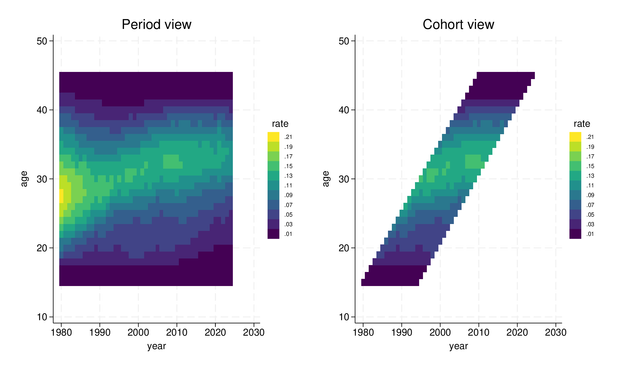
Total Cohort Fertility Rate and Total Period Fertility Rate for Ireland, using birth data up to end 2024. Consistent downward trend in both, the relative pause in the middle of the TPFR decline is associated with large net in-migration (including of young women) during the Celtic Tiger.