Jan Böhmermann 🤨
2026 wird Dein Jahr, Mastodon!
berend
- 65 Followers
- 356 Following
- 176 Posts
Python & go, data engineer, dad, husbrand and nerd.
 Piper Thunstrom
Advice for community managers:
Use the Olivia Hill rule.
It's surprisingly easy to enforce:
Fascists get really upset and will talk to you about why the rule is bad.
You then ban them.
That's it, that's all the work it takes!

 Twra Sun
1x Fahren ohne Fahrschein = 60€
2x = 60€ und interne Meldung
3x = Anzeige
4x = Geldstrafe
5x = Bewährungsstrafe
6x = Gefängnis
1x Parken ohne Parkschein = 20€
2x = 20€
3x = 20€
4x = 20€
5x = 20€
6x = 20€
7x = 20€
8x = 20€
9x = 20€
10x = 20€
via @Perowinger94
 Annika Joeres
 Stefan Lindbohm
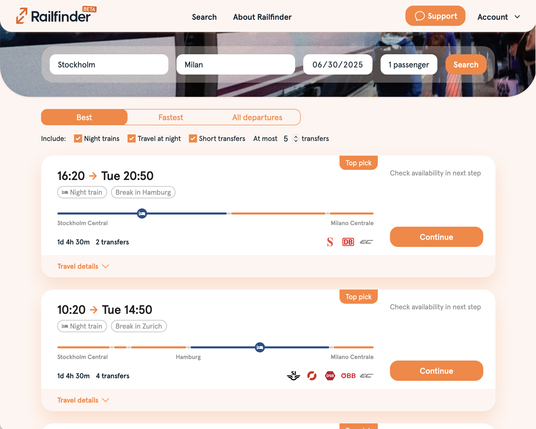
Today we’re quietly (and finally!) opening up Railfinder to the public! This is our beta version and - hopefully - the first step towards that one booking site for trains across Europe that we all dream of.
Lots of work has gone into this and equally lots still to do before reach that vision, but if you’d like to try what we’ve built you can now just go to https://www.railfinder.eu and have a go!
Any and all feedback more than welcome 🙏
 David Zellhöfer
Liebe Leute: ich bin wahrscheinlich die erste Person, die eine Professur für Verwaltungsinformatik (ja - das gibt es! …und es gibt viel zu tun.) auf Mastodon bewirbt. Umso schöner wäre es, wenn Ihr den Post boosten würdet.
Wir freuen uns über die Bewerbungen von Informatiker*innen bzw. verwandten Disziplinen, die zunächst nur eines der beiden Gebiete Datenbanken bzw. Geschäftsprozessmanagement übernehmen können, sich aber auch in das jeweils andere einarbeiten würden.
https://karriere.hwr-berlin.de/jobposting/a6623ab1c94be55eeb9d76fdcd011f44ba1b07710

 Karlheinz E. #noafd 🤮
Sollte die AfD endlich verboten werden?
Bitte kräftig Teilen wegen Reichweite! Danke.
Bitte kräftig Teilen wegen Reichweite! Danke.
Ja
Nein
Ist mir egal
Weiß nicht
Poll ended at .
 mthie
mthie"I am starting a petition to no longer refer to AI "art" as AI art but instead as Computer-Rendered Artificial Pictures (CRAP).
Pass it on."
 Martin Seeger
Warning, long text
Power Outage in Spain – An Analysis
Solar energy comes out of your panels as direct current (DC). That’s all well and good, but homes and grids run on alternating current (AC). Enter the inverter – the humble box that turns solar wizardry into household juice.
Now, inverters aren’t just fancy plug adapters. They have to sync up with the grid – which means they generate exactly the same frequency as the rest of the system. No grid? No syncing. In that case, the inverter goes into what’s called island mode and produces power only for local use. So, if my solar system isn’t connected to the external grid, it can’t run the house – but it can still power two little emergency sockets. Cheers, I guess.
Normally, the grid runs at 50 Hz – that’s hertz, not some obscure Scandinavian metal band. But this frequency can wobble a bit. Physically and technically speaking, it rises when there’s too much power and not enough consumption, and falls when there’s a hungry grid and not enough electricity to feed it.
To keep the grid safe, inverters have an emergency shutdown feature: if the frequency goes over a set limit (apparently around 50.2 Hz), they also jump ship and go into island mode.
Spain’s energy mix is a bit unusual: lots of nuclear, lots of renewables – and a large chunk of those renewables are solar. Makes perfect sense in a country where “cloudy” means three fluffy cotton balls drifted by.
Now, nuclear energy comes with two charming quirks. First, you can’t change its output quickly – it’s not a dimmer switch, more like a cruise ship rudder. Second, nuclear plants cost nearly the same to run at half speed as they do at full throttle. So, naturally, you want to keep them purring along at max capacity.
Then came Monday, with weather conditions perfect enough to make a solar engineer weep with joy: loads of sun, plenty of wind. By 9 a.m., Spain’s energy needs were entirely met by nuclear and renewables. In fact, they had surplus electricity and began exporting it by the bucketload. They shut down everything easy to shut down – but nuclear? No chance. It stayed full steam ahead.
Then, two unfortunate things happened: one transmission line to France caught fire (as you do), and another developed resonances due to meteorological oddities.
So far, this is all well documented. Now we step into speculation territory.
These instabilities meant Spain couldn’t get rid of its excess electricity. The grid frequency rose past that critical 50.2 Hz mark – and boom: many solar systems switched to island mode. At that moment, they were providing nearly 15 gigawatts – around 60% of the national supply. And just like that, poof – they were gone.
Suddenly, two-thirds of the electricity vanished. Wind, nukes, and batteries couldn’t keep up – quite the opposite, in fact. To prevent damage, the nuclear plants initiated emergency shutdowns. Not great. (More on why that’s bad in a bit.) Within seconds, the entire grid collapsed. The solar systems were poised to help – but there was no grid left to sync with.
Everything went dark.
Portugal and southern France were also knocked offline, as they’d been happily sipping from Spain’s excess power. The European grid wasn’t amused and unceremoniously kicked Spain out of the club. France, with a bit of backup and a stiff upper lip, restored its network fairly quickly. My home automation system even picked up the moment the frequency dipped and France cranked up its own generation.
Portugal got the rough end of the stick. With fewer reserves and being smaller in size, they couldn’t help themselves – and no one else could help either, since Spain’s their only neighbour.
Rebooting the Grid – Why It’s a Right Pain
Restarting a collapsed grid isn’t just a matter of flipping a giant switch. It’s tricky for two reasons:
- Generation and consumption have to be in perfect balance. If not, we’re back to square one.
- Nuclear power plants can’t just be turned back on. After an emergency shutdown, they suffer from something called xenon poisoning (yes, one of the very same issues that made Chernobyl a household name). You’ve got to wait for that to wear off – which means the reactors were still offline two days later.
The fix? You split the grid into smaller bits. For each chunk, you build up some capacity, bring it online, then move on to the next. Rinse and repeat. This takes hours. Meanwhile, the sun moves across the sky – and even if you do reconnect the solar arrays, they won’t produce nearly as much as before. Come 8 p.m., they’re more or less useless.
So Spain needed outside help. They were gradually reconnected to the European grid – in small, careful steps. Without that assistance, large parts of Spain would probably still be in the dark. That’s why electricity came back first in places like Barcelona, close to the French border, while Portugal endured the longest wait.
Notes & Musings
- Considering the scale of the event, the recovery was impressively quick. In San Sebastian, power was back within 2 hours. (For comparison: Wismar in Germany had a 45-minute outage last year because one substation had a wobble.) Portugal got its power back after 23 hours. I had expected one to two days.
- This was the largest blackout in Europe in 40 years. If, as suspected, climate-related factors helped spark (pun intended) the situation, then modernising the grid to better handle volatility is absolutely essential. That includes implementing the long-debated power zones in Germany.
 islieb?