
Arlin Stoltzfus

150 Followers
25 Following
169 Posts
Mutation samples from the possible, selection from the actual. Evo toots mostly. bit.ly/3QNudjQ (book), www.molevol.org (blog)

For those interested, this screencast provides an overview of how the mutation spectrum can shape evo, in 3 modes (each with its own theory and empirical results)

* deleterious mut pressure
* ultimate source of raw materials
* introduction of novelty

https://www.youtube.com/watch?v=n8Tb2xatUNs

Most people will benefit from the intro video that explains some basic concepts, including the concept of a generative bias, i.e., a bias in the process of generating variation
https://www.youtube.com/watch?v=5xR8gJuEzVQ

The role of the mutation spectrum in evolution (theory)

YouTube

I'm enjoying this new preprint by Bénitière, et al on alternative splicing (AS) and the drift barrier

Panel A: abundant AS forms tend to be frame-preserving (i.e., sensible), whereas the rare ones look like a lot of junk

Panel C and D: the two kinds have opposing correlations with proxies for 1/N_e (longevity and body size)

https://www.biorxiv.org/content/10.1101/2022.12.09.519597v5

2/3

Right: in neo-Darwinism, variation merely supplies raw materials and has no dispositional role

Wrong: this is not based on assuming isotropic variation

Instead, Darwin and his followers argue explicitly that selection governs evo, so that the details of variation don't matter

They argued this in many ways

That's the real problem. Today we know today that biases in the introduction of variation can be dispositional causes in evo. This is well established theoretically and empirically

The screencast begins by explaining how the SGFP provides clear powerful guidance on how to think about, and how to study, evo

Next, it covers forces and modeling. In the SGFP, evo is formalized as movement of a pop in a frequency-space

but the forces theory only works when evo stays in the *interior* of a freq-space, i.e., when evo takes place by shifting alleles already present

without origination events that jump the system from the surface into the interior where sel and drift operate

2/

Cool new work in #popgen by Tuffaha, et al

@RyanGutenkunst @CastellanoED

In an adaptive walk, the DFE for new beneficial muts is increasingly depleted for higher-rate muts, by the "first come, first served" effect

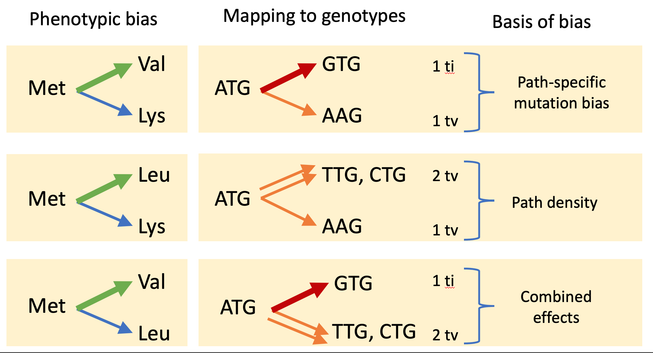
Under a transition (ti) bias, beneficial ti muts in the DFE decrease more rapidly than transversion (tv) muts. This affects both the fractions of ti and tv in the beneficial DFE, and their average s, which differ increasingly

https://www.journals.uchicago.edu/doi/10.1086/726010

1/2

Here are some wrong (yellow) and patently false (pink) claims from Svensson (2023)

Gomez, et al. address selective fixation of beneficial muts: this is NOT a model "in the absence of nat selection"

Nor is it a model requiring "unrealistically high adaptive mut rates": here we see effects over 10 orders of magnitude in mut rate

This is the latest installment of a 4-year disinformation campaign we are powerless to stop

I'll toot more about it tomorrow

@JoannaMasel #popgen #mutation

We argue that, in nature, negative correlations in the fixed dist are more likely (but not inevitable)

Finally, we point out that the mathematical theory also applies directly to 2 higher dists with important meanings: the contribution to adaptation (i.e., to increase in fitness), and the contribution to parallel adaptation

Thanks to you for following along, to my collaborators, and to Deepa Agashe for inviting this symposium contribution

https://biorxiv.org/content/10.1101/2023.02.13.528299v1

(7/7)

For single-nt muts in TP53, we find a positive correlation in the fixed dist

We also compared single- to multi-nt changes, which happen maybe 100X less, but are covered by deep-mut-scanning studies, and are sometimes found clinically as drivers

We found that multi-nt TP53 muts found clinically in tumors are quite rare but tend to have enhanced s (relative to the nominal), as if to compensate for their lower u

(the most fun result for me as a fan of Berkson's paradox)

(6/7)

Our initial focus was on apparent induced (i.e., non-causal) associations that we saw in the literature

Left, the rate of driver muts identified in tumors shows a negative relation with growth rate (from https://ncbi.nlm.nih.gov/pubmed/30647454)

Middle, same kind of thing in regard to clonal haematopoesis (from http://biorxiv.org/content/early/2022/05/09/2022.05.07.491016.abstract)

Right, I replotted the same data to make the negative association clear

(3/7)

APOBEC-induced mutations and their cancer effect size in head and neck squamous cell carcinoma - PubMed

Recent studies have revealed the mutational signatures underlying the somatic evolution of cancer, and the prevalences of associated somatic genetic variants. Here we estimate the intensity of positive selection that drives mutations to high frequency in tumors, yielding higher prevalences than expe …

PubMed

The de novo is simply the nominal weighted by u and, under a simple model of beneficial changes, the fixed is the de novo weighted proportional to s

In this example, u and s are exponentially distributed and uncorrelated. Weighting by u increases the density rightwards, and weighting by s increases it upwards

Even with no correlation in the nominal, there is a negative association in the de novo, and a stronger negative association in the fixed

Why is that interesting?

(2/7)