Arin Dube 🚫

@arindube
5 Followers
56 Following
23 Posts

Dad, Economist, Pro-Democracy

UMass Amherst, @nberpubs, visting BU

Advisor: The Stone Foundation

Topics: Minimum Wage. Monopsony. Unemp Ins.

Book project: The Wage Standard
@wwwojtekk @ivanwerning editor told us to run more experiments on left digit bias sorry
@ivanwerning @wwwojtekk I'm offering a "unverified" certification for $7.99 only
One problem with extreme wealth is that it reduces the cost of making big mistakes. Which is fine if it only affected us, but in reality it affects many other people. And that makes it very costly for society.
The "interest rate hikes are raising rents" argument is just simply wrong and I really would like some smart people whom I respect to stop making them.
@ShengwuLi Well put
It's great @paulgp started the econtwitter instance, but some of us economists here on mastodon.social will have bragging rights that "we joined mastodon before it was cool and the econtwitter instance wasn't even around." Amirite @dynarski?
We've run *a lot* of regional panel wage and Phillips curves of late! I'm not going to tweet out results until our paper is out. But suffice it to say that (properly defined) tightness predicts nominal wage and price growth not very different from the simple model I linked above.

To be clear, I'm NOT saying that tightness in the labor market has no impact on inflation today. It very well might (more on this later).

What I AM saying is that it can't be the primary factor according to textbook models when price growth>>average nominal wage growth.

This is where having simple formal models can help clarify logic of arguments and avoid talking in circles. Doesn't mean the model is right. Just disciplines conversations and arguments.

Cc @paulkrugman @Noahpinion

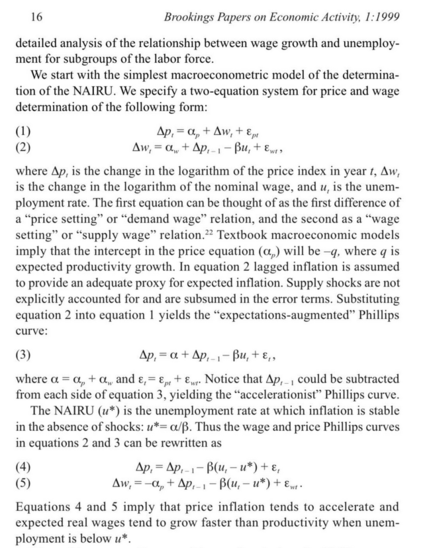
This comes right off the 1999 analysis by @lkatz42 and Krueger in their BPEA. Take the difference between equations 4 and 5: that's the real wage growth. Tightness will raise nominal wage and price similarly. If price growth > nominal wage growth, gap likely from supply shocks.