 Anirban Mitra
"I hope that Python’s legacy will reflect its spirit of grassroots and worldwide collaboration based on equity and respect rather than power and money, and of enabling “the little guy” to code up dream projects." - Guido van Rossum #python

Anthony Lee
@antmaker
- 13 Followers
- 316 Following
- 22 Posts
 Mastodon Migration
RE: https://mastodon.online/@sarahtaber/115295799120027393
This is a spectacular thread by @sarahtaber, a farmer, describing what is happening in the US farm sector, how it is largely responsible for electing this administration, and how they are now, because of the tariffs, entirely dependent on bailouts from the government.
 Sarah Taber
US farmers are saying they "just need temporary help, until things get better."
Here's the thing. US farm exports- which are mostly soy- CANNOT get better.
Other countries expanded their soy industries to fill China's demand.
We've walled ourselves out of the global market, folks. This is it.
 Ars Technica
F-Droid calls for regulators to stop Google’s crackdown on sideloading
F-Droid sees Google's plans as a threat to FOSS apps.
https://arstechnica.com/gadgets/2025/09/f-droid-calls-for-regulators-to-stop-googles-crackdown-on-sideloading/?utm_brand=arstechnica&utm_social-type=owned&utm_source=mastodon&utm_medium=social
F-Droid sees Google's plans as a threat to FOSS apps.
https://arstechnica.com/gadgets/2025/09/f-droid-calls-for-regulators-to-stop-googles-crackdown-on-sideloading/?utm_brand=arstechnica&utm_social-type=owned&utm_source=mastodon&utm_medium=social

 gofoss
For 15 years, F-Droid has been the antidote to Google Play: no trackers, no ads, just open source apps. Now, Google wants to kill it.
Under the guise of "security", Google is forcing devs to register, pay, and surrender control. F-Droid can’t comply without betraying its principles. Thousands of apps could vanish overnight.
Fight back: demand sideloading rights, pressure regulators/Parliament, and defend one of the safe harbors for ethical tech.
https://f-droid.org/2025/09/29/google-developer-registration-decree.html

 Molly White
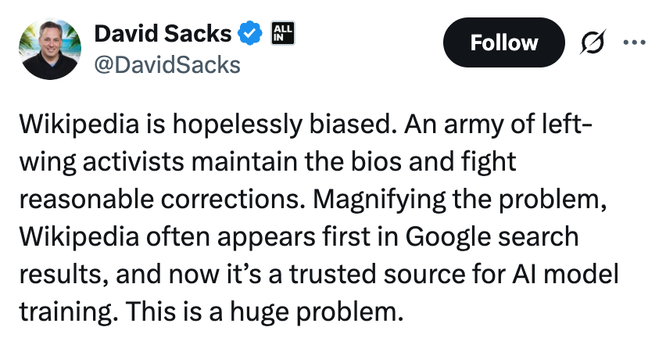
Someone should probably inform the White House's "AI & Crypto Czar" that no one is forcing AI companies to train their models on Wikipedia
You would think the obvious solution to "the volunteer-powered project we all train our AI models on for free isn't adequately twisting reality to our political views" would be "... and so we stopped training on it" and not "... and so we will force the volunteers to bend to our will"
 MicheleV_AK
Interrupting my self-induced Social Media hiatus to bring you exciting NORHTERN LIGHTS photos from a friend in #HomerAlaska taken last night. Yes, it is that time of year again! Enjoy! #Alaska #NorthernLights #BeBackSoon




 Cat 🐈🥗 (D.Burch)
Synchronized kitties
 bioRxiv Neuroscience
BARTharm: MRI Harmonization Using Image Quality Metrics and Bayesian Non-parametric https://www.biorxiv.org/content/10.1101/2025.06.04.657792v1?med=mas

BARTharm: MRI Harmonization Using Image Quality Metrics and Bayesian Non-parametric
Image derived phenotypes (IDPs) harmonization from Magnetic Resonance Imaging (MRI) data is essential for reducing scanner-induced, non-biological variability and enabling accurate multi-site analysis. Existing methods like ComBat, while widely used, rely on linear assumptions and explicit scanner IDs - limitations that reduce their effectiveness in real-world scenarios involving complex scanner effects, non-linear biological variation, or anonymized data. We introduce BARTharm, a novel harmonization framework that uses Image Quality Metrics (IQMs) instead of Scanner IDs and models scanner and biological effects separately using Bayesian Additive Regression Trees (BART), allowing for flexible, data-driven adjustment of IDPs. Through extensive simulation studies, we demonstrate that IQMs provide a more informative and flexible representation of scanner-related variation than categorical Scanner IDs, enabling more accurate removal of non-biological effects. Leveraging this and its ability to model complex relationships, BARTharm, consistently outperforms ComBat across a range of challenging scenarios, including model misspecification and confounded scanner-biological relationships. Applied to real-world datasets, BARTharm successfully removes scanner-induced bias while preserving meaningful biological signals, resulting in stronger, more reliable associations with clinical outcomes. Overall, we find that BARTharm is a robust, data-driven improvement over traditional harmonization approaches, particularly suited for modern, large-scale neuroimaging studies. ### Competing Interest Statement EP, RTS, CCH, TEN, and HG declare no competing interest. DAH and LG are employees and shareholders of Novartis Pharma AG. EPSRC Centre for Doctoral Training in Health Data Science, EP/S02428X/1
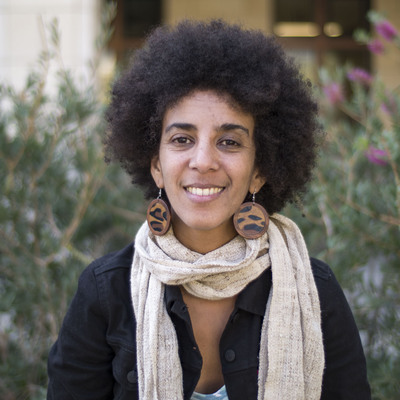 Timnit Gebru (she/her).
Google wasted no time in using the Nobel prize to argue that its ok to steal data and exploit labor to train generative AI models.
And Geoff Hinton wasted no time in telling us how the Nobel prize will add credibility to his claims on LLMs understanding and more of his doomer stuff.
➡ https://www.youtube.com/watch?v=-icD_KmvnnM
Fun times ahead of us.

Mentioning the Nobel Prizes for AI research, Google asks court to consolidate Leovy and Zhang suits
Google wasted no time to mention this week’s Nobel Prizes to Geoffrey Hinton (formerly at Google) and Demis Hassabis (Google DeepMind) in its more mundane motion for consolidation of the laws…