ane

@ane57is
0 Followers
1 Following
13 Posts
🏺 Archaic Religions 🏛 Pre-Modern Epidemics 🦠 Computational Historiography 🧮 Historian of religion & PhD student. Also QA/QE.

Wondering if any scientific discipline could really get by with
just one type of source and a single method nowadays 🤔


At least when it comes to reconstructing the demography of the Roman Empire, modern scholars have had to draw on:
🏺 archaeological evidence
📜 papyrological records
🏛️ comparative data from other premodern societies
👾 and increasingly, sophisticated modeling

🎙️ V nové epizodě pořadu Věda Plus na @CRoPlus jsem krátce mluvil s Lukášem Matoškou o naší studii antoninovského moru, kterou jsme s Alešem Chalupou publikovali v @PLOS.

Řešíme, jak pomocí výpočetních modelů zkoumat starověké pandemie a jak takový interdisciplinární výzkum vzniká v rámci CEDRRu na Ústavu religionistiky Filozofické fakulty Masarykovy univerzity.

🎧 Poslechněte si epizodu zde:
https://www.mujrozhlas.cz/veda-plus/povolani-zdravotni-sestry-se-v-pruzkumech-prestize-umistuje-na-prednich-prickach

Povolání zdravotní sestry se v průzkumech prestiže umisťuje na předních příčkách

Podle výzkumníků to tak však mnoho sester nepociťuje. Čím to je? - Čeští vědci zmapovali šíření pandemie ve druhém století našeho letopočtu. O čem to, co zjistili, vypovídá? - Klíšťata jsou v těchto dnech nejaktivnější. Jak se proti nim nejlíp bránit? Moderuje Lukáš Matoška.

mujRozhlas

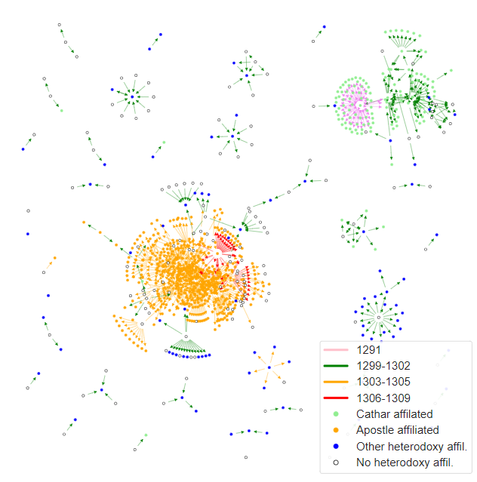
Did the people investigated by the inquisition in Bologna form a few cohesive communities, or are they better understood as many small groups or individuals who drew the attention of the inquisitors separately?

To find out, explore the data visually using our most recent data snapshot by T. Hampejs, K. Riccardo, and D. Zbíral: https://dissinet.cz/data-snapshots/items/structural-insights-into-the-inquisition-register-of-bologna-1291-1310

Structural insights into the inquisition register of Bologna (1291-1310)

Inquisition registers are an excellent source for studying the social organisation of medieval communities. Did the investigated people form one or a few cohesive social bodies of “heretical movements” – communities – or are they better understood as many unrelated cases of small groups or individuals who drew the attention of the inquisitors separately?

Dissident Networks Project (DISSINET)

One of the most common ways inquisitors found new suspects to investigate was by asking deponents to incriminate others. Interestingly, men and women exhibited different patterns when providing incriminations.

Find out more in our recent study published in PLOS One: https://journals.plos.org/plosone/article?id=10.1371/journal.pone.0315467&?utm_id=plos111&utm_source=internal&utm_medium=email&utm_campaign=author

Gender, kinship, and other social predictors of incrimination in the inquisition register of Bologna (1291–1310): Results from an exponential random graph model

The medieval inquisition of heresy strongly relied on depositions, where witnesses were expected to report on the crimes of others and oneself. The resulting patterns of incrimination could be influenced by various factors, including the characteristics of the underlying dissident social network; the investigators’ choices and biases; the trial circumstances, some of which must have exerted considerable pressure upon deponents; and the deponents’ decisions to protect some suspects more than others. This case study aimed at disentangling selected social factors of incrimination in the register of the inquisition in Bologna, 1291–1310. We used social network analysis and, more specifically, an Exponential Random Graph Model (ERGM) to assess the influence of four social predictors: gender, churchperson status, membership of the urban “middle class”, and kinship ties between incriminators and the incriminated. To increase the validity of our results, we controlled for various trial circumstances and structural parameters of the incrimination network. Our model corroborated a tendency towards female-to-female incrimination, while we did not find any positive or negative tendency towards male-to-male incrimination. We identified no effect of churchperson status on incriminating, while we found that among Cathars, members of the middle class were more likely to be incriminated than people without this status. Our model also corroborated the tendency to incriminate one’s kinship group. Overall, our study underlines the relevance, but also the non-trivial operation, of social and demographic predictors in medieval heresy trials.

MŠMT vyžaduje tvorbu novýho záznamu o díle ačkoliv dilo je již Open Access 🤡 by mě zajímalo, komu tenhle extra byro krok prospívá 🫠

DISSINET is offering support to M.A. graduates applying for fully funded Ph.D. studies focusing on medieval anti-heretical hate speech using digital and quantitative methods. Go to https://dissinet.cz/news/articles/medieval-anti-heretical-hate-speech-funded-phd-opportunity to find out more.

Proposals are due by 15 April 2025!

Please share with anyone who might be interested in this unique opportunity.

Medieval anti-heretical hate speech: Funded Ph.D. opportunity

DISSINET is offering support to M.A. graduates applying for fully funded Ph.D. studies focusing on medieval anti-heretical hate speech using digital and quantitative methods. Send us a preliminary research proposal by 15 April 2025.

Dissident Networks Project (DISSINET)

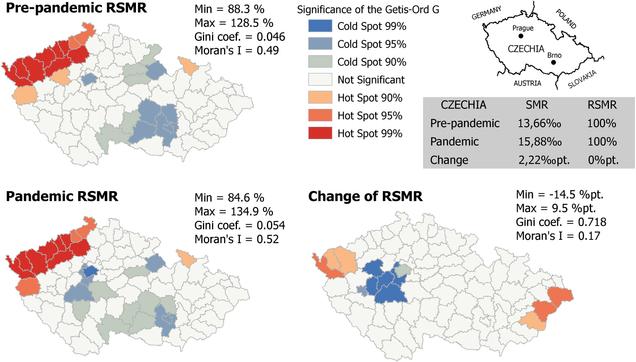
📄 New paper "Exploring vulnerability amplification in regional health inequality: COVID-19 case study in Czechia" by Pavlína Netrdová, Klára Hulíková Tesárková, and Dagmar Dzúrová shows the pandemic increased mortality rates in regions that were already struggling the most.

https://doi.org/10.1016/j.apgeog.2025.103565

If you work in government and are asked to remove content from websites (as a result of executive orders), please use the HTTP status code 451 instead of 404.

451 is the correct status code to use for these cases, and you'll be doing the rest of the country a service by using it.

Addendum: you should also include a Link header with the link relation "blocked-by" that "Identifies the entity that blocks access to a resource following receipt of a legal demand."

https://www.rfc-editor.org/rfc/rfc7725.html

RFC 7725: An HTTP Status Code to Report Legal Obstacles

📢 Want a quick overview of our research on the Antonine Plague?

We used epidemic models to reassess its mortality in ancient Rome. Learn more in our plain-language summary on Kudos!

🔗 https://link.growkudos.com/1e66f38j474

#OpenScience #Epidemiology #AncientRome #AntoninePlague #HistoryOfMedicine

Using epidemic models to reassess the Antonine Plague’s mortality in ancient Rome

Our study uses SIR/SEIR models to test different pathogen scenarios for the Antonine Plague in ancient Rome. The results suggest that historical mortality estimates may have been exaggerated. Since our models do not fully reproduce reported death tolls, factors like seasonality or reporting biases may have influenced ancient records.