Dimitra Maoutsa

354 Followers
312 Following
104 Posts

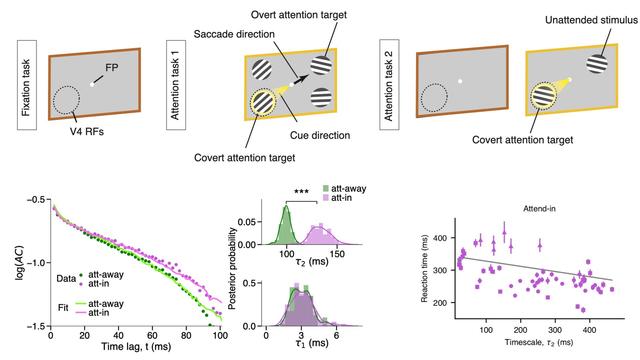
Thrilled to share our paper "Intrinsic timescales in the visual cortex change with selective attention and reflect spatial connectivity" now out at #NatureCommunications
https://www.nature.com/articles/s41467-023-37613-7

We have added interesting new analyses to our preprint version (thanks to the reviewers!),
so here goes a new summary:

#NeuroNewPaper #NeuroPaperThread
#Timescale #Attention #visualcortex #connectivity

Intrinsic timescales in the visual cortex change with selective attention and reflect spatial connectivity - Nature Communications

Not much is known about how intrinsic timescales, which characterize the dynamics of endogenous fluctuations in neural activity, change during cognitive tasks. Here, the authors show that intrinsic timescales of neural activity in the primate visual cortex change during spatial attention. Experimental data were best explained by a network model in which timescales arise from spatially arranged connectivity.

Nature

Paper thread! 🧵
How do individual neurons process temporal sequences of spikes? Pascal Nieters, Gordon Pipa and I claim that it's all about dendritic plateau potentials and their interactions. I'll summarize this in a short thread below. You can find our paper here: https://tinyurl.com/plateaupotential.

I also posted an informal write-up of these ideas, including some interactive demos, at: https://jleugeri.github.io/2023/04/dpc-paper/.

Dendritic plateau potentials can process spike sequences across multiple time-scales

The brain constantly processes information encoded in temporal sequences of spiking activity. This sequential activity emerges from sensory inputs as well as from the brain's own recurrent connectivity and spans multiple dynamically changing timescales. Decoding the temporal order of spiking activity across these varying timescales is a critical function of the brain, but we do not yet understand its neural implementation. The problem is, that the passive dynamics of neural membrane potentials occur on a short millisecond timescale, whereas many cognitive tasks require the integration of information across much slower behavioral timescales. However, actively generated dendritic plateau potentials do occur on such longer timescales, and their essential role for many aspects of cognition has been firmly established by recent experiments. Here, we build on these discoveries and propose a new model of neural computation that emerges from the interaction of localized plateau potentials across a functionally compartmentalized dendritic tree. We show how this interaction offers a robust solution to the timing invariant detection and processing of sequential spike patterns in single neurons. Stochastic synaptic transmission complements the deterministic all-or-none plateau process and improves information transmission by allowing ensembles of neurons to produce graded responses to continuous combinations of features. We found that networks of such neurons can solve highly complex ...

Frontiers
RT @BendorD
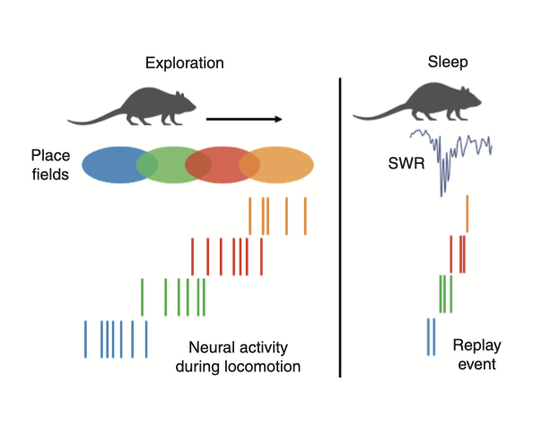
Replay is the spontaneous reactivation of a memory trace, a mechanism thought to underly memory consolidation

Trends in Neurosciences

🧐

Astrocytes: integrators of arousal state and sensory context
https://www.cell.com/trends/neurosciences/fulltext/S0166-2236(23)00050-4

Astrocytes: integrators of arousal state and sensory context

The brain is constantly integrating signals conveying information about the inner states of the body with external sensory inputs from the outside world to produce appropriate, context-dependent behaviors [1–4]. This process ensures both efficient behavioral shifts when conditions change and the selection of relevant information for memory consolidation to guide future behavior.

Trends in Neurosciences
Look how amazing this wall looks

RT @leafs_s
Current Biology

Recording electrical activity from the brain of behaving octopus
https://www.cell.com/current-biology/fulltext/S0960-9822(23)00145-8

RT @leafs_s
Trends in Neurosciences

Continual task learning in natural and artificial agents
https://www.cell.com/trends/neurosciences/fulltext/S0166-2236(22)00260-0

RT @MillerLabMIT
This is one of the coolest MS I have read in a while. It is one of those results where you think, "of course, that's how the brain should work!". Congrats, @timbuschman

Multiplexed Subspaces Route Neural Activity Across Brain-wide Networks https://www.biorxiv.org/content/10.1101/2023.02.08.527772v1

On the Role of Theory and Modeling in Neuroscience
https://www.jneurosci.org/content/43/7/1074

#neuroscience

On the Role of Theory and Modeling in Neuroscience

In recent years, the field of neuroscience has gone through rapid experimental advances and a significant increase in the use of quantitative and computational methods. This growth has created a need for clearer analyses of the theory and modeling approaches used in the field. This issue is particularly complex in neuroscience because the field studies phenomena that cross a wide range of scales and often require consideration at varying degrees of abstraction, from precise biophysical interactions to the computations they implement. We argue that a pragmatic perspective of science, in which descriptive, mechanistic, and normative models and theories each play a distinct role in defining and bridging levels of abstraction, will facilitate neuroscientific practice. This analysis leads to methodological suggestions, including selecting a level of abstraction that is appropriate for a given problem, identifying transfer functions to connect models and data, and the use of models themselves as a form of experiment.

Journal of Neuroscience

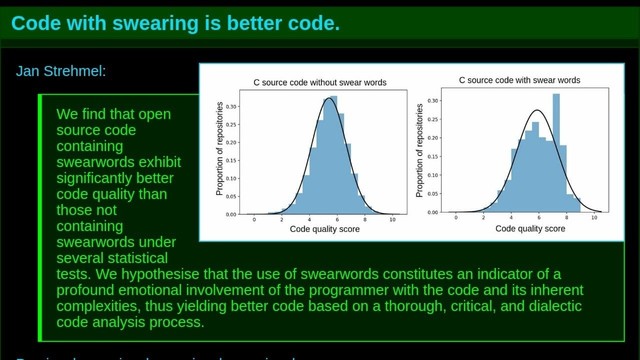
Code with swearing is better code.

Jan Strehmel: We find that open source code containing swearwords exhibit significantly better code quality than those not containing swearwords under several statistical tests. We hypothesise that the use of...
https://jwz.org/b/yj95