 Lars Brinkhoff
Hot take? Every editable text field should be an Emacs buffer. I don't want your semi-arsed Emacs keybindings, I want the full thing.

David Arnold
@__d
- 12 Followers
- 203 Following
- 546 Posts
Technology, bikes, books, music. He/him. Living on Gadigal land.
 🚲
🚲It’s equal parts invigorating and depressing to watch Mamdani’s progress. It’s like, all those things they claimed “can’t be done” or “are too hard/impossible” actually are doable. Which means that all the other politicians are not doing them as a *choice*. Which I kind of knew already but Mamdani draws a line under it.
 Harold Jarche
RE: https://mstdn.ca/@teledyn/116652708401285794
"every single warning that paper made about large language models has now happened at scale"
1. The hallucination problem before anyone had a word for it.
2. Bias amplification
3. Environmental cost
4. Documentation — the training datasets being assembled were too large for anyone to actually audit
 Ol' Sawdust Flowers
Groggy morning thought: A business that hosts a ton of open standard network APIs for a large number of time/self/thought management data (to-do, event, calendar, note, mindmap, wiki, etc) but they will never ship an app. They are solely a hosting service.
Users pay a monthly fee, cancel at any time, all of their data can be downloaded at any time, no surveillance ads, ... all of the good behavior we should demand from service providers.
Maybe the business even open the service source code and maintain container images for self-hosters and to reduce impact if they go out of business. They might also maintain a number of freely licensed client libraries in a number of coding languages.
The bet is that there are enough people who will pay a subscription to have someone host their info but only if it is 100% standards-based and portable and only if they can use (or make) whatever app they want.
 Ken McLeod
@drahardja Yes! Too late to vote by mail now, so drop your ballot in an actual ballot box.
(I wish we had Democracy Sausage at voting locations. It's an Australian thing.)

 ololduck
Finally migrated to #Snac2 by @[email protected] !
I've been on the fence about hosting my own #fediverse account for a while now, mainly because of the insane hardware requirements.
I've considered pleroma/akkoma for a while, but i don't know the first thing about elixir and their docs are not the most clear. I've been really tempted by #GoToSocial, but #snac's easy install & general simplicity made me take the plunge.
I've been on the fence about hosting my own #fediverse account for a while now, mainly because of the insane hardware requirements.
I've considered pleroma/akkoma for a while, but i don't know the first thing about elixir and their docs are not the most clear. I've been really tempted by #GoToSocial, but #snac's easy install & general simplicity made me take the plunge.
 bert hubert 🇺🇦🇪🇺🇺🇦
Having a particularly hard time today with the simultaneous death of the climate, software development and the rule of law. And especially cheesed off with the people riding these waves for profit.
 Charlie Stross
This is how the AI bubble bursts: https://www.theverge.com/ai-artificial-intelligence/917380/ai-monetization-anthropic-openai-token-economics-revenue
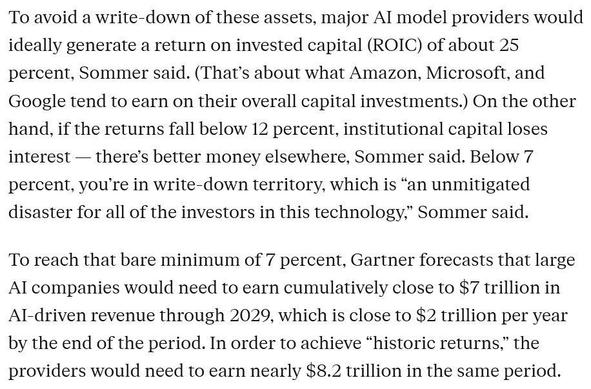
There is no conceivable way to break even for the AI industry—let alone to repay an investment that requires $2Tn a year from now to the end of the decade. That's about 3% of the entire planetary GNP. Just to break even.
 Jeff Atwood
people still on substack are like "(fetches fainting couch) but mah clicks! my metrics!" You know what, fuck your clicks, fuck your metrics, and FUCK YOU. Grow a backbone, you absolute cowards. I do not, and will not, give any quarter to fundamental assaults on human dignity and civil rights.
 John Rogers
We should never have let fame become a middle-class job, or even middle-class job adjacent. It’s the toxic run-off of actual accomplishment, and instead we made it the top of the food pyramid.