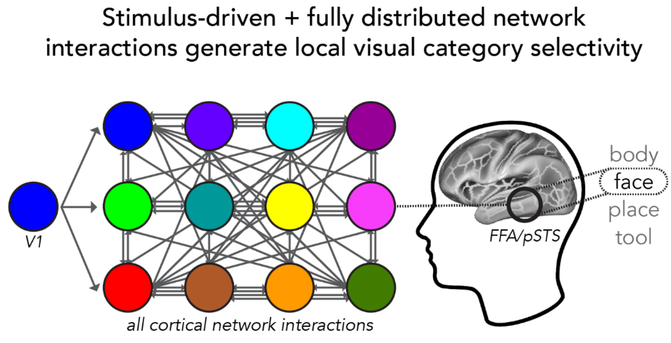
Lab’s latest at PLOS Comp Biol, led by Carrisa Cocuzza: “Distributed network flows generate localized category selectivity in human visual cortex”. This one changed how I think the brain works! Even "localized" functions are likely generated by distributed processes
https://doi.org/10.1371/journal.pcbi.1012507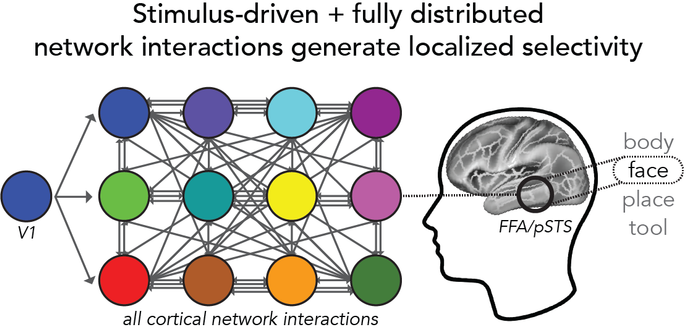

Distributed network flows generate localized category selectivity in human visual cortex
Author summary A fundamental question in neuroscience has persisted for over a century: to what extent do distributed processes drive brain function? The existence of category-selective regions within visual cortex provides long-standing evidence supporting localized computations, wherein specialized functions (e.g., selective responsiveness to face images) are thought to be primarily generated by within-region processes. This account was recently updated to include category selectivity dispersed across visual cortex, in the absence of category-selective regions. Here we provide groundwork evidence demonstrating that locally-exhibited visual-category-selective responses can be accurately generated via distributed activity flowing over globally connected systems. These processes were simulated via empirically-based computational models initialized by stimulus-evoked activity patterns and empirical connectivity matching each category-selective region’s unique intrinsic functional connectivity fingerprint. Results demonstrate that activity flowing over the human brain’s distributed network architecture can account for the generation of category selectivity in visual cortex regions.
SFN poster 4) Neural representation dynamics reveal computational principles of cognitive task learning” https://abstractsonline.com/pp8/#!/10892/presentation/40404, VV39, Wed 11/15 8am-12pm
If you’re going to SFN please come check out these posters!
N/N
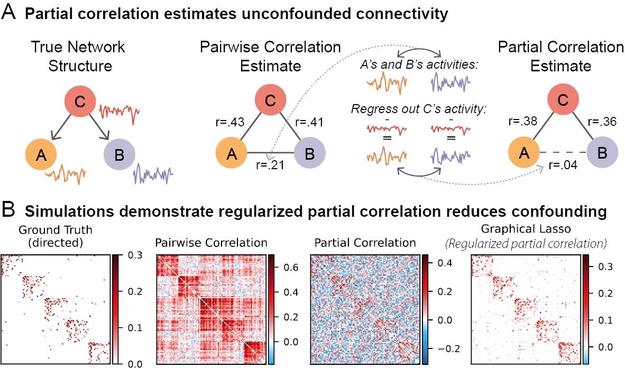
SFN poster 3) “Regularized partial correlation provides reliable functional connectivity estimates while correcting for widespread confounding” https://abstractsonline.com/pp8/#!/10892/presentation/35506, XX42, Mon 11/13 1-5pm
3/N
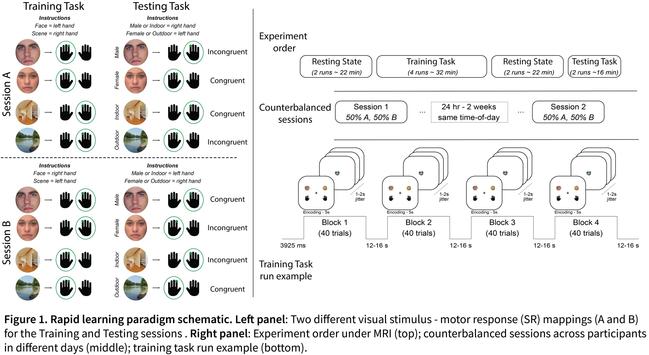
SFN poster 2) “Rapid learning to automaticity reveals learned content stored within patterns of resting-state functional connectivity changes”
https://abstractsonline.com/pp8/#!/10892/presentation/21690, TT28, Sun 11/12 8am-12pm
2/N
The Cole Neurocognition Lab has 4 posters reporting our latest findings at #sfn23
SFN poster 1) “Brain network processes underlying the generation of hundreds of visual category responses in the human brain” https://abstractsonline.com/pp8/#!/10892/presentation/28495, Z2, Sat 11/11 1-5pm A 🧵1/N
The Behavioral & Neural Sciences (BNS) PhD graduate program at Rutgers University is open for applications, due December 15. Lots of great neuroscience labs, faculty, and students here! Please spread the word
https://sasn.rutgers.edu/bns-graduate-programBNS Graduate Program | Rutgers SAS-Newark
And regularization improved prediction of individual differences in demographics (age) and behavior/cognition (general intelligence) relative to standard partial correlation. The glasso results were more interpretable than pairwise correlation (fewer false connections) 10/n
Also empirical, prediction of task-evoked activity (via activity flow modeling) was better with regularized partial correlation 9/n
First empirical validation: regularized partial correlation was much closer to structural connectivity, which doesn’t have the causal confounding problem (despite other issues) 7/n
This pattern of results was mirrored in empirical resting-state fMRI data across 4 validation measures. Regularization was key to estimating individual subject-level networks with reduced confounding. 6/n