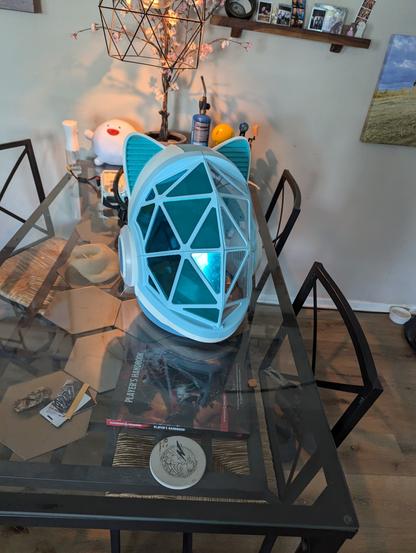
Finished the visor. On to V2!.
| Rocket 🚀 | Saturn V |
| Launchpad | Vandenberg |
| Website | Https://flotilla.space |
| Human | https://Kylecothern.com |


| Rocket 🚀 | Saturn V |
| Launchpad | Vandenberg |
| Website | Https://flotilla.space |
| Human | https://Kylecothern.com |
@skydog low carbon steel has an infinite cycle life below it's endurance limit.
We designed the tube with this in mind. If you maintain FS of 3 on yield and 4 on ultimate you'll never have problems with fatigue from cyclic loading, we were around 10, because the system is stiffness driven rather than strength. Deflection is the more critical driving design constraint, and the sag directly drives vehicle suspension design.
@skydog also it's possible to go supersonic if you build a special transition region that would swallow the standing shock around the vehicle, much like the variable geometry inlet on the sr-71 engines, but inside out.
You do have to time the transitions to happen at the right location on the track, which would be difficult for emergency stops.
@skydog but please let me know why you seem to think it's not feasible.
I did design the primary structure and we got it built in a few months with minimal tooling.
I'm pretty sure with a better sales team there'd even be some infrastructure routes that would benefit from the tech. The pricing has to be low though and that wasn't enough of a focus at VH1
@skydog so uh. We used an orelikon water ring pump to pull a 10^-3 torr vacuum on a 500m section of 10' diameter tube in about an hour.
It worked just fine. This rough vacuum could easily support speeds up to the transonic regime around 300m/s.
The physics are pretty simple and this system was implemented and tested at speed (though lower top speed due to how short the first track was).