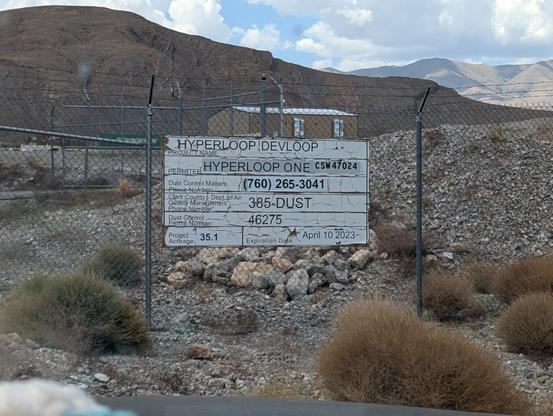
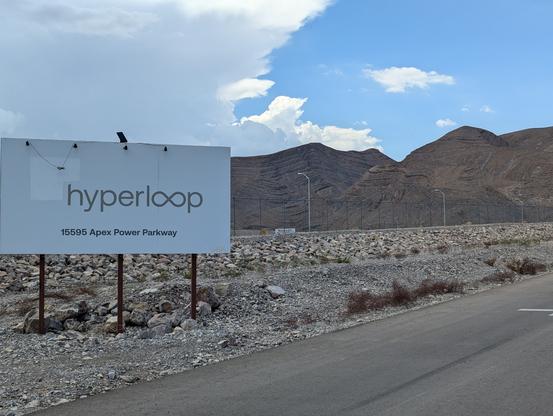
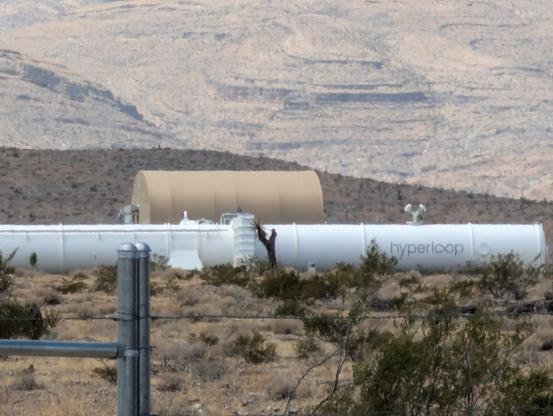
I visited the abandoned hyperloop site after defcon this year. It looked like they just left work one day and never came back. There was no security and the perimeter fence was open.

The site foreman for the powerplant next door didn't recognize my truck and said hi. Being isolated in the desert has gotta be a hard job.

@Risknc

The Hyperloop was not feasible thru the necessity of simple physics. We aren't even close to the tech to provide the pressure gradient in the tube that would be needed. It was all a 1960s Popular Mechanics fever-dream, less feasible by far than the monorail, which ran into its own brick wall in terms of practicality. Most of Musk's stuff is revisioned Pop Mechanics, some things better than others, but he's not original, by any means.

Musk got some press from it, and that's all he wanted, I think. It will become archeology fodder.

@skydog so uh. We used an orelikon water ring pump to pull a 10^-3 torr vacuum on a 500m section of 10' diameter tube in about an hour.

It worked just fine. This rough vacuum could easily support speeds up to the transonic regime around 300m/s.

The physics are pretty simple and this system was implemented and tested at speed (though lower top speed due to how short the first track was).

@skydog but please let me know why you seem to think it's not feasible.

I did design the primary structure and we got it built in a few months with minimal tooling.

I'm pretty sure with a better sales team there'd even be some infrastructure routes that would benefit from the tech. The pricing has to be low though and that wasn't enough of a focus at VH1

@skydog also it's possible to go supersonic if you build a special transition region that would swallow the standing shock around the vehicle, much like the variable geometry inlet on the sr-71 engines, but inside out.

You do have to time the transitions to happen at the right location on the track, which would be difficult for emergency stops.

@Risknc

Thank you for the bother going into addressing my post. Obviously, your specific knowledge level will be far above mine.

It's not feasible, in my opinion, because of scale, the precision of fit, and cycle life. Expanding the route to full distance will create a pressure vessel that cannot maintain a near vacuum (1mb, is it?). It has to be designed of materials that can withstand rapid pressure gradient spikes, as well as the constant pressure on the vacuum vessel. In aircraft ops (my old stomping ground), the tube is constrained by the frame a/c cycles of ~50,000 ('70's tek), and accidents have shown this to roughly correlate to the pressure cycle limit. Any aberration in the tube itself can be catastrophic.

How many cycles a day would such a system operate at, and I'm assuming one way transit? The icing is the Musk business model, which you've evidently run into, as well.

Beyond that, I'll link from a source that might be good. https://interestingengineering.com/transportation/biggest-challenges-stand-in-the-way-of-hyperloop.

The Biggest Challenges That Stand in the Way of Hyperloop

On paper, the Hyperloop is an engineering marvel that promises to set supersonic travel underground. The system is proposed to carry people around the

Interesting Engineering

@Risknc

Trying to force a system like this thru transonic into supersonic sounds like an interesting problem, but I think that would multiply the stresses involved with concomitant drastic reduction on the cycles the material used could withstand. In short, fatigue and leakage are the two biggest hurdles. After that, the infrastructure for creation of full track vacuum seems a challenge.

The whole idea has (and has had for over a century) a fascination in the popular imagination, and I'm of the opinion that this is the sole reason Elon Musk was interested in the project...selling the idea, over selling the product.

@skydog low carbon steel has an infinite cycle life below it's endurance limit.

We designed the tube with this in mind. If you maintain FS of 3 on yield and 4 on ultimate you'll never have problems with fatigue from cyclic loading, we were around 10, because the system is stiffness driven rather than strength. Deflection is the more critical driving design constraint, and the sag directly drives vehicle suspension design.