Paola Domínguez

107 Followers
143 Following
30 Posts

Astrophysicist working at #CenterForAstrophysics, #Harvard

Hecha en #UNAM. PhD at the University of #Hamburg

Research interests: #galaxyclusters, #primordialmagneticfields, the #radiosky, #shocks and #turbulence

Lived in 🇲🇽🇺🇸🇩🇪🇰🇷🇮🇹

Innevitably a #tacolover

Personal website:
https://paoladominguez-fernandez.me
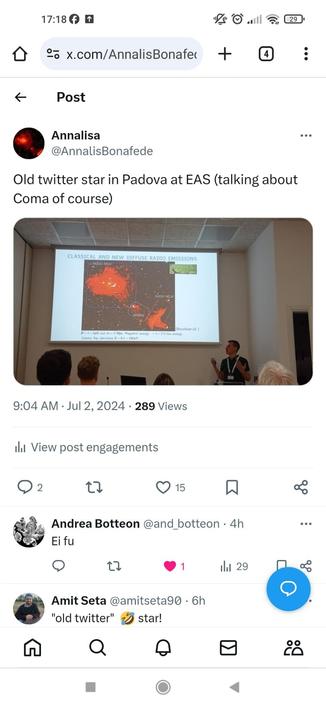
#astronomy #Astrodon funny wife has posted this on twitter during my #Eas2024 talk 🤣

#astroph by P.Dominguez-Fernandez @PaolaDom et al. https://arxiv.org/abs/2406.19681

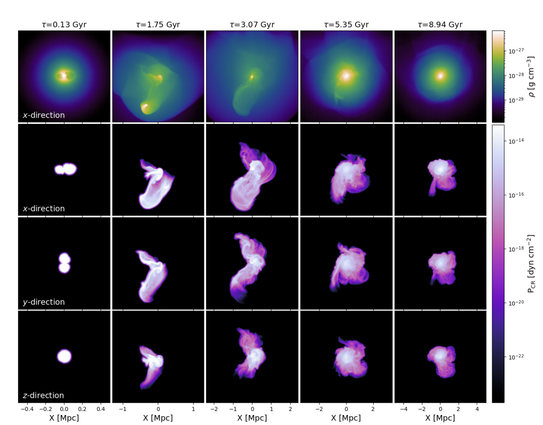
"Jet interaction with galaxy cluster mergers" using AREPO

#astrodon #astronomy

Jet interaction with galaxy cluster mergers

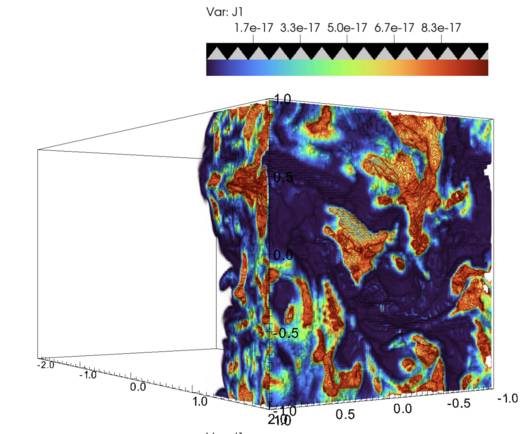
AGN bubbles in cool-core galaxy clusters are believed to facilitate the transport of cosmic ray electrons (CRe) throughout the cluster. Recent radio observations are revealing complex morphologies of cluster diffuse emission, potentially linked to interactions between AGN bursts and the cluster environment. We perform three-dimensional magneto-hydrodynamical simulations of binary cluster mergers and inject a bi-directional jet at the center of the main cluster. Kinetic, thermal, magnetic and CR energy are included in the jet and we use the two-fluid formalism to model the CR component. We explore a wide range of cluster merger and jet parameters. We discuss the formation of various wide-angle-tail (WAT) and X-shaped sources in the early evolution of the jet and merger. During the last phase of the evolution, we find that the CR material efficiently permeates the central region of the cluster reaching radii of $\sim1$-2 Mpc within $\sim5$-6 Gyr, depending on the merger mass ratio. We find that solenoidal turbulence dominates during the binary merger and explore the possibility for the CR jet material to be re-accelerated by super-Alfvènic turbulence and contribute to cluster scale radio emission. We find high volume fractions, $\gtrsim 70$\%, at which the turbulent acceleration time is shorter than the electron cooling time. Finally, we study the merger shock interaction with the CRe material and show that it is unlikely that this material significantly contributes to the radio relic emission associated with the shocks. We suggest that multiple jet outbursts and/or off-center radio galaxies would increase the likelihood of detecting these merger shocks in the radio due to shock re-acceleration.

arXiv.org

#astroph
New numerical simulations of merger shocks propagating through a turbulent and magnetised intracluster medium, with the Pluto code, to study "Radio surface fluctuations in radio relics"
https://arxiv.org/abs/2402.12375

by P. Dominguez-Fernandez et al. @PaolaDom

#astronomy #astrodon

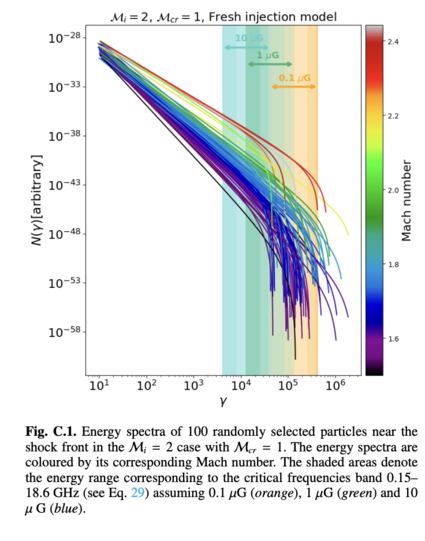
Radio surface fluctuations in radio relics

Recent observations have revealed detailed structures of radio relics in a wide range of frequencies. In this work, we perform three-dimensional magnetohydrodynamical simulations of merger shocks propagating through a turbulent magnetized intracluster medium, and employ on-the-fly Lagrangian particles to explore the physical processes originating radio substructures and their appearances in high and low-frequency observations. We employ two cosmic-ray (CR) electron acceleration models: the fresh injection of electrons from the thermal pool and the re-acceleration of mildly relativistic electrons. We use the relative surface brightness fluctuations, $δS_ν$, to define a "degree of patchiness''. We find that: 1) Patchiness is produced if the shock's surface has a distribution of Mach numbers, rather than a single Mach number; 2) Radio relics appear patchier if the Mach number distribution consists of a large percentage of low Mach numbers ($\mathcal{M}\lesssim2.5$); 3) As the frequency increases, the patchiness also becomes larger. Nevertheless, if radio relics are patchy at high frequencies (e.g., 18.6 GHz), they are necessarily also at low frequencies (e.g., 150 MHz); 4) To produce noticeable differences in the patchiness at low and high frequencies, the shock front should have a Mach number spread of $σ_{\mathcal{M}}\gtrsim0.3$-0.4; 5) The amount of the patchiness depends on the Mach number distribution as well as the CR acceleration model. We propose $δS_ν$ as a potential tool for extracting merger shock properties and information about particle acceleration processes at shocks in radio observations.

arXiv.org

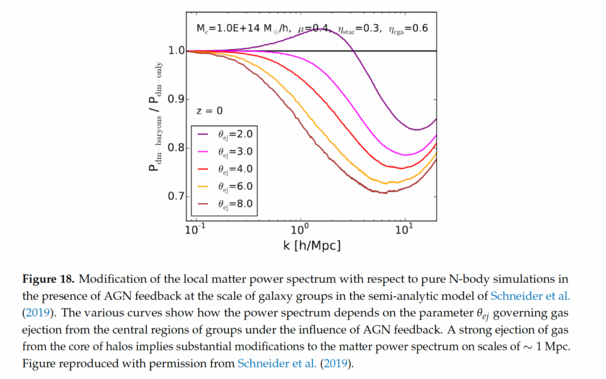
Finally, understanding how feedback energy is deposited into the host halos, and out to distance, turns out to be crucial for future cosmological studies, too:

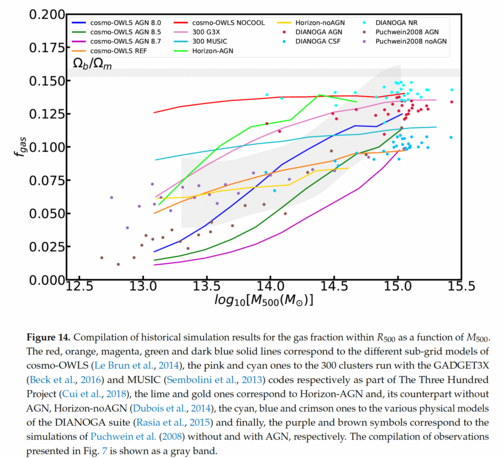
different prescriptions for feedback in simulations lead to a different "baryon fraction" (i.e. mass of ordinary matters vs dark matter) in low mass halos.

This in turn affects the matter power spectrum of the nowadays observable universe, which people hope to use to better constrain cosmological models.
Feedback changes it a lot!
EoT

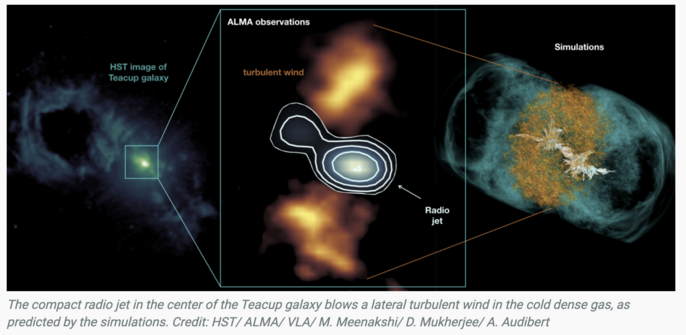
The next #AstroPhysicsFactlet prompted by the conference I am following is about the interaction between active galactic nuclei and their host galaxy.

How much can jets from supermassive black hole affect the iterstellar medium of their host galaxy?

(this post is a continuation of
https://mastodon.social/@franco_vazza/111047676382711436)

#astrodon
#astronomy

As planned (https://mastodon.social/@franco_vazza/111035316234009184) I am going to use the key science topic of the day at my conference (https://agnonthebeach.space/) to produce every day a new timely
#AstroPhysicsFactlet

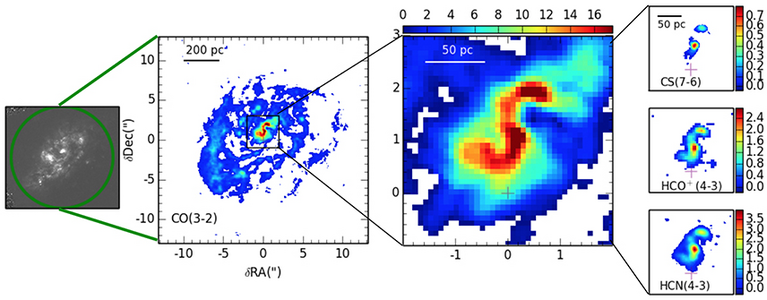
Todays theme was "fueling" how do central supermassive black holes (SMBH) at the centre of galaxies grow their mass, up to the level needed to make a sense of their powerful emission?

#astronomy
#astrodon

AGN on the Beach

<h2>The many facets of fuelling and feedback in jetted AGN</h2><h6>10-15th September 2023, Tropea, Italy</h6>

AGN on the Beach

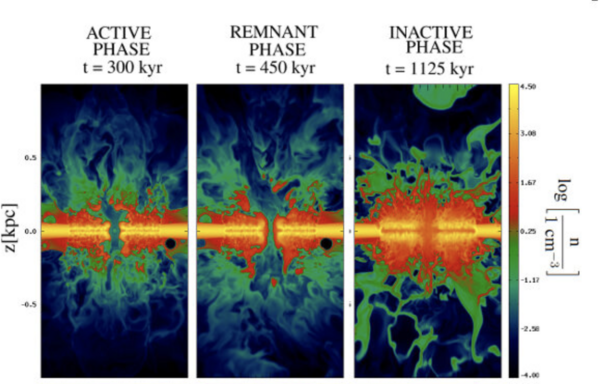
Day three on my Active Galactic Nuclei conference mostly focused on the topic of the Duty Cycle of AGN feedback: for how long are AGN “on” during their lifetime?

How long do feedback events last?

A new #AstroPhysicsFactlet

#Astrodon #astronomy

(previous threads here

https://mastodon.social/@franco_vazza/111047676382711436

https://mastodon.social/@franco_vazza/111056329365756242

#CosmoMag2023 , Day 4:
the order of todays talk is more mixed than other days, so having a unique summary gets difficult
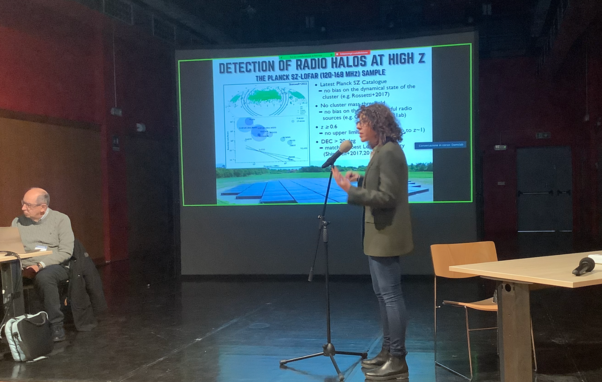
G. Di Gennaro showed how the detection of radio halo emission in clusters of galaxies at "high" redshift (z=0.6) may be used to constrain the growth rate of primordial magnetic fields.
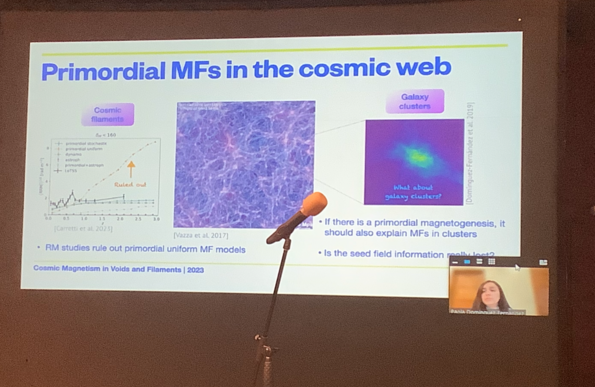
P. Dominguez-Fernandez @PaolaDom showed that latest simulations can be used to link the helicity in primordial B-fields with the z=0 properties of magnetic fields in the intra-cluster medium.
First day at my new workplace, going through all the bureocreacy (of course!). But already feeling encouraged. Also new cup! :) #CenterForAstrophysics #Harvard