 Paola Domínguez
 franco_vazza
#astroph
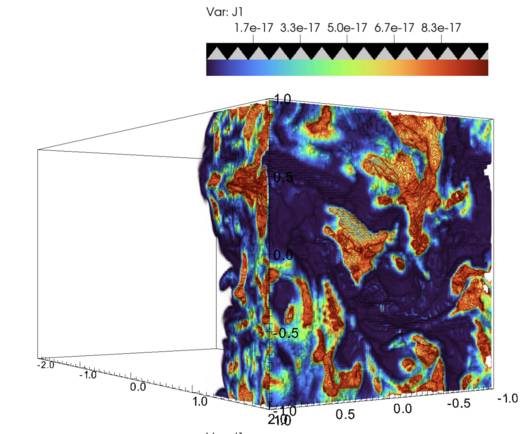
New numerical simulations of merger shocks propagating through a turbulent and magnetised intracluster medium, with the Pluto code, to study "Radio surface fluctuations in radio relics"
https://arxiv.org/abs/2402.12375
by P. Dominguez-Fernandez et al. @PaolaDom

Radio surface fluctuations in radio relics
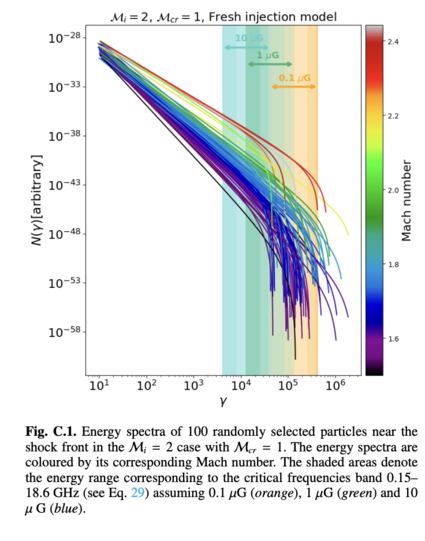
Recent observations have revealed detailed structures of radio relics in a wide range of frequencies. In this work, we perform three-dimensional magnetohydrodynamical simulations of merger shocks propagating through a turbulent magnetized intracluster medium, and employ on-the-fly Lagrangian particles to explore the physical processes originating radio substructures and their appearances in high and low-frequency observations. We employ two cosmic-ray (CR) electron acceleration models: the fresh injection of electrons from the thermal pool and the re-acceleration of mildly relativistic electrons. We use the relative surface brightness fluctuations, $δS_ν$, to define a "degree of patchiness''. We find that: 1) Patchiness is produced if the shock's surface has a distribution of Mach numbers, rather than a single Mach number; 2) Radio relics appear patchier if the Mach number distribution consists of a large percentage of low Mach numbers ($\mathcal{M}\lesssim2.5$); 3) As the frequency increases, the patchiness also becomes larger. Nevertheless, if radio relics are patchy at high frequencies (e.g., 18.6 GHz), they are necessarily also at low frequencies (e.g., 150 MHz); 4) To produce noticeable differences in the patchiness at low and high frequencies, the shock front should have a Mach number spread of $σ_{\mathcal{M}}\gtrsim0.3$-0.4; 5) The amount of the patchiness depends on the Mach number distribution as well as the CR acceleration model. We propose $δS_ν$ as a potential tool for extracting merger shock properties and information about particle acceleration processes at shocks in radio observations.