RT @[email protected]
How to combat autocratization and strengthen democracy? In a new @[email protected] paper, @[email protected], @[email protected] and I demonstrate that online civic education promotes democratic values in new democracies. https://onlinelibrary.wiley.com/doi/10.1111/ajps.12765 1/
🐦🔗: https://twitter.com/AnjaNeundorf/status/1618938556428472328
Informationsveranstaltung zu unseren Masterprogrammen am 01.02.2023 | Institut für Politikwissenschaft
Einladung zum Institutskolloquium am 25.01.2023 | Institut für Politikwissenschaft
RT @[email protected]
📢📣 We've got a new paper out from @[email protected] today in @[email protected] 📢
Russia's foreign influence campaign on Twitter in 2016 caused widespread concern. But who was exposed? How effective was it? 🧵👇
1/
https://www.nature.com/articles/s41467-022-35576-9
🐦🔗: https://twitter.com/j_a_tucker/status/1612462348656074753

Exposure to the Russian Internet Research Agency foreign influence campaign on Twitter in the 2016 US election and its relationship to attitudes and voting behavior - Nature Communications
Here, using longitudinal survey and Twitter data, the authors examine the relationship between exposure to Russian Internet Research Agency activities on Twitter and voting behavior and attitudes in the 2016 US election.
RT @[email protected]
This one is for both my football and poli sci bubbles: The colleagues @[email protected] have launched the test survey for our @[email protected] research project on Football and European Identities. If you have the time it would be great if you could participate https://twitter.com/PoWiMZ/status/1609872851234086915
🐦🔗: https://twitter.com/JensJungblut/status/1609897738816131074
“The FANZinE research project @eu_foot on "Football, European identities and social cohesion in Europe", led by Prof. Arne Niemann @PoWiMZ, has launched a test survey on #Europe and #Football ⚽️🇪🇺
https://t.co/N07Lm6X5hd
We invite you to participate. Feedback is most welcome!”
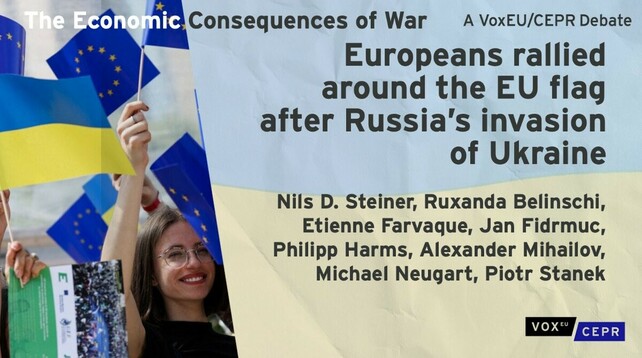
Europeans rallied around the EU flag after Russia’s invasion of Ukraine
Russia’s invasion of Ukraine was met with a rapid and robust response by EU governments. This column uses a survey of European university students to study the impact of the invasion on attitudes toward the EU and Europe. It finds that pro-European attitudes improved in the immediate aftermath of the invasion. These effects are particularly strong for the societal aspects of European integration, rather than individual considerations. The invasion seems to have brought Europeans closer together, by rallying them around the common European flag.
RT @[email protected]
Annd we're live! @[email protected]
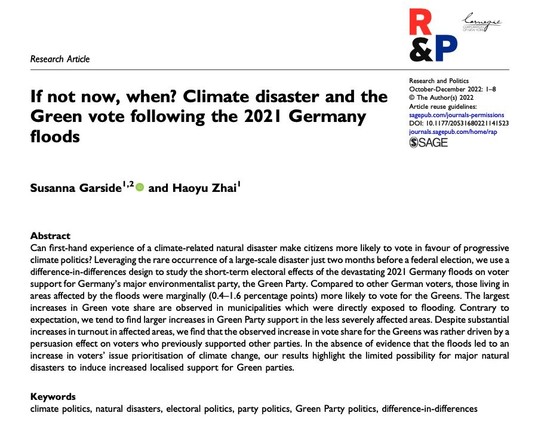
Did the 2021 Germany floods have an impact on the Green vote? Yes, by 0.4 - 1.6 percentage points in affected areas. Interestingly, we found larger increases in support for the Greens in less severely affected places.
🔗https://doi.org/10.1177/20531680221141523
🐦🔗: https://twitter.com/susannagarside/status/1603358640727015424
RT @[email protected]
While European citizens’ #immigration attitudes did not change much over the last two decades, far-right parties (FRPs) have nonetheless been increasingly successful. #Why? In a new publication @[email protected], @[email protected] and I aim to provide an answer: http://dx.doi.org/10.1093/ijpor/edac034
🐦🔗: https://twitter.com/cschnaudt/status/1603757992696025093