 Jaclyn Wong
I'm wearing a mask at #ASA2023 and I hope you all will too! I don't want to get sick at the beginning of the semester
Matt Borus
@MatthewBorus
- 203 Followers
- 121 Following
- 27 Posts
PhD candidate in sociology and social welfare at UChicago. Topics include: community, disability, social movements, organizing, the state, coffee, bad puns...
Not using this account much lately, but find me on BlueSky at MatthewBorus.BSky.Social
#sociology #sociodon #disability #socialwork
 Brendan Nyhan
Got a bluesky invite. Find me if you're over there at MatthewBorus.bsky.social.
Let me know if you need an invite, though I have no clue if/when I'll get any.
If I’m reading the submission guidelines correctly, you’re allowed to submit two different papers to ASA. But if they’re both solo-authored, and both get in, then apparently you have to withdraw one of them.
Is this correct? If it happens, does it create problems for the organizer of the session that gets a paper withdrawn? Or is it sort of routine?
Would love guidance from someone with more experience navigating this conference…
Really good to see that so many New York Times contributors have already signed on to this letter critiquing the Times' coverage of trans issues.
I'm pretty sure that some folks I know on here have written for the Times, and I hope you'll sign on as well!
 Molly White
Reiners: "There is no evidence whatsoever to suggest that crypto promotes financial inclusion. In fact, there is overwhelming evidence to suggest the exact opposite is happening. Most people who've invested in cryptocurrency have lost money. Of those people, a plurality are minorities and low-income Americans. This is an example of predatory inclusion..." 1/2
Question for #sociology folks: Is it appropriate to contact the organizer for a Section Session at ASA to ask if my paper might be a fit?
Not sure if that's why the names are listed, or if it would be a faux pas. Thanks! #Sociodon
 Social Service Review
In our current issue, Warren Lowell and Maria Hanratty look at how different government definitions of homelessness impact children's educations.
They find that kids in doubled-up families, whom HUD does not define as homeless, still face notable educational risks.
You can read the open-access article at https://www.journals.uchicago.edu/doi/full/10.1086/722003

Who Counts? Educational Disadvantage among Children Identified as Homeless and Implications for the Systems That Serve Them | Social Service Review: Vol 96, No 4
Abstract The Department of Education’s (ED) definition of homelessness includes any child who lacks a fixed, regular, and adequate nighttime residence, but the Department of Housing and Urban Development (HUD) uses a narrower definition that excludes doubled-up families. These definitions determine how resources are prioritized for families, yet we know very little about the differences in risks faced by children identified by these departments. We leverage a data linkage between public schools and homeless management information systems in Minnesota to provide novel evidence on the educational risks faced by children identified as homeless by ED and HUD. We find that ED-identified-homeless and HUD-identified-homeless children experience comparable increases in chronic absenteeism and school instability in the year they experience homelessness, challenging the popular conception that doubled-up families face lower educational risks. Using these findings, we discuss strategies to integrate homelessness data better, assess needs, and prioritize resources for children experiencing homelessness.
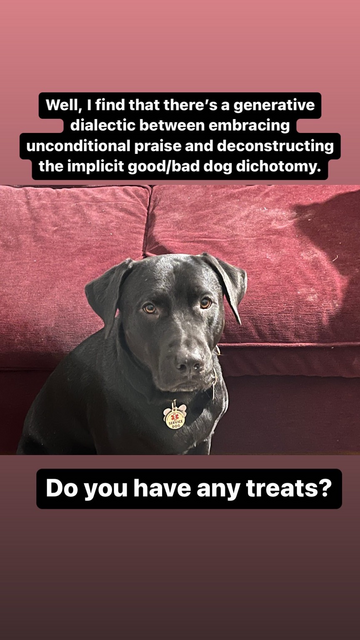
Prediction: #AcademicDog will be the hip new meme in early 2023. (You may have to expand the photo gif full effect.) #sociodon #academics
We kindle light, even when we don’t know if it will be seen, even when the night threatens to encompass all.
Let our hope, and our defiance of tyrants, burn brighter than our fear.