
Marc S. Boxberg

@MarcBoxberg
8 Followers
20 Following
8 Posts
Geophysicist at RWTH Aachen University interested in 👨‍💻 geophysical modelling, 🪐 icy moon exploration & 📖 #SciComm | PhD from @ruhrunibochum | Toots in 🇬🇧 & 🇩🇪
Eine starke #Wissenschaft braucht faire Arbeitsbedingungen. Aber: Fast 9 von 10 wissenschaftlichen Angestellten an Unis sind #befristet beschäftigt - oft auf kurze Zeit. Das muss sich ändern. Unterzeichnet jetzt und #StopptDauerbefristung https://weact.campact.de/petitions/stoppt-die-dauerbefristung-in-der-wissenschaft?source=twitter_share_button&utm_medium=recommendation&utm_source=rec-tw&share=c99445d0-1741-4c07-9414-3b4abe2360d9
Stoppt die Dauerbefristung in der Wissenschaft

Eine starke Wissenschaft braucht faire Arbeitsbedingungen. Aber: Fast 9 von 10 wissenschaftlichen Angestellten an Unis sind befristet beschäftigt - oft auf kurze Zeit. Planbarkeit für Lebenswege oder anspruchsvolle Projekte - Fehlanzeige. Das muss sich ändern. Unterzeichne jetzt die Petition!
WeAct
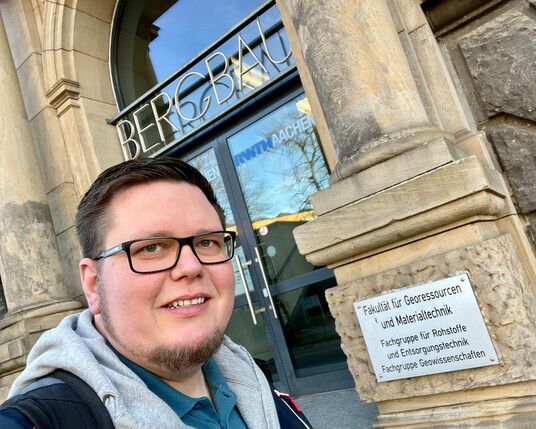
I just started a new position as PostDoc and deputy director at the Geophysical Imaging and Monitoring group. I'm still at RWTH Aachen and this allows for a smooth transition in the next few months while still being part of MBD. Entering the mining building feels kind of right.
Did you miss my poster at #DGG23? Check it out now via https://e-docs.geo-leo.de/handle/11858/10510.
The Ice Data Hub as a powerful interface between data and simulations

Our virtual testbed allows us to evaluate the performance of technology currently used on Earth for space missions and, for the first time, derive an extensible collection of mission-relevant metrics such as transit time and required power supply.
If you want to learn more about this topic, you can also watch this video we prepared for #EGU21.

https://youtu.be/MPDJMMOVE8A

🧵4/4

Concepts to utilize planetary analogue studies for icy moon exploration missions #vEGU21

YouTube
That's where our virtual testbed for cryobots comes in. We use close-contact melting theory to estimate the descent rate, and hence trajectory, of a cryobot in a given cryoenvironment. We test our trajectory model for various cryobots in analogous terrestrial scenarios in Antarctica and elsewhere.
We also rely on geodynamical models from our colleague Ina Plesa at @DLR to make predictions about the transit time of a cryobot on Jupiter's moon Europa. 🧵3/4
Some icy moons, such as Jupiter's moon Europa or Saturn's moon Enceladus, are prime targets for the search for extraterrestrial life that might originate in the oceans beneath their ice crusts. Any conclusive search for biosignatures must penetrate and traverse the ice. That's why cryobots or ice melting probes, like the TRIPLE-IceCraft, are being developed. But to plan the missions, you need to know how much energy and time is needed to reach the subglacial water. 🧵2/4

How can we actually plan missions 🚀 to icy moons 🪐 to study the alien oceans for signs of life 🧬?

This question motivated my paper on "Ice Transit and Performance Analysis for Cryorobotic Subglacial Access Missions on Earth and Europa" now published in Astrobiology.

For the full paper, have a look at https://dx.doi.org/10.1089/ast.2021.0071 or contact me for a pre-print version.

For a summary of our findings, read this thread. 🧵1/4

Hello #fediverse,
nice to meet you all! My name is Marc and I am a geophysicist interested in icy moon exploration and wave propagation phenomena. This includes numerical #modelling of (seismic) wave propagation in porous media, computational #seismology, geophysical inverse problems like full waveform #inversion and traveltime #tomography as well as trajectory models of ice melting probes.