Interested in sounds and/or music in the context of archaeology? Submit your paper for the session I am co-organizing at the @EAAarchaeology conference in Rome (28 - 31 August 2024)!

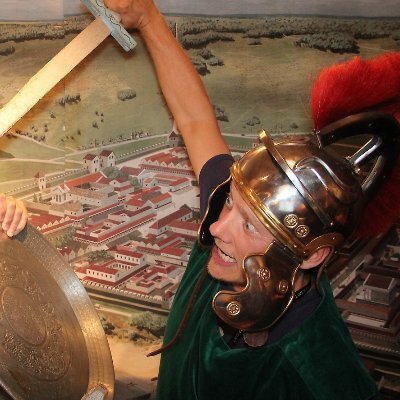
Publication alert! Have you ever wondered how many people might have heard Marcus Brutus’ speech delivered on the Capitol after the assassination of Caesar? A new article has been published as a result of a research project I am leading, which is funded by the National Science Centre, Poland.
Together with A. Pilch, M. Drab, and Sz. Poplawski, I investigated the acoustic properties of the speaking platforms on the Capitoline Hill and at the temple of Bellona in Rome in the context of public speaking.
The result of our research is the article ‘One, Two, Three! Can Everybody Hear Me? Acoustics of Roman Contiones. Case Studies of the Capitoline Hill and the Temple of Bellona in Rome’ published in Open Archaeology, 9(1). You can read it at https://www.degruyter.com/document/doi/10.1515/opar-2022-0330/html
#AncientRome #Capitolium #Rome #PublicMeetings #contiones #RomanPolitics


Rhetoric was one of the cornerstones of Roman education and public speaking, the essence of being a Roman politician. The speakers attempted to captivate the audience with their style and convince them of their arguments. Studying the audience is therefore just as important as investigating the speakers and their speeches. The aim of this article is to estimate the number of people who could intelligibly hear a speaker delivering a speech from two speaking platforms located in the city of Rome: the podium of the Temple of Bellona in the Campus Martius (in the Late Republican and Late Augustan periods) and the Capitoline Temple. To do this, we built virtual reconstructions of both venues according to the current state of knowledge about them, taking into account the geometry of the space as well as the materials from which they were built. On the models thus prepared, we carried out acoustic simulations for three different levels of background noise (36, 49, and 55 dBA), resulting in Speech Transmission Index maps. The results became the basis upon which we estimated the size of the maximum potential crowds that could hear speech intelligibly, using two methods based on the behaviour of contemporary crowds. We further compared our results with those of previous studies that concern other speaking platforms in Rome.
There's nothing like getting up on a Monday morning, checking your inbox, and finding out that your article has been published.
"More than words: a study on the visibility of hand gestures in public spaces"
This is the first in a series of articles presenting research findings from our grant "One, two, three! Can everybody hear me? Can everybody see me? – Acoustics and proxemics of Roman contiones"
The article presents the results of our experiment and focuses on methodological issues related to the analysis of the visibility of rhetorical gestures. Stay tuned, more is coming (in the next dozen months or so... ;) )
📞The call for papers for the RAC/@TRAC
is now open. Consider submitting a paper for the session "Investigating public spaces with digital tools" co-organized by me and Alexander Braun from the University of Cologne. Deadline: 15 September.
You can find the abstract of the session here: http://www.romansocietyrac.ac.uk/live/wp-content/uploads/2023/03/RAC-TRAC-24-Session-Abstracts-Final.pdf
If you're interested, please, contact me & Alex: [email protected], [email protected] and send us:
1⃣ title of your paper,
2⃣ name(s) and contact details
3⃣ 200-word abstract
That Nabatean merchants had their factories in the port city of Puteoli (Italia) has long been known, but new underwater discoveries (2 altars dedicated to Dushara the main god of their pantheon) indicate that a temple to this deity may have been located in the flooded area of the city.
Remote sensing has led to the discovery and analysis of marching and temporary Roman camps on a larger scale. This article focuses on the study of two camps in Spain, potentially linked to M. Junius Brutus' campaign
https://www.sciencedirect.com/science/article/pii/S2352409X23001682#b0275


In dit rapport worden de resultaten van de opgravingen van de Romeinse villa Voerendaal-Ten Hove gepresenteerd. Naast een analyse van de villa binnen een breder landschappelijk, cultureel en politiek-economisch kader, is er ook aandacht voor de bewoning voorafgaande en na de hoogtijdagen van deze bijzondere nederzetting.
Inscriptions and Rock Art from Jabal Manshir (from David F. Graf, Rome and the Arabian Frontier: From the Nabataeans to the Saracens [1997], p. 307)

 Ronald Visser