Joe Wasserman

145 Followers
79 Following
75 Posts
quantitative social scientist at RTI International | data for good | methodologically eclectic | boardgames | he/him | my opinions
Twitterhttps://twitter.com/JoeWasserman
ORCiDhttps://orcid.org/0000-0002-9705-1853
I wrote an #rstats blog post to remind myself that just because a log transform improves an ordinary least squares regression in conventional terms (eg makes it more linear and residuals less heteroskedastic), doesn't mean it is more fit for purpose. http://freerangestats.info/blog/2023/07/30/log-transforms
Log transforms, geometric means and estimating population totals

A model that is 'improved' (in terms of making standard assumptions more plausible) by using a logarithm transform of the response will not necessarily be improved for estimating population totals.

free range statistics

Heads up, @cfaworkers has made a call for public support of their nascent union, which is facing union-busting tactics.

If you think civic tech workers deserve a union, this is the time to voice it to Code for America's leadership—specific instructions at the bottom of the post:

https://cfaworkersunited.com/stories/2023/07/14/cfa-actions-dont-align-with-values.html

Code for America’s Private Actions Don’t Align with Our Public Values

Recent bargaining sessions have shown that—despite public assertions to the contrary—Code for America management is not interested in bargaining with our union in good faith. Code for America Workers United was founded with one clear goal in mind: to better live out our external values internally. With our clients and partners, we listen first, act with intention, and include those who have been excluded. It’s the animating mantra of our work, threaded through our design choices, engineering projects, and communications work.

CfA Workers United
This is BIG!!! R for WebAssembly: https://www.tidyverse.org/blog/2023/03/webr-0-1-0/ and you can embed it in rmd already: https://github.com/coatless/quarto-webr #rstats #web #gamechanger
webR 0.1.0 has been released

webR 0.1.0 has been released! Using the magic of WebAssembly, webR allows you to run R code directly within a web browser.

The second edition of R for Data Science is out now, and it’s been a blast to join @hadleywickham as a co-author! Learn more about the second edition at https://www.tidyverse.org/blog/2023/07/r4ds-2e/, read it for free at https://r4ds.hadley.nz/, or buy a copy at https://amzn.to/3PTdLRQ. #rstats
R for Data Science, 2nd edition

The second edition of R for Data Science is out, and it's a major reworking of the first edition.

The other week, we published “Monthly excess mortality across counties in the United States during the COVID-19 pandemic, March 2020 to February 2022” (open access!).

If I wrote a thread at some point, what would you want to know? I’ll happily answer questions or address comments in the meantime.

Top-line findings: almost as much excess mortality in year 2 as year 1, greatest concentration shifted from NE large metros to S nonmetros.

https://www.science.org/doi/10.1126/sciadv.adf9742

Monthly excess mortality across counties in the United States during the COVID-19 pandemic, March 2020 to February 2022

Excess mortality estimates show increases in rural mortality during the second year of the COVID-19 pandemic in the United States.

Science Advances

Stop staying you can't put R in prod.  

I made a blog post with my thoughts and reactions.

#rstats #rust #putRinprod

https://josiahparry.com/posts/2023-07-06-r-is-still-fast.html

Josiah Parry - R is still fast: a salty reaction to a salty blog post

THREAD: Bias and disparity in a causal modeling framework.

1. A few months ago, @vtraag and @LudoWaltman posted a superb paper to the arXiv.

http://arxiv.org/abs/2207.13665

I've been meaning to write about it for a while and finally found the time.

Causal foundations of bias, disparity and fairness

The study of biases, such as gender or racial biases, is an important topic in the social and behavioural sciences. However, the literature does not always clearly define the concept. Definitions of bias are often ambiguous or not provided at all. To study biases in a precise manner, it is important to have a well-defined concept of bias. We propose to define bias as a direct causal effect that is unjustified. We propose to define the closely related concept of disparity as a direct or indirect causal effect that includes a bias. Our proposed definitions can be used to study biases and disparities in a more rigorous and systematic way. We compare our definitions of bias and disparity with various criteria of fairness introduced in the artificial intelligence literature. In addition, we discuss how our definitions relate to discrimination. We illustrate our definitions of bias and disparity in two case studies, focusing on gender bias in science and racial bias in police shootings. Our proposed definitions aim to contribute to a better appreciation of the causal intricacies of studies of biases and disparities. We hope that this will also promote an improved understanding of the policy implications of such studies.

arXiv.org

DO YOU WORK ON AN IRB OR OTHER ETHICS APPROVAL BOARD! I want to talk to you!!

(1) I run a website (childrenhelpingscience.com) where over 100 research labs provide studies that children and families can participate in from home

(2) Participants consent individually to each study

(3) We provide template consent forms that researchers can use, as well as automatic tools for implementing other best practices for informed consent

(4) Most IRBs asks for *some* changes to the consent form, especially around how data will be used after collection

(5) This creates a bad situation for families that lowers their ability to consent with full information - every single form is slightly different and the differences that really matter are hard to spot.

(6) As an infrastructure provider, I'd like to solve this!

RT @UoL_CEN
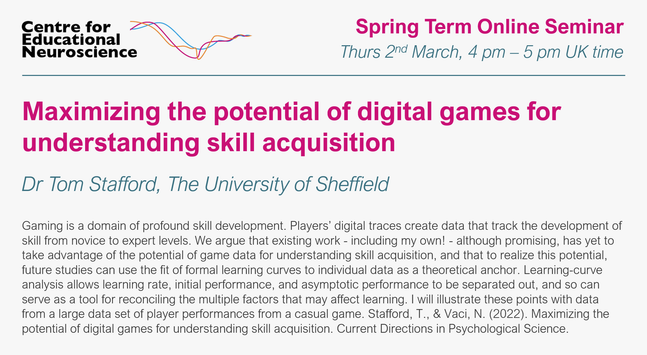
This Thurs at the CEN seminar, Dr Tom Stafford @tomstafford will be discussing the use of digital games for understanding how we learn new skills. Thurs Mar 02, 4-5pm GMT. Registration - http://tinyurl.com/tucbkoo
Seminar registration

Please fill in the form below to register for the Centre for Educational Neuroscience online seminars. Please note that you only have to register once for the full series of seminars. If you have previously registered for a seminar, you do not need to register again. Links to attend the online seminars will be sent via email on Monday and Thursday each week. IMPORTANT: If you register on the day of the seminar, a link to attend the seminar will be emailed to you at 3.30 pm prior to to the start of the session. More information on our seminars can be found here: www.educationalneuroscience.org.uk/events/seminars Please note that all email addresses and personal details are kept strictly private and will not be shared with any other third parties. To remove your details from the database and unsubscribe from the mailing list, please email [email protected] using the subject UNSUBSCRIBE.

Google Docs
🔭 Get to know the immensely powerful r-universe:
🪐 “Discovering and learning everything there is to know about R packages using r-universe” by Jeroen Ooms #RStats
https://ropensci.org/blog/2023/02/27/runiverse-discovering/
Discovering and learning everything there is to know about R packages using r-universe

The goal of r-universe is to provide a central place for browsing through the R ecosystem to discover what is out there, get a sense of the purpose and quality of individual packages, and help you get started in seconds.