207 Followers
145 Following
76 Posts

Professor, Department of Anthropology, Western University πŸ‡¨πŸ‡¦
Biological Anthropologist with emphasis on bioarchaeology, biomechanics, paleoanthropology, human athletic paleobiology, life history theory, foragers, and the transition to agriculture

Born on Treaty 3 (1792) land at 325 ppm atmospheric carbon dioxide

Websitehttp://www.pavelab.ca
Academic Discpline#BiologicalAnthropology

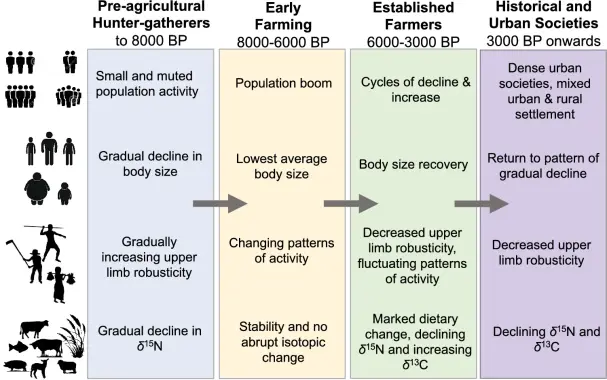
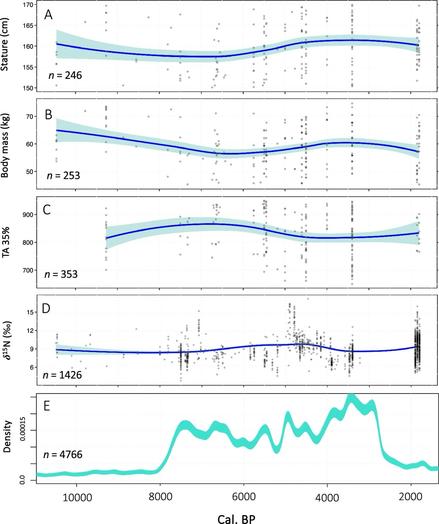
Very pleased to have a new paper out that illustrates long-term interaction between diet, body size, activity, and demography over 30,000 years in the central Mediterranean. A great test of life history models across subsistence transitions, led by EΓ³in Parkinson.

https://www.nature.com/articles/s41598-023-49406-5

Multiproxy bioarchaeological data reveals interplay between growth, diet and population dynamics across the transition to farming in the central Mediterranean - Scientific Reports

The transition to farming brought on a series of important changes in human society, lifestyle, diet and health. The human bioarchaeology of the agricultural transition has received much attention, however, relatively few studies have directly tested the interrelationship between individual lifestyle factors and their implications for understanding life history changes among the first farmers. We investigate the interplay between skeletal growth, diet, physical activity and population size across 30,000 years in the central Mediterranean through a β€˜big data’ cross-analysis of osteological data related to stature (n = 361), body mass (n = 334) and long bone biomechanics (n = 481), carbon (Ξ΄13C) and nitrogen (Ξ΄15N) stable isotopes (n = 1986 human, n = 475 animal) and radiocarbon dates (n = 5263). We present the observed trends on a continuous timescale in order to avoid grouping our data into assigned β€˜time periods’, thus achieving greater resolution and chronological control over our analysis. The results identify important changes in human life history strategies associated with the first farmers, but also highlight the long-term nature of these trends in the millennia either side of the agricultural transition. The integration of these different data is an important step towards disentangling the complex relationship between demography, diet and health, and reconstruct life history changes within a southern European context. We believe the methodological approach adopted here has broader global implications for bioarchaeological studies of human adaptation more generally.

Nature
Under conditions of negative energy balance, endurance athletes upregulate spatial cognition, but downregulate episodic memory. Suggests that life history trade offs may help to explain cognitive plasticity and evolution. I'm pleased to see our latest paper published here:
https://onlinelibrary.wiley.com/share/RXSBZXGAKI8PXUBMAFVV?target=10.1002/ajpa.24820
RT @danny_longman
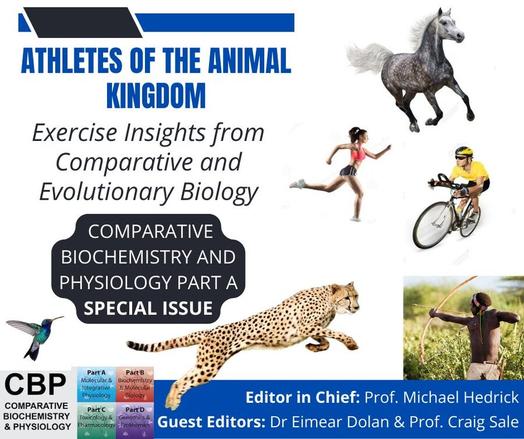
Delighted to contribute to @eimeardol's excellent @CompBiochPhys special issue, discussing the use of ultra-endurance events to gain insights towards patterns of energy allocation during energetic scarcity. Co-authors @JayTStock @eimeardol & Jonathan Wells https://www.sciencedirect.com/science/article/pii/S1095643323000557
RT @MDPetraglia
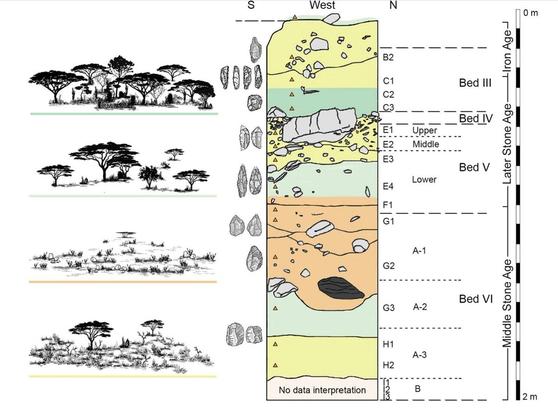
Check out this important new environmental sequence for the Middle and Later Stone Age at Mumba Rock Shelter by @ProfMercader and team. #MSA #LSA
https://www.frontiersin.org/articles/10.3389/fevo.2021.699609/full
Phytolith Palaeoenvironments at Mumba Rock Shelter

The rock shelter site of Mumba in northern Tanzania plays a pivotal role in the overall study of the late Pleistocene archaeology of East Africa with an emphasis on the Middle to Later Stone Age transition. We used phytolith analysis to reconstruct general plant habitat physiognomy around the site from the onset of the late Pleistocene to recent times, tallying 4246 individual phytoliths from 19 archaeological samples. Statistical analysis explored phytolith richness, diversity, dominance, and evenness, along with principal components to compare phytolith distributions over the site’s sequence with known plant habitats today. Generally, the phytolith record of Mumba signifies paleoenvironments with analogs in the Somalia – Masai bushland and grassland, as well as Zambezian woodlands.

Frontiers
RT @MDPetraglia
Seeking #PhD students! Scholarships available - must have a research MA degree in hand.
If interested, please get in touch. @ARCHE_Griffith

RT @R_J_Gilmour
Excited to announce the release (for pre-order) of our new edited book 'Behaviour in our Bones' with @Kimberly_Plomp & Francisca Alves Cardoso!

https://www.elsevier.com/books/behaviour-in-our-bones/hirst/978-0-12-821383-4

Check it out if you're curious about latest research on reconstructing behaviour in the past!

Behaviour in our Bones - 1st Edition

Purchase Behaviour in our Bones - 1st Edition. Print Book. ISBN 9780128213834

RT @trowelblazers
πŸ“’ NEW POST!
Our first of 2023 is #KathyMacDonald, a brilliant Palaeolithic archaeologist who tragically passed away last year. She worked on 'Big Picture' questions eg how hominins settled vast & challenging landscapes, with or without fire πŸ”₯
https://trowelblazers.com/2023/01/31/katharine-macdonald-a-burning-light-in-prehistory/
RT @VDSEE_univie
#JobAlert! We're offering 3 fully funded, 3-year PhD positions at @univienna with @tim_wollesen @Katerina__Douka and @s_waldherr.
Application deadline is 10.03.2023. For more info and to apply, visit:
https://vds-ecology-evolution.univie.ac.at/application/open-positions/
Please retweet!!
#PhD #PhDJobs #AcademicTwitter
Open positions

Open positions

RT @RKP_Industries
CHAPTER 11 @ERC_Research @fragsus book:

B.Ariano et al., β€œ#aDNA: An Investigation of Uniparental #Genetic Heritage in Neolithic #Malta”. 🧬

FREE #OpenAccess via @UCamArchaeology πŸ”“πŸ™πŸ”„

Chapter: πŸ”—πŸ‘‰ http://tinyurl.com/4uwxac9e

Book: πŸ”—πŸ‘‰ http://tinyurl.com/yd6ttx8x

CW: Human Remains

aDNA: an investigation of uniparental genetic heritage in Neolithic Malta

RT @RKP_Industries
CHAPTER 8 @ERC_Research @fragsus:

R.K.Power et al., β€œGeneral Pathology in the Circle: #Biocultural Insights into Population Health, Trauma and Care in Neolithic #Malta”.

FREE #OpenAccess πŸ”“πŸ™πŸ”„

Chapter: http://tinyurl.com/5ex2vsse

Book: http://tinyurl.com/yd6ttx8x

CW: Human Remains

General pathology in the Circle: biocultural insights into population health, trauma and care in Neolithic Malta