Martin Götte

@GotteProf
10 Followers
23 Following
4 Posts
Molecular Cell Biologist focussing on Cancer and Endometriosis research.
Personal views.
New cooperation paper of my Group at Münster University & @ChariteBerlin
: Characterisation of Pale Cells in #adenomyosis. #stemcells #endometriosis.https://doi.org/10.3390/biom14111355
Characterization of E-Cadherin, SSEA-1, MSI-1, and SOX-2 Expression and Their Association with Pale Cells in Adenomyosis

Adenomyosis (AM) is a gynecological disease characterized by the invasion of endometrial glands and stroma within the myometrium. The etiology and pathogenesis of AM remain inadequately understood. Pale cells were identified as a novel cell type characterized by the absence of desmosomal contacts and light-colored cytoplasm. These cells were observed to migrate individually through ultra-micro ruptures in the basal membrane of the endometrial glands, translocating into the stroma and then further into the myometrium. Our study aimed to explore the possible stem cell properties of these pale cells. Forty hysterectomy specimens were analyzed using immunohistochemistry and immunofluorescence to assess negative E-cadherin expression and the positive expression of stem cell markers SSEA-1, MSI-1, and SOX-2. Immunohistochemical analysis revealed the presence of pale cells and occasionally rounded, enlarged E-cadherin-negative cells predominantly in the basal endometrial epithelium. The stem cell marker SSEA-1 was significantly elevated in the basalis epithelium, as well as in the ectopic epithelium. SSEA-1 positive cells were also identified in the stroma and myometrium. Sporadic colocalization of SSEA-1+/E-cadherin– cells was confirmed through immunofluorescence. The positive staining of pale cells for SSEA-1 and MSI-1 was also confirmed at the ultrastructural level by immunoelectron microscopy. These findings indicate that pale cells may possess stem cell characteristics, particularly a positive SSEA-1 profile, warranting further in vitro investigation into their role in the pathogenesis of adenomyosis.

MDPI
6/6 Last but not least GlycoShape was and continues to be developed for and with the #glycotime community  BIG MASSIVE THANK YOU 👏 to all the beta testers around the world. Happy glycosylating!  

A spoonful of sugar #16 🍬

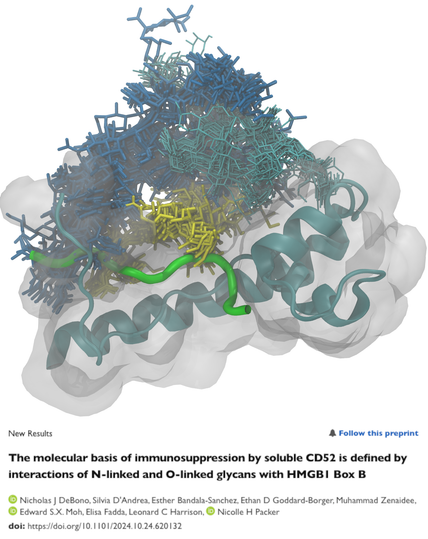
How does glycosylation affect not only structure and function of proteins, but also binding specificity?

In a new paper fresh off the #bioRxiv press https://doi.org/10.1101/2024.10.24.620132 in collaboration with Nicki Packer, Len Harrison and Ethan Goddard-Borger, we explain how glycosylation of CD52 (reconstructed with https://glycoshape.org) determines:
1) the peptide's conformation,
2) binding to the HMGB1 Box B and only then
3) to SIGLEC-10  

#glycotime

New cooperation paper of my Group at Münster University & @ChariteBerlin
: Characterisation of Pale Cells in #adenomyosis. #stemcells #endometriosis.https://doi.org/10.3390/biom14111355
Characterization of E-Cadherin, SSEA-1, MSI-1, and SOX-2 Expression and Their Association with Pale Cells in Adenomyosis

Adenomyosis (AM) is a gynecological disease characterized by the invasion of endometrial glands and stroma within the myometrium. The etiology and pathogenesis of AM remain inadequately understood. Pale cells were identified as a novel cell type characterized by the absence of desmosomal contacts and light-colored cytoplasm. These cells were observed to migrate individually through ultra-micro ruptures in the basal membrane of the endometrial glands, translocating into the stroma and then further into the myometrium. Our study aimed to explore the possible stem cell properties of these pale cells. Forty hysterectomy specimens were analyzed using immunohistochemistry and immunofluorescence to assess negative E-cadherin expression and the positive expression of stem cell markers SSEA-1, MSI-1, and SOX-2. Immunohistochemical analysis revealed the presence of pale cells and occasionally rounded, enlarged E-cadherin-negative cells predominantly in the basal endometrial epithelium. The stem cell marker SSEA-1 was significantly elevated in the basalis epithelium, as well as in the ectopic epithelium. SSEA-1 positive cells were also identified in the stroma and myometrium. Sporadic colocalization of SSEA-1+/E-cadherin– cells was confirmed through immunofluorescence. The positive staining of pale cells for SSEA-1 and MSI-1 was also confirmed at the ultrastructural level by immunoelectron microscopy. These findings indicate that pale cells may possess stem cell characteristics, particularly a positive SSEA-1 profile, warranting further in vitro investigation into their role in the pathogenesis of adenomyosis.

MDPI