 David Blanchflower BSc

DJDWade
@DWade25@mstdn.social
- 112 Followers
- 221 Following
- 2.9K Posts
Radio personality...voice overs..voice tracking..astrophotography..astronomy..anthropology..sports...comedy.
 Corey S Powell
A mind-blower for a Friday evening:
This deceptively simple-looking graph is a spectrum of *gravitational waves* ringing through the Milky Way.
The waves may be caused by a chorus of supermassive black holes colliding all across the universe. Whoa!
https://arxiv.org/abs/2306.16227 #science #space #physics #astronomy


The second data release from the European Pulsar Timing Array: IV. Implications for massive black holes, dark matter and the early Universe
The European Pulsar Timing Array (EPTA) and Indian Pulsar Timing Array (InPTA) collaborations have measured a low-frequency common signal in the combination of their second and first data releases respectively, with the correlation properties of a gravitational wave background (GWB). Such signal may have its origin in a number of physical processes including a cosmic population of inspiralling supermassive black hole binaries (SMBHBs); inflation, phase transitions, cosmic strings and tensor mode generation by non-linear evolution of scalar perturbations in the early Universe; oscillations of the Galactic potential in the presence of ultra-light dark matter (ULDM). At the current stage of emerging evidence, it is impossible to discriminate among the different origins. Therefore, in this paper, we consider each process separately, and investigate the implications of the signal under the hypothesis that it is generated by that specific process. We find that the signal is consistent with a cosmic population of inspiralling SMBHBs, and its relatively high amplitude can be used to place constraints on binary merger timescales and the SMBH-host galaxy scaling relations. If this origin is confirmed, this is the first direct evidence that SMBHBs merge in nature, adding an important observational piece to the puzzle of structure formation and galaxy evolution. As for early Universe processes, the measurement would place tight constraints on the cosmic string tension and on the level of turbulence developed by first-order phase transitions. Other processes would require non-standard scenarios, such as a blue-tilted inflationary spectrum or an excess in the primordial spectrum of scalar perturbations at large wavenumbers. Finally, a ULDM origin of the detected signal is disfavoured, which leads to direct constraints on the abundance of ULDM in our Galaxy.
BepiColombo got some enticing previews of Mercury during its 2021 flyby of the planet.
These images come from the spacecraft's little monitoring camera. The real ones (assuming the spacecraft pulls through) will be far more spectacular.
https://www.esa.int/Science_Exploration/Space_Science/BepiColombo/BepiColombo_s_first_views_of_Mercury #space #science #astronomy #ESA #Japan


Uh oh. The ambitious European-Japanese BepiColombo mission to Mercury has experienced a worrisome "glitch" in its thrusters.
Engineers are scrambling for a fix so the spacecraft can enter orbit around Mercury late next year, as planned.
https://arstechnica.com/space/2024/05/europe-is-uncertain-whether-its-ambitious-mercury-probe-can-reach-the-planet/ #science #space #astronomy #tech


One of the great frustrations in the search for life in the universe: It's much easier to study extreme, hellish planets (huge, hot, etc) than to study the moderate worlds where life could plausibly exist.
After years of searching, astronomers have finally detected an atmosphere on a rocky planet around another star.
But what a strange planet it is! 55 Cancri e seems to be blanketed in carbon dioxide gas bubbling out of a global ocean of lava. Like an image out of Dante's Inferno.
https://webbtelescope.org/contents/news-releases/2024/news-2024-102 #space #science #nasa #astronomy

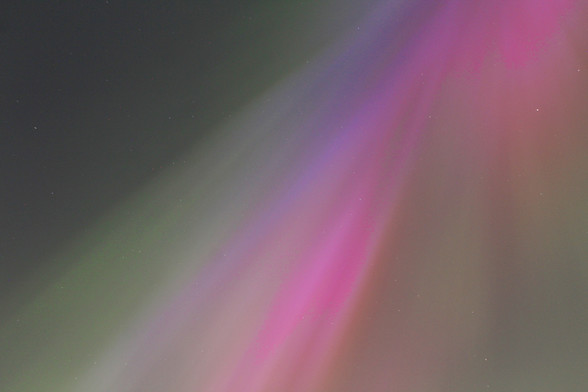
So many beautiful aurora photos going around right now. Wonder where those amazing colors come from? Here's a helpful breakdown.
When you split up the light of a typical aurora, it looks like this.
Many colors from just nitrogen & oxygen!
https://www.swpc.noaa.gov/content/aurora-tutorial #aurora #space #science #nature

Colors of an aurora depend not only on which element is emitting light, but also on *where* it is.
Oxygen at high altitudes glows red; at lower altitudes it glows green. Purple nitrogen is lower still.
Atoms are complicated creatures!

Waxing Crescent Moon through clouds. 2010UT 13 May 2024. #AstroDon #Astronomy #Astro #Space #Astrophotography

Last night when I was waiting for the aurora I made the mistake of looking north. In reality the aurora was above and behind me. #AstroDon #Astronomy #Astro #Space #Astrophotography