Blubber

@Bobele
53 Followers
191 Following
81 Posts
Maternal third dose of BNT162b2 mRNA vaccine and risk of infant COVID-19 hospitalization - Nature Medicine

Analysis from a population cohort in Israel found that a third booster dose of the BNT162b2 mRNA vaccine in mothers before or during pregnancy was associated with greater protection against COVID-19 hospitalization in their infants compared to two doses.


Nature
Norwegische Studie: gestörter Energiestoffwechsel bei ME/CFS — Deutsche Gesellschaft für ME/CFS

Möglicher Meilenstein in der ME/CFS-Forschung: Norwegische Studie findet Hinweise auf einen gestörten Energiestoffwechsel bei ME/CFS.

Deutsche Gesellschaft für ME/CFS

Woher kommt die Muskelschwäche bei Post Covid? Um dieser Frage nachzugehen haben wir (@ChariteBerlin und @MDC_Berlin) in einer Studie Muskelproben von 11 Patient*innen untersucht.

"Preprint" (ohne Begutachtung) auf https://www.medrxiv.org/content/10.1101/2023.02.15.23285584v1 – hier zusammengefasst: … (1/4)

ME/CFS: Er hatte sich aufs Sterben eingestellt – dann meldete sich eine Ärztin

Jahrelang vegetiert er unter Schmerzen in einem dunklen Raum, mit der Krankheit ME/CFS findet Faraz Fallahi keinen Arzt. Er rechnet mit dem Tod – als plötzlich Hoffnung naht. Die einzigartige Geschichte eines Heilversuchs.

DER SPIEGEL

The German language has quite a few animalistic verbs:

fuchsen ("to fox") = to annoy
hechten ("to pike") = to dive
reihern ("to heron") = to puke
dackeln ("to dachshund") = to walk slowly
aalen ("to eel") = to bask
vögeln ("to bird") = to have sex
einigeln ("to hedgehog in") = to curl up
hamstern ("to hamster") = to hoard
schlängeln ("to snake") = to wriggle
stieren ("to bull") = to goggle
unken ("to toad") = to gripe, augur doom
tigern ("to tiger") - to walk tigerishly

Animaljoy our language!

Als Journalistin profitiere ich sehr von der Arbeit der Kolleg:innen, die sich in eigenen Redaktionen zusammengeschlossen haben, um Themen zu bearbeiten, die für viele Redaktionen - leider - immer noch nicht zum Alltag gehören. Deshalb spende ich genau diesen Redaktionen Geld. Auch das ist Demokratieförderung. Falls ihr also kurz vor knapp noch ein paar Euro in den Topf werfen wollt, diese Redaktionen freuen sich auf Unterstützung:
@netzpolitik_org @correctiv_org
@Krautreporter
@riffreporter
Und? Wie viele Böllerwerfer sind jetzt in Präventivhaft?
@[email protected]
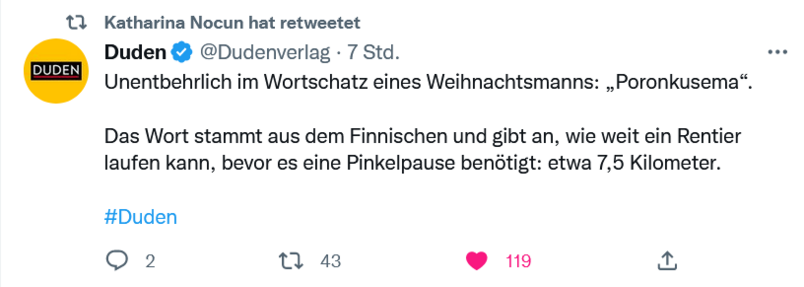
Schau mal, was für Dein finnisches Vokabular.
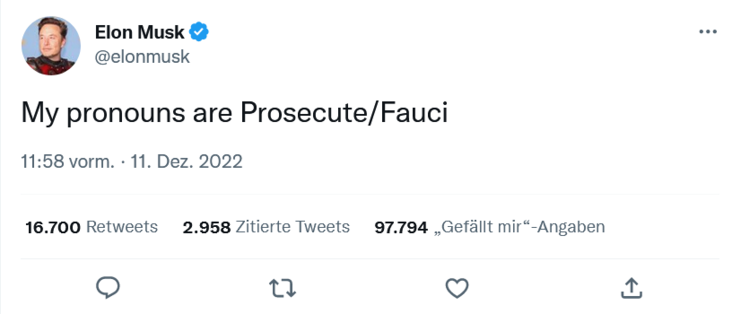
Jetzt dreht er vollkommen durch
Muscle sodium content in patients with Myalgic Encephalomyelitis/Chronic Fatigue Syndrome - Journal of Translational Medicine

Background Muscle fatigue and pain are key symptoms of Myalgic Encephalomyelitis/Chronic Fatigue Syndrome (ME/CFS). Although the pathophysiology is not yet fully understood, there is ample evidence for hypoperfusion which may result in electrolyte imbalance and sodium overload in muscles. Therefore, the aim of this study was to assess levels of sodium content in muscles of patients with ME/CFS and to compare these to healthy controls. Methods Six female patients with ME/CFS and six age, BMI and sex matched controls underwent 23Na-MRI of the left lower leg using a clinical 3T MR scanner before and after 3 min of plantar flexion exercise. Sodium reference phantoms with solutions of 10, 20, 30 and 40 mmol/L NaCl were used for quantification. Muscle sodium content over 40 min was measured using a dedicated plugin in the open-source DICOM viewer Horos. Handgrip strength was measured and correlated with sodium content. Results Baseline tissue sodium content was higher in all 5 lower leg muscle compartments in ME/CFS compared to controls. Within the anterior extensor muscle compartment, the highest difference in baseline muscle sodium content between ME/CFS and controls was found (mean ± SD; 12.20 ± 1.66 mM in ME/CFS versus 9.38 ± 0.71 mM in controls, p = 0.0034). Directly after exercise, tissue sodium content increased in gastrocnemius and triceps surae muscles with + 30% in ME/CFS (p = 0.0005) and + 24% in controls (p = 0.0007) in the medial gastrocnemius muscle but not in the extensor muscles which were not exercised. Compared to baseline, the increase of sodium content in medial gastrocnemius muscle was stronger in ME/CFS than in controls with + 30% versus + 17% to baseline at 12 min (p = 0.0326) and + 29% versus + 16% to baseline at 15 min (p = 0.0265). Patients had reduced average handgrip strength which was associated with increased average muscle tissue sodium content (p = 0.0319, R2 = 0.3832). Conclusion Muscle sodium content before and after exercise was higher in ME/CFS than in healthy controls. Furthermore, our findings indicate an inverse correlation between muscle sodium content and handgrip strength. These findings provide evidence that sodium overload may play a role in the pathophysiology of ME/CFS and may allow for potential therapeutic targeting.

BioMed Central