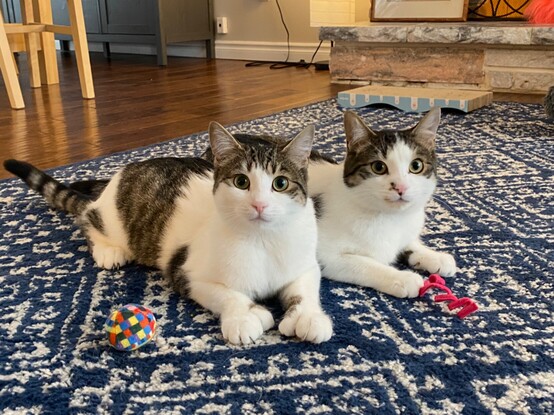
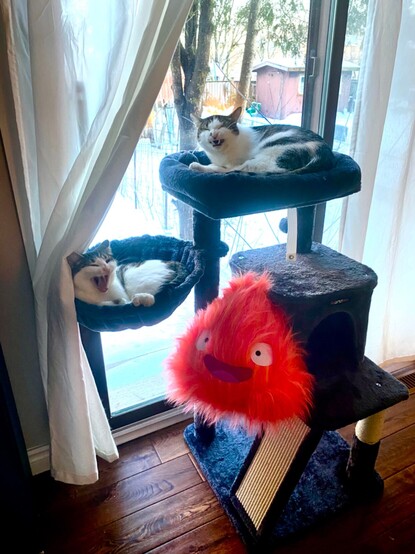
Sophie the cat, using her thumbs for good.

Sketchiness at the journal "Symmetry"
In January, a special issue of Symmetry published an article on perception of unit charts. Exactly my interest! But the more I looked, the more problems I found. Then, a "correction" made it worse. 🧵
https://www.mdpi.com/2073-8994/15/1/219#

Unit charts are a common type of chart for visualizing scientific data. A unit chart is a chart used to communicate quantities of things by making the number of symbols on the chart proportional to the number of items represented. An accurate perception of the order of magnitude is essential to evaluating whether a unit chart can effectively convey information. Previous studies have primarily focused on perceptual properties at small order-of-magnitude scales or the efficacy of pictographs in unit charts. However, few researchers have explored the perceptual effectiveness of unit charts when representing large orders of magnitude. In this study, we performed a series of sampling measurements to investigate the visual–perceptual characteristics of unit charts when representing asymmetric interactions such as large-scale numbers. The results showed that under the restriction of the current conventional display medium, unit charts still offer a significant advantage over bar charts in a single-scale visual overview. However, this comes at the cost of a longer response time. Although this study constitutes basic research, accumulating evidence about how people reason about magnitudes beyond human perception is critical to the field of information science. This study may contribute to understanding how viewers perceive unit charts and the factors that influence graphical perception. This article provides some specific guidelines for designing unit charts that may be useful to visualization designers.
Small plea: please stop bringing-up heavy-bottomed fonts whenever accessibility for dyslexic people is being discussed, especially if you are not dyslexic, because it is limiting discussion.
These heavy-bottomed fonts get a lot of attention paid to them, but there is no peer reviewed evidence for them being helpful for dyslexic people of any age or reading ability.
They are preferred by some dyslexic people, but for others they actively hinder readability.
Our semester is starting to wrap up (they're only 12 weeks long, and start in early January), so my History of Psych students are getting the setup lecture for their last week's readings on Monday.
We'll be talking about the potential future, and they'll be reading some of @timnitGebru 's work, because I think it's critical to have in their heads as we talk about ML and AI and their implications.
You know you're a vision scientist when a friend has used your face as a stimulus.
...or when you discover your PhD *advisor's* face in a stimulus set.
Having a skunk express its displeasure at the universe somewhere in the front yard at 0330 was not what I needed.
Yes, that will wake me up from a sound sleep.
 Steve Haroz (@sharoz on 🐤)
 Ann 🧡 (she/her)