
5 Followers
79 Following
35 Posts

Cybersecurity researcher.

#NoUseByLLMs
#NoBot
#NoAI

Auto delete after 1 week

the reach is broad: from civil servants to fashion models, from data workers to screen writers, from nurses to warehouse workers — employers everywhere are eager to leverage new technologies to re-configure the domestic and global economy. In these intersections, worker organizing has and will continue to overlap with broader struggles, including racial, immigration, and environmental justice, struggles that necessitate research that cuts across any individual labor sector. Using this framework, we must develop a clear worker-first agenda that foregrounds human working conditions, not just the advancement of AI industry objectives.

tech workers are being forced to answer the question which side are you on? they are giving the wrong answer so far.

The history of AI and automation has long been rooted in political projects of sorting hierarchies of labor often along the lines of gender, race, and class. Societally devalued labor is particularly vulnerable to flawed AI deployments, enabling “AI failure loops” wherein poor design and integration further entrenches and justifies the devaluation of occupations like home health care, K-12 education, and social work.83 Many of the most vaunted applications of AI specifically target the automation of occupations that are racially stratified, often highly feminized, and societally devalued: teachers, care workers, clerical and administrative staff, nursing and parahealthcare workers, public sector workers, creative professionals, customer service workers, and gig platform workers.

Amen. If you're a tech worker in love with the orb, you join the history of labor hierarchy on the side of the hierarchy. An ounce of class solidarity could instead end up saving your own ass.

Workers’ explicit and tacit knowledge, their expertise, and their digital likenesses are increasingly used to train AI systems. [...] Legal scholar Ifeoma Ajunwa uses the term “captured capital” to describe how worker data has value for employers beyond merely automating workplace management [...] These are not merely efforts to augment labor, but to wholesale co-opt professions and profit from the semblance of expertise.

There is a long history of workers taking the lead to professionalize their craft like electricians who developed training and apprenticeship programs as well as collectively bargaining for safe and fair working conditions. [...] The International Brotherhood of Electrical Workers was formed, first and foremost, to develop safety standards for people working with this new technology. [..] Similarly, information workers like librarians have an ethical mandate to ensure that the public has access to trustworthy and accurate information, which has led to professionals developing new protocols to counteract the flood of low-quality, AI-generated records.

don't you fucking dare train your replacement. if you're an information worker too shy to think of yourself as a worker, now's the time.

When AI companies operate in this way, they are also aided by the fact that building, training, and deploying AI systems requires vast workforces, resources, datasets, and finances available only to a very small number of big tech companies. Employers often do not have the resources to invest in fit-for-purpose AI tools, instead turning to off-the-shelf commercial tools whose generalpurpose architectures shape the contours of their implementation.

For workers, this growing centralization and control may obscure avenues for decision-making, increasing vendor lock-in that makes it difficult to wean off technologies or consider alternatives. Recent Amazon Web Services and Cloudflare outages (which took down the entire website for Medicare) have also highlighted the fragility of concentrating infrastructures within a handful of big tech companies.

For anyone that might have ever presented themselves as giving a shit about the political core of what gets tossed around as "decentralization," a distribution of power that intends to undermine avenues of extraction and dominance, an embrace of "AI" is a laughable punchline to the lie.

Within the public sector, agencies may implement AI tools under the guise of handling increased workloads and easing administrative burdens.Yet administrative burdens themselves are often by design: public administration has long implemented complex bureaucratic hurdles like means testing and demanding paperwork to create roadblocks that impede access to public benefits. [...] In other words, policymaking often produces the problems that AI is then purported to solve.

AI-driven efficiency metrics can serve as a smokescreen for deeper structural problems — such as chronic understaffing, disinvestment in public services, and intensifying labor extraction — by presenting AI adoption as a technical solution to fundamental political and economic challenges. [...] Within the healthcare sector, insurers have employed genAI to speed up claims denials, while hospital administrators have done the same to generate appeals to those denials. [...] In other words, AI-driven efficiency may simply be a means for many workers to run as fast as they can to stay in the same place.

The belief that "AI sets us free" from labor is ahistorical and ignorant to the systems that yoke us to corporate labor in the first place. The conditions that make labor so precarious are the only conditions that could make a massive shroud of bullshit seem appealing in comparison. You think you're running faster but that's just the treadmill being ripped out from underneath you.

AI investments, domestically and abroad, are supported by a federal government intent on the idea of AI dominance. The US AI Action Plan has signaled that any limitations placed on tech companies, including those addressing harms to workers, would be deemed an impediment to innovation, instead opting for industry-led self-regulation, a tightening fusion between public institutions and private sector tech companies. [...]

At the 2026 World Economic Forum, Alex Karp, the CEO of Palantir, asserted that advances in AI would eliminate the need for most immigration to the US. Nvidia’s CEO Jensen Huang echoed this sentiment, stating that “AI immigrants” (as opposed to actual immigrants) were the solution to labor shortages in industries like manufacturing and health care. [...]

https://datasociety.net/library/last-place-in-the-ai-first-economy/

Reading "Last Place in the AI-First Economy"
via: https://labor.dair-institute.org/

The only reason that you would set an amount of wealth that is impossible to recoup on fire to force a technology is if you are assured that you are too big to fail. That the project of gutting labor power, dissolving the capacity for people to make sense and organize together, and concentrating information itself into so few hands could be so stupendously extractive that it renders all the wealth accumulated so far irrelevant.


Last Place in the AI-First Economy

Data & Society
It amazes me that people have no issue with supporting paedophiles as long as they are an artist/movie/pop/rap star.
@dansup Drake lost so hard he filed a law suit to stop himself from losing so hard and it didnt work. He's still mega rich so there's that but he's not even close to actually being one of the most talented of all time, just an Industry plant where the timing worked out really well for him but even more so for his record label.

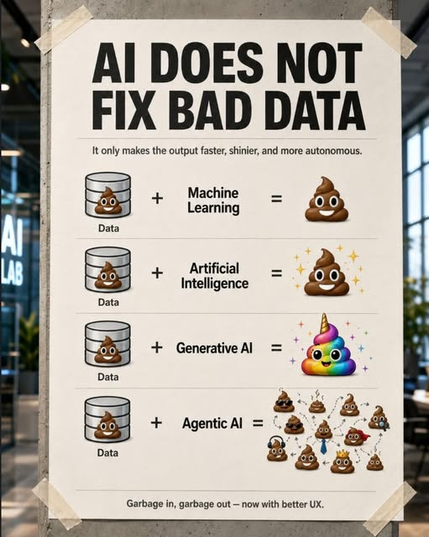
Garbage in, Garbage out. Mit KI nur hübscher und teurer.

(geklaut, wegen fehlender Bildbeschreibung)

#AI #AgenticAI #genai