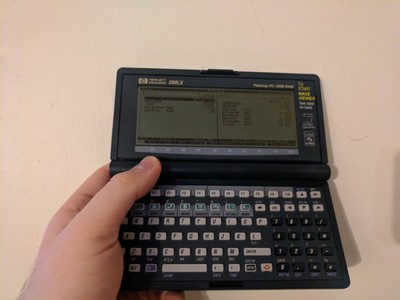
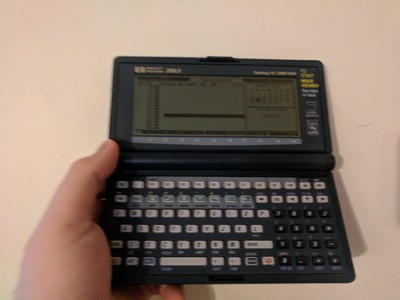
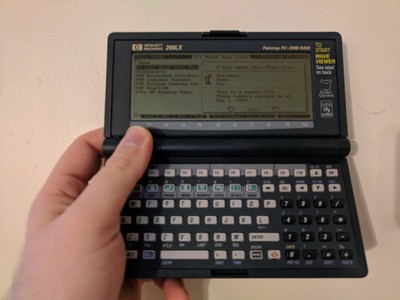
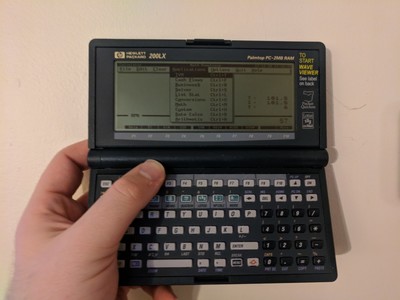
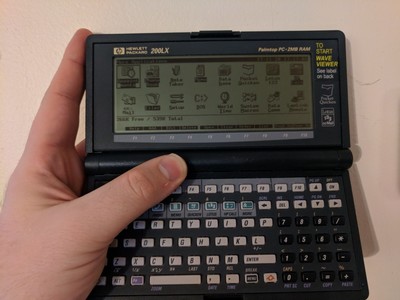
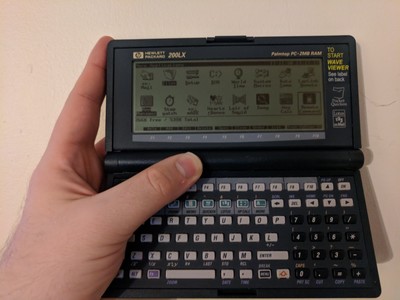
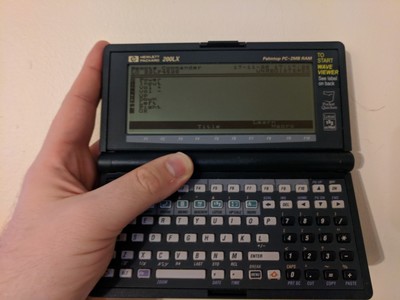
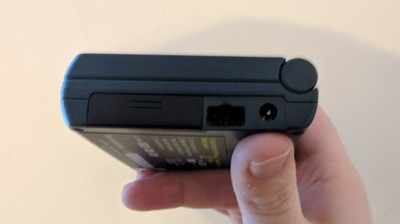
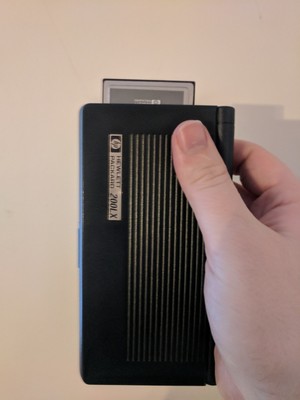
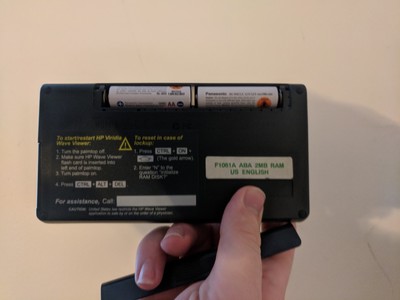
It's #retrocomputing time, and this time, I'm going to post one of my own retrocomputers.

Say hello to my #HP 200LX, one of my favorite #handheld #computers.

A basic rundown of the specs:

* 7.91 MHz Intel 80186
* CGA-compatible graphics
* 1-4 MiB RAM, 640k conventional, the remainder is a RAM disk (mine has 2 MiB)
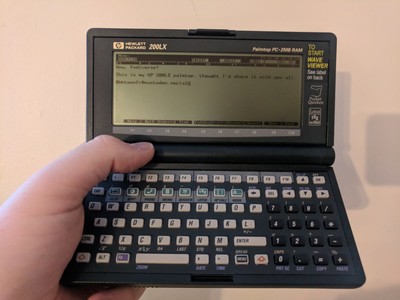
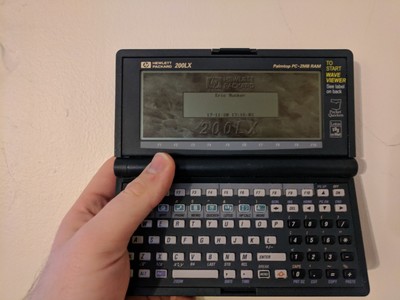
https://mastodon.social/media/jk30gLkEj55lyXsnFmQ

#umpc #handhelds #computers #DOS

The HP LX family of #palmtops was far from the first to run DOS, though - the DIP Pocket PC (aka the #Atari Portfolio), the Poqet PC, and some others come to mind - but I'd argue that it was the best thought-out of them.

Most DOS palmtops were, at their heart, DOS machines first - you usually got a bare minimum of PDA functionality in the form of a TSR, but they expected you to run DOS applications to actually do anything.

HP did things... differently here, mainly thanks to #Lotus.

Lotus was developing a DOS-based personal information manager (PIM) intended for a PDA, but they weren't in the hardware business, and looked for hardware. Simultaneously, HP's calculator division was designing a DOS-based PDA, the 95LX, but hadn't gotten to the software yet.

Ultimately, Lotus designed the 95LX's System Manager and databases, with HP contributing an implementation of their RPN calculator.

The 95LX, however, was not fully PC compatible due to a low-resolution (240x128) screen, something that HP rectified with the (higher resolution, 640x200) 100LX.

With a rewrite of the System Manager's database system, HP released the 200LX. In my experience, especially for 1994, this is a /very/ solid PIM - as good as any other PDA of the time, nearly as good as, say, a Palm OS device.

I should probably post some screenshots.

The view when it starts up: https://mastodon.social/media/uwsShxRgs0okDLny6u0

2-pane file manager: https://mastodon.social/media/ejMQQmfkRFFXoQ9BaOU

Appointments: https://mastodon.social/media/oLK3rBopGmrK0dsyuf8

Phone book (note there's some skeuomorphism - also note that one of the default entries, the HP Palmtop Paper, is a third-party newsletter, from a company that still exists today, and still serves the HP LX community - http://www.palmtoppaper.com/): https://mastodon.social/media/R4MwpMMd__AIL9_TAF0

The Hp Palmtop Paper Online

HP Palmtop-We buy, sell, repair, upgrade 200LX, 100LX, 1000CX palmtops

And a few more screenshots.

HP Calculator, showing pull-down menus: https://mastodon.social/media/t9c1pfWwwS1S1W77Dw8

Application Manager (note all of the highlighted applications, this thing is multitasking!): https://mastodon.social/media/Djwf4dx8F2mNB9L4uEs

A second Application Manager screenshot - I've got the hidden Hex Calc app in there, as well as a third-party remote app: https://mastodon.social/media/zJyF2MT2CScIYQ_9Sf8

And, let's look at that third-party app, this one written for the 95LX, hence the weird font: https://mastodon.social/media/3VfsMrqJJt9Qe0LWxXI

So, this was a legit /good/ PDA on the software front. You could use this and barely know that it's DOS, and get tons of value out of it. Or, you could use it as the pocket XT that it is, and run almost any DOS program that would run on an XT.

But, while I love it for its software, I also love it for its hardware.

The thing feels /solid/ in the hand, while being - for the era, anyway - rather compact.

The screen is quite readable in low light, even without a backlight. (It could use more contrast when displaying grayscale - some DOS games are unplayable as a result - but for most things, it's great.)

The keyboard uses the rotate-and-click hinged key mechanism that HP's calculators used, providing fantastic tactile feel. The layout isn't the best, but the key spacing means thumb-typing is rather easy.

The 200LX offered a decent amount of connectivity, too.

Infrared (pretty powerful, too - it works as a remote, after all) and RS-232 (proprietary connector, with a good terminal app in the PIM) on one side: https://mastodon.social/media/BDeniAqYqZ3UnAOpQhg

PCMCIA Type II on the other side (although HP went their own way for the software for PCMCIA, and compatibility with cards, especially ones that aren't memory/flash cards, is poor as a result): https://mastodon.social/media/6ndsci4i_rtUtULMq1w

And, finally, all of this lasts for weeks or even months (I recharge the Eneloop batteries in it every 3-6 months) on a pair of AAs: https://mastodon.social/media/224y_6KmhUGJF1puLHk

Oh, and did I mention... this was in 1994? And MSRP for a 1 MiB model was US$549, 2 MiB was $699 at launch, per V3N4 of the HP Palmtop Paper: http://www.hpmuseum.net/pdf/TheHPPalmtopPaper_V3N4_68pgs_Jul-Aug94_OCR.pdf

Also apparently I forgot that Pocket Quicken was an addition to the software for the 200LX. And, I didn't forget to post a screenshot of Lotus 1-2-3 - it's just not interesting, because it looks just like it does on a DOS PC.

But, the story didn't end there.

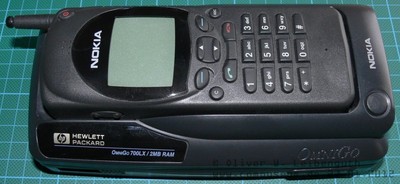
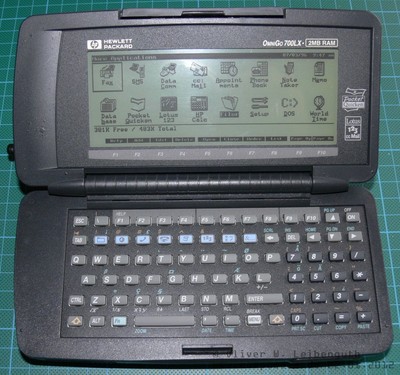
The 200LX hardware got reused in the (bulkier) OmniGo 700LX, which had a dock for a #Nokia 2110 or 2190 in the lid - and it could use the Nokia phone for fax, SMS, and Internet access, turning the HP LX into a full-on smartphone (not my photos, I don't have a 700LX, so I stole them from here: http://blog.compuseum.de/dummy-nr-31-hp-omnigo-700lx/). https://mastodon.social/media/8SowniYbtcqB0SXc4l8 https://mastodon.social/media/NTdB-fYW92PXnAdJ0nI

Dummy Nr. 31: HP Omnigo 700LX | Olivers virtuelles PDA-Museum

Olivers virtuelles PDA-Museum

Now, there's a point I want to get towards. I've realized that, with form factor optimization, this is ultimately my ideal for a #smartphone.

Give me something that fits in my hand, performs like a 10 year old desktop, has compatibility with desktop-experience operating systems... and has a dumbphone attached to it, and somewhat independent of it.

Myself, I'm a #Windows user, and I actually think MS has done enough work on the tablet experience that this idea just might be usable, too...

Note that there's ways to make #Linux or another *nix play well in this environment, too, though - Nokia's work on #Maemo may be worth revisiting.
@bhtooefr I loved my N800 and N900. I'd still use my N900 if it had patched SW and more RAM. (256 MB RAM, but 32 GB flash.... seems legit)