I’ve been experimenting with my newish solar battery

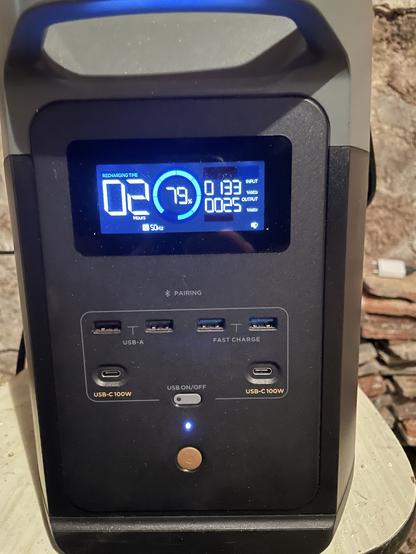
Represented here is the end of the charge cycle yesterday at about the same time the sun started to set

I’ve been powering the freezer with this 2 kWh battery, and every morning there is ~50% charge left, and so far every day I get it up to 90% (by choice) from solar alone

I can also do a load of laundry or two, and some vacuuming, without being even connected to the grid (if I get the timing right)

Of course this is clear summer weather, so this won’t be the same all year

(This is far from sufficient to power the entire house, it’s just an experiment)

Essentially, 1-2 kWh that aren’t drawn from the grid on a daily basis

#solar

The experiment has been running smoothly so far

(TL;DR for today: was a bit uncertain but still managed 1 laundry and some vacuuming, in addition to the freezer)

This photo is from today at 1pm, because this morning the battery was much lower than usual, with a cloudy sky a few days in a row

I seemed like it was going well so I started a load of laundry, shown in the output in the photo

Two hours and a stretch of clear skies later, the battery was upwards of 70% so I got a little greedy and I did some vacuuming too, and it dropped to 40% (no surprise there)

I was hoping to get it back above 50% before the sun rays stop shining on the panels, so that it can last the night for the freezer

Seems that I am in luck, it’s now 5:30pm and the battery level is at 60%, cloudy skies again but charging a little regardless, and I only need a half charge to tie it up with tomorrow’s first rays (if they are on time)

#solar

A little bit of a hiccup today that, in hindsight, I really should have seen coming [1]

Outside temperatures were in the thirties (°C), so the battery, being built to protect itself against aggressive use, started rotating a fan according to the room temperature

In summary: the battery has been using additional 50 W consistently all day for cooling purposes, even after the sun set, and it actually needed recharging from the grid

/cc @solaradmin fiy watch out for this?

[1] the air-water heat pump has the same issue

#solar #HeatPump

I am feeling more confident in my little #solar experiment here

I was worried that absorbing 1-2 kWh per day (about a third of my daily use in the summer) didn’t mean anything in the grand scheme of things

I was also worried that since we have so much excess energy in the summer, my experiment was moot

But I’m coming to realize a few things

first: how I’m using my solar

I have a 2 kWh battery/generator that I can easily fill on clear days, probably even several times over

I have my freezer on this 24/7, that’s the only appliance not plugged into the grid; that’s about 1 kWh per day of background use

Sometimes I spend my work from home days outside, plugged into this battery; that’s 1 kWh per day too, spread over 8h

As for surge uses, the vacuuming and the laundry machines also haven’t needed the grid for over a month; that’s another 1-2 kWh within a few hours but not every day

The vacuuming is the most surge-like of these examples

usage spikes

I understand that usage spikes (noon & evening for example) are an issue for energy providers, especially when most of the energy comes from nuclear sources (as is the case in France)

Nuclear reactors aren’t meant for episodic production within the day, their cost is constant throughout the year and they are meant to function more or less constantly at their optimal level

Spikes mean unpredictability, and we can’t guarantee that there are enough dams, wind and solar to absorb tomorrow’s for example; which means having giant backup generators that run on fossil fuel, and I’m not in favor of those

excess in the summer at utility scale

I’m not sure how energy providers deal with excess energy produced from domestic solar and such, but if negative prices are any indication, they aren’t doing great

This is also a spike, just in production rather than use, and it’s equally difficult to deal with this problem at scale

We would need storage at scale, and we don’t have that

So… We can’t really count on excess production spikes to excuse our behavior (consumption without regard, just “because we have excess anyway”)

disclaimer

I am in no way an energy professional and I don’t work at a utility

I’m just a random trying his best

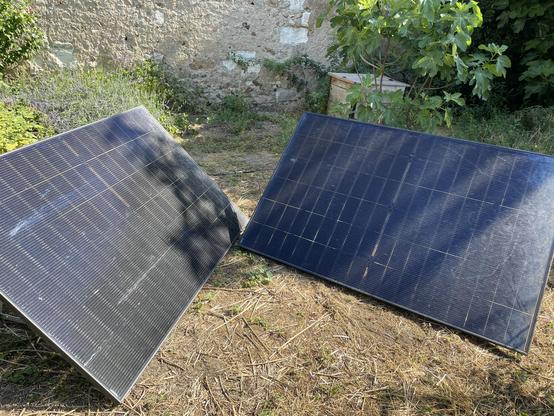
Today was very cloudy, a blanket white-grey sky, but the two solar panels were still able to eke out a little over 130 W when I was looking, and sometimes even 200 W

The panels charged most of the battery (almost 80%) by noon even while I was using it (freezer + some computer stuff)

I decided to do some vacuuming (went down to 52%) and to start a laundry

At 16h30, the battery level was back up to 75%

Cloudy days and photovoltaics are weird

#solar

I tried charging from last night’s full moon, but no luck 🤣

Here’s the latest on my #solar battery experiments

[Quick recap: two 450 W solar panels in the garden hooked up to a single 2 kWh battery, usually powering the freezer, plus laundry loads and vacuuming sessions]

I kept at it until last month (Sept) when there was a 10 day streak of thick clouds cover, and I just had to switch back to the grid

The battery was fully charged last night even after two laundry loads, then went down this morning to 30% or so (as is usual); I’m getting less and less charge every day because the sun is at a lower angle now; nights are longer

But today the clouds were too thick and the charge only went up to 45% at the end of the day, with only the freezer to provide for

This is not much to draw conclusions from, and this particular setup isn’t a viable way to save money, but it does avoid spikes

(2023 was an outlier and I don’t have the numbers before that)

We are nearing the end of the cold season here, so I have a better understanding of what it means to follow the sun’s schedule for my energy needs

[Quick recap: I have two 450 W solar panels in the garden hooked up to a maybe 1 kWh battery, which lost some capacity from 2 kWh originally]

First, I don’t have much capacity or storage, and at the same time my heat pump draws a lot of power in this season. So the heat pump will be left out of this.

challenges of a grid

My understanding of the requirements of running a national power grid is limited.

I do understand that one of their challenges is to be able to absorb spikes, for example when everyone starts preparing lunch in the same general time bracket. They built systems to buffer some amount of excess energy while they spin up or down production, so they can adapt to an extent.

Predicting lunch break is an easy task. The amount of additional power that needs to be produced, not so easy to guess exactly, but doable.

Now if a lot of people started using their most powerful machines at home at the same time, that would be a problem for the grid because there isn’t a way to predict this at all.

There is also the issue that the grid has a maximum throughput capacity. If we started using all our equipment at once, then even with advance warning, the grid wouldn’t be able to accommodate the demand. The grid would have to stop powering certain things, possibly entire neighborhoods, just to stay online.

In fact there are talks and plans to enable the grid to shut down some home appliances remotely when the energy load is too high. Your dish washer can be paused to preserve the grid.

I accept that but I also think there is another way.

how a little home system can help

All I’ve been powering this winter with my solar panels were the work laptop + additional screen, plus my washing machine and vacuum cleaner.

The last two are the most power hungry machines in my home (except for the heat pump) and I’m happy that my little system can offset that, and reliably too.

how it’s been doing in the winter

My panels haven’t been absorbing nearly as much light as in the summer, due to lower orbit and nearby roofs. The days are much shorter.

In December I couldn’t often get the battery to even a full charge in one day, while in the summer, I could get at least three full charges every day.

More panels would have helped, and more battery too.

heating

The heat pump stays completely out of range of this kind of system. The order of magnitude is just too great.

I would need about 100 of the batteries that I have, just for one day of heating at 0°C outside temp. And of course the same for the panels, and aside for the cost, I just don’t have nearly the space for 200 solar panels.

And beyond that, I’d need storage for extended clouds cover.

So, just no.

financial considerations

The plug and play solutions like the EcoFlow that I have are much too expensive to be useful to the grid, in the way that they could be useful if priced differently.

I paid upwards of a thousand EUR for two panels and a battery that is already damaged one year in…

This won’t take off as a product. We’d need something that could conceivably be installed as cheaply as any appliance.

policy considerations

There is an opportunity here to avoid having to entertain telling people “we need to shut down your dishwasher and stuffs remotely this week”

A system like the one I’ve been using, but refined and optimized and with regulatory help, would be a much better solution

#solar #resilience #energy

An entire year of fiddling with this battery and two solar panels and I’ll stand behind my last post

This is not a good financial move

  • at perhaps 1 kWh per day, maybe 2
  • at 0.14 €/kWh
  • that’s €50/y
  • ROI is probably around 20 years
  • the battery is unlikely to last that long

This is at best a way to avoid hitting the grid for every little thing… And that’s good enough for me, but it should be much cheaper

#solar #energy

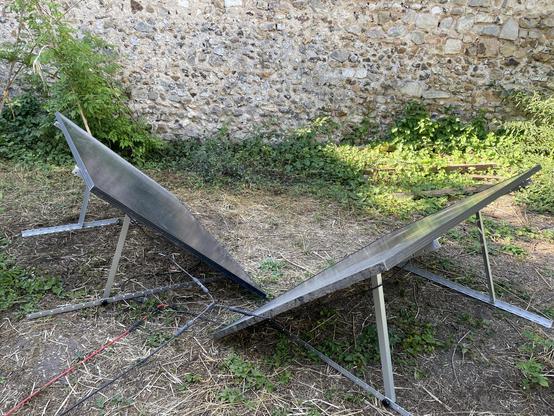
I’ve had my panels propped against the wall for a while (probably last fall, since I set them up vertically) and I thought it was time to try something else

I got some supports and I’m trying to get an angle for longer yields, rather than optimize for best throughout but limited time

The new setup does eat up a big chunk of the available space, and I don’t know that I will tolerate that for long

#solar #SolarPunk

I was way off with my numbers

First, I checked the sticker on the panels and they are 400W each

Second, I currently have them plugged into the only solar port directly on the battery, which caps at 460W or something, while I could wire them to the provided inverter (2 inputs) and use their full potential

So this isn’t 1-2 kWh per day at all, this is 400W * 8h per day with my current setup (that’s over 3 kWh), and likely at least +50% once the new wires arrive

I could almost power the entire house off of these two panels, in the summer

I’m reasonably sure that with some clever engineering to reposition them to follow the sun automatically, I could just about tie it over (at least in the summer with clear weather)

I am also reasonably certain that 16+ panels, which is usually quoted to me, is a tad overkill

#solar

@GuillaumeRossolini Mechanical trackers tend to not be economic, vs. buying more panels. But space constraints could affect that.
@donburi yes indeed, space constraints in my case