It kind of seems like if a city wants to have good bike infrastructure, there should be a mandated policy to city planners that everything should just be done the way Amsterdam does it, and only diverge from that if there's a documented really really good reason.

Going on more long urban bike rides this year in my own city, which has actually developed pretty decent infra in recent years, I'm just kind of struck by how inconsistent even the good parts are from one area to another. Like they're constantly reinventing the wheel with every new stretch of bike lane or intersection.

Which isn't just confusing for cyclists. I imagine it's pretty confusing for pedestrians and drivers who have to interact with it too.

@megmac

Yeah we need consistent policy. I feel there are several ‘legacy issues’ embedded deep in the admin side of city hall - people who worked up the ranks ages ago, have negative opinions about all this new stuff they’re ‘supposed’ to do, make a half effort but don’t really engage and half expect it to fail. If you don’t really value it, you won’t grasp the core concepts that make it hold together.

<imho … based on little more than intuition and listening to the news>

@DavidM_yeg @megmac Some of that old thinking, and even newer planners do it, is that SUVs come first and bike infrastructure has to be crammed into the leftover scraps of space. It also cannot delay drivers or hurt their feelings.

Also, I really think there’s a saboteur who makes something about every bike project crappy.

@geodarcy @DavidM_yeg @megmac
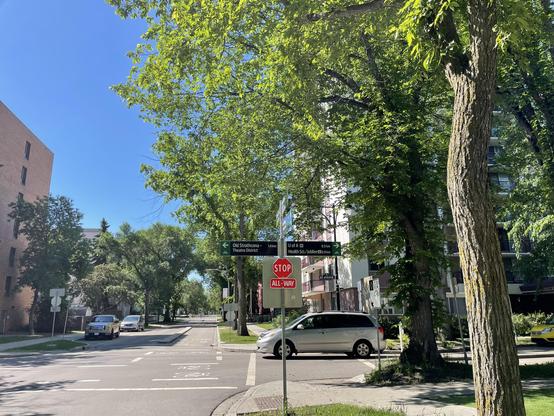
But there are some excellent stretches, now! I could go run errands easily and safely this week. Wayfinding has improved a LOT in recent years, with excellent signage and bike detectors at most intersections. For some reason, U of A doesn't seem willing to play along, and it's a mess to get in and out of the university.
#YegBike #BikeTooter

@EllenInEdmonton @geodarcy @megmac

A stark contrast to the crumbly incomplete concrete lumps and flexiposts dropped into my neighbourhood.

Based on the rate of attrition, flexiposts must have some kind of powerful bumper magnet in them.

@DavidM_yeg The wonderful thing about flexiposts on movable concrete dividers is that they're as quick to install as paint. But that means the drivers don't have months of cursing at construction to get used to the idea that there's going to be a bike lane there!

And even in neighbourhoods where there has been construction & careful design, there is still the inconsistency issue @megmac mentioned. Like 106 St in Old Strathcona switching from separated bike lanes to bikes on extra-wide sidewalks, then a mix of bike lane on one side of the street & wide sidewalk on the other. And then you turn onto the two-way bike lane on 83rd Ave.

@EllenInEdmonton @geodarcy

@AmeliasBrain @megmac @geodarcy @EllenInEdmonton

Yes, at some point we need to move beyond experimentation and interative design with a revoving set of contractors and set some solid clear parameters, policy and expectations about this stuff. We’re not blazing a new trail here, we should be able to learn from others. At some point consistent and good is better than inconsistent and variable but with a shining perfect block somewhere. 🤷‍♂️

@DavidM_yeg @AmeliasBrain @megmac @EllenInEdmonton The City has all the policies already. Some policies could be better but, from my experience, admin gets away with ignoring the policies making exceptions. They always have an excuse of why they cannot follow the policy. The usual excuse is because drivers’ feelings might get hurt

@geodarcy

cf hide-bound obstructionist numpties practically or ideologically unwilling or unable to change

@EllenInEdmonton @megmac @AmeliasBrain

@EllenInEdmonton @geodarcy @DavidM_yeg @megmac
In older (read: 2+ years old) infrastructure, the bike detectors seem to be based on metal detector loops in the ground. They can be finicky it seems - a heavy old clunker with steel rims gets detected reliably, but the less metal the bike is made of, the less reliably it's detected.

(...)

@EllenInEdmonton @geodarcy @DavidM_yeg @megmac
... but in the stuff they've built in the last year or two, they're using cameras with some kind of image recognition. And they're really unreliable. I'd say they recognize me as a human on a bicycle less than half the time.

@megmac @EllenInEdmonton @geodarcy @dragonfrog

Yeah, that seems like a poor choice. To my mind, the fact that it’s needed is an admission of failure… ultimately, we should design infrastructure that protects people without the need for any system like that (old or new)

@DavidM_yeg @megmac @EllenInEdmonton @geodarcy

I guess? I mean, I wouldn't say a car-activated traffic light that is always green unless a car approaches from the side street, or a pedestrian-button activated traffic light, is necessarily an admission of failure - unless the existence of a traffic light itself at an intersection is an admission of failure.

A traffic light that
- isn't on a timer but needs activating
- can't be activated by everyone
... that's a failure for sure

@dragonfrog

Not exclusively, no; …but usually.
That bikes travelling E-W along 83 Ave appear to give priority to N-S vehicles and need a dedicated traffic signal to remain safe is definitely an infrastructure failure given the context. Maybe it’s the best that can be done *for now* but its mostly a band-aid to a deeper deficit.

@geodarcy @EllenInEdmonton @megmac