 Brighid's Ogham Grove
Language Barriers (Barrier de la langue) by Veronica Smith
As an English-speaker living in France, it makes sense to learn the French language. That is not just essential for every-day tasks, like going shopping and making appointments (prendre un rendez-vous) but also for dealing with my old bug-bear, French bureaucracy – which even confuses native French speakers!
Occasionally I get my own back on officials. When they ask for my original documents, such as my birth certificate, a little smile comes over my face! They automatically assume that I am British but I come from the Republic of Ireland and my birth certificate and all my documentation appear in two languages: Irish and English.
Gaelic was reinstated as the official language of the Irish Republic after independence from Britain in the early 20th century. Under the British regime, native languages (including Irish, Manx, Scottish and Welsh) were discouraged in favour of English, the language of officialdom. So by the twentieth century, Irish was no longer commonly spoken and became an obligatory subject in the school curriculum. Today, Irish is one of the many regional languages recognized by the European Community.
Irish Gaelic is a Celtic language, coming from the same branch as Scottish Gaelic, although Welsh comes from a different Celtic branch. I have friends from Brittany, who can understand the Welsh language (but not Irish) because Welsh is akin to their own Breton language. That has everything to do with history – but I will save that for another post!
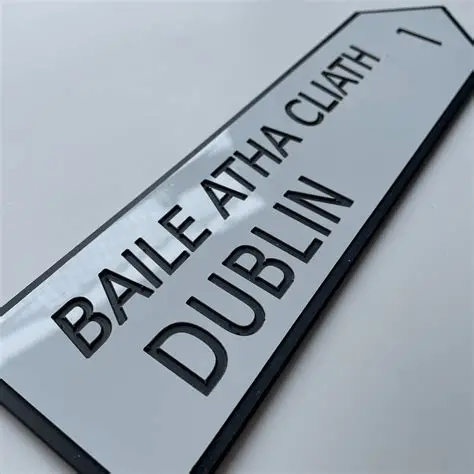
What confuses French officials the most is the name of the place where I was born. In Irish, that is Baile Atha Cliath. Comment??? Then they see the English version beside it: “DUBLIN”! There are sighs of relief. Many of them have been on a weekend city break to Dublin, so they even know where it is!
I wish I could say that I am fluent in the Gaelic language but unfortunately, I only have enough to get by, a bit like my level of French! Nevertheless, these two languages are very much part of my life.
Here on Continental Europe, it is common for people to be multi-lingual. If you have a bit of German, a bit of Spanish, a bit of French, a bit of Italian, then you can easily get by and even work out some of the other related languages too, such as Dutch. That is because we all share the Roman alphabet.
The further east you go, then you start to encounter different alphabets, such as Greek, Arabic, Hindi, Chinese. A friend of mine, who is in her 80s, recently visited Japan on her own and immediately got in to trouble because she could not understand the directional signs: they were all in the Japanese script! As Ursula pointed out, we tend to take it for granted that everything will be in the “international alphabet” of the Roman script, when it is arrogance to expect other cultures to give up their own languages.
Let’s face it: language is not just about communication but also about cultural identity.
Parlez-vous ma langue?
An féidir leat Gaeilge a labhairt?
Do you speaky English?!
ENDS Veronica Smith first published 24th June 2026
#culturalIdentity #dailyprompt #dailyprompt2802 #FrenchLanguage #greekScript #IrishLanguage #languageAndCulture #languages #romanScript