 Phil Stooke
A Canadian team, Plan B, suggested a landing similar to Luna 9, landing at sunrise. It would slow until just above the surface, the engine would be discarded and the spacecraft would fall to the ground, cushioned by airbags. A landing video would cover the entire braking phase from 4 minutes before landing to 1 minute after. If the landing occurred in darkness, LED lights would be turned on for the last few seconds before landing to record the airbag deployment.
#moon #GLXP
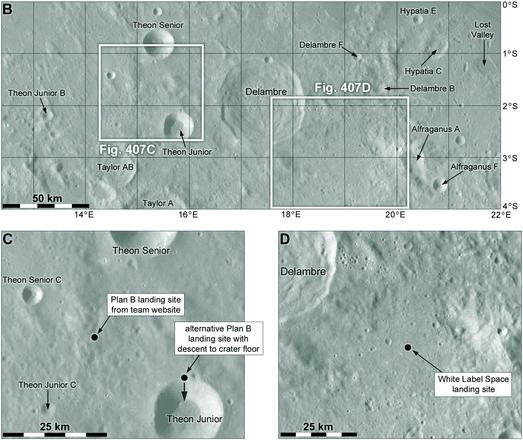
The Plan B site was at 2 S, 15 E, south of Mare Tranquillitatis, only 150 km from the White Label Space site. Two craters, Theon Junior and Theon Senior, lie within 30 km to the east, each about 18 km across and 3 km deep. If the landing site was moved to 2.1312 S, 15.7745 E on the rim of Theon Junior the rover might descend the inner slope, travelling about 5 km in as little as 8 minutes, taking video all the way to observe the geology from rim to floor and record the descent.
#moon #GLXP
#moon #GLXP
A GLXP team from Pennsylvania State University, 'Penn State Lunar Lion', would fly a lander called Lunar Lion (after the university sports teams). In 2012 they announced that their primary landing site was at Apollo 11 and a secondary site was Apollo 12. In 2014 this was refined to a point 30 km north of the Apollo 11 site, and the team hoped to image the Apollo 11 LM descent stage (during their descent?) to win the Heritage Prize. I don't know more about them.
#moon #GLXP
#moon #GLXP
Angelicum was from Argentina. Its small rover was called Dandelium for its open basket-style wheels which resembled a dandelion seed. In 2012 Angelicum signed an agreement to fly their rover as a payload on the Omega Envoy lander. After the lander released its own Sagan rover to win the GLXP, Dandelium would be released to win the second prize. Later the rover was referred to as Unity. In 2015 the team announced it would fly with Astrobotic. This did not happen.
#moon #GLXP
#moon #GLXP
Sorry - forgot to mention I would be off grid for a couple of days. We are nearing the end of our Catalogue of Teams for the Google Lunar X Prize. Today's team is Team Indus, and there is quite a lot to say about them, so this will go over several days. They were from Bangalore, an important hub for space in India. They first planned to deploy 2 or 3 small rovers from one lander, for the basic prize plus long range driving or night survival (secondary prizes).
#moon #GLXP
#moon #GLXP
A possible landing site from the team’s website early in the competition was in Sinus Medii at 0.50° N, 1.50° W, but this preceded any detailed analysis. A 2014 study described a lander carrying a UV telescope to a site at 38.336° N, 26.006° W in Mare Imbrium near Sinus Iridum (Figure 409A, B). This site was in the mid-latitudes to reduce thermal stress on the hardware, a common theme for lander planning in this period and used for all 4 Chinese landing sites so far.
#moon #GLXP
#moon #GLXP
A few more sites were considered for Team Indus in 2016-2019. A 2016 study mentioned landing at 35° N, 29° W in Mare Imbrium. The 2014 site was in a cluster of secondary craters and would not have been a desirable site, but the 2016 site followed the analysis of better images and is very smooth. Hakuto moved its small rover from Astrobotic to Team Indus in 2017, and a Hakuto presentation at a meeting of the Space Resources Roundtable in Montreal in May 2017...
#moon #GLXP
#moon #GLXP
... identified the landing site as 35.25° N, 29.23° W. The presenter suggested that China’s Chang’e 3 was originally intended to land at that location before moving to its actual site near Sinus Iridum. I've never seen that suggested anywhere else. This set of maps shows these various sites and leads us to a more detailed site study tomorrow. For details of these studies see my Moon Chronicle, part 8 (which now includes a few recent edits).
#moon #GLXP
#moon #GLXP
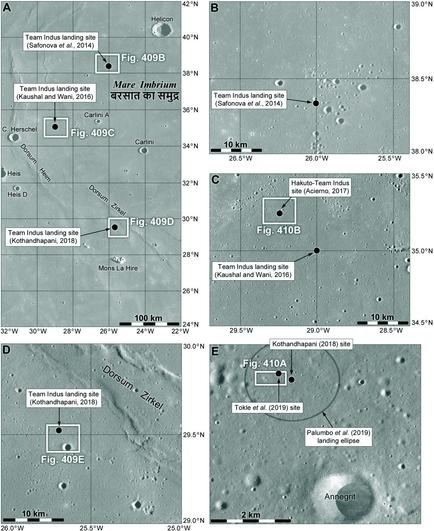
Further work on a Team Indus site used LRO high resolution elevation maps and so was limited to areas with NAC stereo at that time (2018). A NAC DEM (one of roughly 20 in the region) was one of 3 evaluated by Team Indus. The other two were at the Chang’e 3 site and near the Chang’e 5 site. A final landing site at 29.52° N, 25.68° W, near Annegrit crater in Mare Imbrium, was illustrated at a lunar landing site workshop at NASA Ames Research Center in January 2018.
#moon #GLXP
#moon #GLXP
The Team Indus rover was named ECA (Ek Choti si Asha, meaning ‘One Small Wish’). Hakuto was to fly its rover with Astrobotic, but when Astrobotic withdrew from GLXP Hakuto arranged a ride on the Indus lander. At the LEAG meeting in October 2017 it was said that their rover Sorato would operate for one lunar day, moving at least 500 m to win the GLXP. Then it would try a longer traverse, following a ‘flower petal’ pattern which returned to the lander at intervals to be imaged.
#moon #GLXP
#moon #GLXP
In March 2018 Team Indus described missions to the Moon each year tarting in 2019. The first would be to the vicinity of Annegrit crater in Mare Imbrium, landing within 1 km of the target point, carrying their ECA rover, Hakuto's Sorato rover and another from Synergy Moon. The second mission would go to the same place with 500 m accuracy and try to survive through the lunar night. The third mission would be to Shackleton crater (south pole) with 250 m accuracy to try sample return.
#moon #GLXP
#moon #GLXP
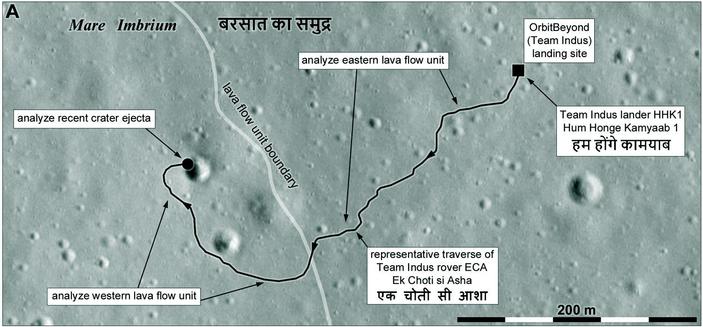
What about this landing site? What would team Indus actually do? They teamed up with Brown University's Apollo veteran Jim Head to develop a plan. The map (located in the previous map) shows their idea - analyze two different lava flows and a fresh crater's ejecta.
As the Google Lunar X Prize faded into oblivion a new opportunity arose: NASA's CLPS program. But foreign companies were unable to join it. Team Indus created Orbit Beyond in the USA to join it.
#moon #GLXP
OrbitBeyond was 1 of 3 teams given contracts to fly a CLPS mission in May 2019, and their first mission in September 2020, would be the first CLPS flight. There would have been a naming contest for the lander prior to flight. On 29 July 2019 OrbitBeyond withdrew from the contract after funding difficulties arose but (officially) remained in the running for future contracts. Here is their website: https://orbitbeyond.com/
#moon #GLXP
#moon #GLXP

Our last GLXP team, Phoenicia, was American. Their lander was 'Storming the High Heavens' and it targeted the south pole. The lander would use airbags to soften the landing. After driving far enough to win the GLXP their rover, named 'Victory at Pangaea' would spin up large flywheels to provide power during the lunar night. It would attempt a 5 km drive to win an additional prize. The team withdrew from the competition in July 2013 to work on arranging shared launches for others.
#moon #GLXP
#moon #GLXP
So there are our teams. The deadline for the prize was extended repeatedly but eventually it became apparent that nobody would be ready to fly in time. A few other groups signed letters of intent to register but did not follow through. Raising enough money was always the biggest problem, and the whole notion of prizes as a way to spur innovation lost some of its luster. The bravado of the space tech bros did not bear fruit. So what came out of the GLXP?
#moon #GLXP
#moon #GLXP
I don't want to suggest that the GLXP work was all wasted. We have seen several teams continue after the competition ended. Astrobotic got 2 CLPS awards and so far has flown one failed mission, but there's another one around the end of the year. SpaceIL flew to the Moon and crashed. Orbit Beyond won a CLPS award but had to abandon it - but still hopes for more. Puli Space developed an instrument which has flown twice on a bad landing, giving no data, but they have another...
#moon #GLXP
#moon #GLXP
... chance coming up. CLPS itself can be seen as a more serious follow-on to GLXP, funded by awards on the order of $100 million instead of the $20 million X Prize. Its results have been mixed so far but I think when we get through the difficult birth it will achieve something.
OK - where now? This sequence of posts is about commercial lunar exploration, not just the GLXP, so I think our next study will be of Golden Spike... Remember them?
#moon #GLXP
OK - where now? This sequence of posts is about commercial lunar exploration, not just the GLXP, so I think our next study will be of Golden Spike... Remember them?
#moon #GLXP
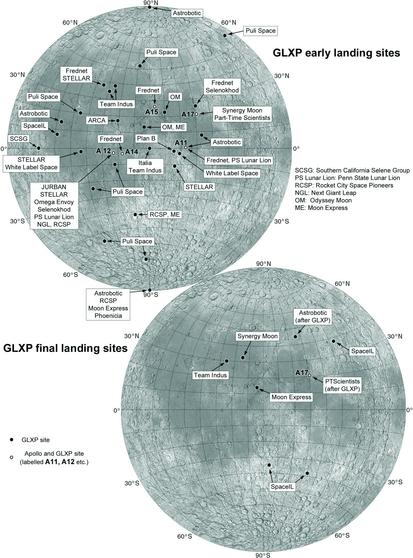
Oops, I forgot I had said I would provide a map of all GLXP sites, so here it is. First, all specific sites mentioned by the teams, and a second map showing the sites being considered at the end of the competition. If anybody knows of any other sites please let me know.
Golden Spike will start tomorrow.
Golden Spike... not the transcontinental railroad one but a space company begun by Gerry Griffin and Alan Stern. Griffin was a former Apollo Flight Director and JSC Director, and NOT the person Astrobotic's big lander is named after. Stern was a former NASA Associate Administrator for Science. Work began quietly in 2010 and it was publicly announced in 2012. I think this episode in lunar history is not as well known as GLXP so I will give more detail on it.
#moon #goldenspike
#moon #goldenspike
I am an optimist so I told Stern in 2012 that this was the best thing to happen to the Moon in a long time. But I was mistaken, as usual, and it fizzled out around the end of 2013. Its goal was to conduct private crewed lunar missions using hardware already existing or in development at that time. The first Golden Spike meeting at Telluride, CO in Aug. 2010 examined feasibility, and a 10 week study concluded it was possible. The company was set up in Delaware in Nov. 2010.
#moon #goldenspike
#moon #goldenspike
GS would use existing rockets and crew vehicles then being developed but needed a landing vehicle and EVA suits. Northrop Grumman designed a 2 crew lander nicknamed Pumpkin, with a very small return capsule taking off with small thrusters. A 2nd lander concept by ULA and Masten was called XEUS. GS designed a ‘GoldSEP’ ALSEP-like instrument package for some sites. It would work for at least 2 years powered by batteries recharged by solar panels on the lander.
#moon #goldenspike
#moon #goldenspike
Capabilities were intended to be comparable to Apollo 12 or Apollo 14, with a pinpoint landing capability and two walking EVAs which might last up to 7 hours. Two or three flights per year might be possible. The customers for these missions would mainly be national space agencies, possibly including NASA but also any other agencies around the world, but other wealthy institutions or even individuals might also purchase a mission. What would a flight look like?
#moon #goldenspike
#moon #goldenspike
Golden Spike flights were expected to cost about $1.5 billion each. At first 4 launches would be needed for each mission. 2 put the lander and an upper stage in low Earth orbit. They dock and the upper stage would send the lander to lunar orbit to wait for its crew. 2 more launches put the crew vehicle and an upper stage in orbit where they would dock and go to the Moon. The crew would dock with the lander and descend to the surface. After two Earth days on the Moon ....
#moon #goldenspike
#moon #goldenspike
...they would return to lunar orbit, dock with the crew vehicle and return to Earth. By 2013 studies showed that the 4 launches could be reduced to 2 using the Falcon Heavy or an upgraded Atlas 5. A flight test in about 2017 would check things out in Earth orbit. A second test would send a crew to lunar orbit. A third test would keep a crew in lunar orbit but send the lander down on its own, testing landing and return to orbit. The first revenue flight would be in c. 2020.
#moon #goldenspike
#moon #goldenspike
All Golden Spike landings were designed to be automated so the crew did not have to train to fly the lander. By October 2013 the plan had hardware procurement starting in 2015, test flights in 2018 and revenue flights in 2020.
After all that, let's get to the part that really interested me. As usual it was landing site selection. Tomorrow we will start to consider where these crews might go.
You found $1.5 billion under a couch cushion and purchased a Golden Spike flight. Where are you going to go? You get to choose - landing sites would be chosen by each customer, but Golden Spike initiated discussion through a crowdfunding exercise on Indiegogo.com in the spring of 2013, not to fund lunar missions but for outreach and public participation. The goal was to raise $240,000 US ($1 per mile to the Moon) but only $19,450 was collected. We call this foreshadowing!
#moon #goldenspike
#moon #goldenspike
One reward for participating in the Indiegogo event was to choose a landing area from a list of eight: Aristarchus, Copernicus, Davy crater chain, Marius Hills, Schröter’s Valley, Tycho, Plato and Dionysius, and the winner was Aristarchus. I don't know how the list was compiled.
Stern said at LPSC in 2013 that a Russian response to the Golden Spike concept had been that they could land by one of their old landers, and NASA suggested the same later.
#moon #goldenspike
Stern also said that the initial capability would be to land at nearside sites up to 75° latitude in either hemisphere, with longer stays and polar and farside site capabilities added later.
A more serious effort commenced with a workshop held at LPI in October 2013. I attended it, with a poster. It happened during one of those periodic US government shutdowns so some folk were only on screen. Lots of sites were discussed.
#moon #goldenspike
David Kring of LPI suggested numerous areas for Golden Spike landings. The dates of the youngest and oldest impact basins needed refining, so the eastern edge of the Orientale basin and older basins such as Smythii and Nectaris would be good sites. Rima Bode would provide pyroclastic samples, and Flamsteed would have some of the youngest lava flows. Impact melt from craters of various ages (e.g. Eratosthenes, Aristarchus, Copernicus, and Tycho) would date younger events.
#moon #goldenspike
#moon #goldenspike
These sound like good targets but they are not specific landing sites - careful mapping would be needed to select the best sites in those areas. Some other examples from Clive Neal were Ina, Hansteen Alpha, Reiner Gamma, and the need to sample KREEP and the youngest lava flows. He also emphasized the desirability of extending the existing laser reflector network, and attempting some in situ resource utilization experiments such as extracting oxygen from regolith.
#moon #goldenspike
#moon #goldenspike
Bill McKinnon also mentioned the anomalous volcanism at Compton-Belkovich (but it is on the far side so not an early site) and spectacular ejecta blocks on the NE rim and walls of Aristarchus which consisted of layered basalts, which conveniently allowed multiple layers to be sampled without drilling. Here are some images of those blocks:
https://lroc.im-ldi.com/images/291
Next we will look at some actual sites with astronaut EVA routes... from my poster.
#moon #goldenspike
I will look at my Golden Spike landing site study from the 2013 workshop... then we will look at other suggestions from that meeting. Here is my abstract:
https://www.hou.usra.edu/meetings/gs2013/pdf/6002.pdf
I only realized today that it was online.
The basic idea is simple. These unusual young-looking features, now called 'irregular mare patches', are interesting themselves, and more so if they have a second kind of material nearby, in reach of a walking EVA as on Apollo 12.
#moon #goldenspike
I showed 5 sites where an IMP had a second geologic target within reach of walking astronauts. The abstract shows the Hyginus example. Here is Ina - the type example of an IMP. At its northwest corner a crew could reach Ina, sample the basalt flows around Ina, and get to Imbrium ejecta (Fra Mauro Formation) directly or possibly in crater ejecta. If you are not acquainted with irregular mare patches (IMPs), the next post will show more.
#moon #goldenspike
#moon #goldenspike
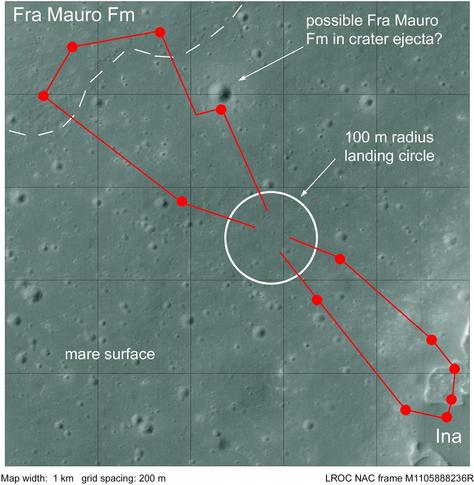
Here is Ina from Quickmap. It really is the most extraordinary structure. The basalts around it are 3 billion years old, from crater counts. Ina itself is 100 million years old or even less, from crater counts, if we can believe them. I think the incredible sharpness of the edges of Ina prove it is very young, though others have tried to show why an old surface could have so few craters. I follow Peter Schultz in thinking this is an outgassing feature.
#moon #goldenspike
#moon #goldenspike
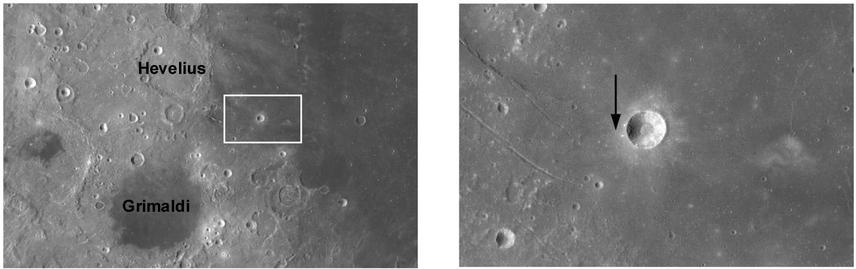
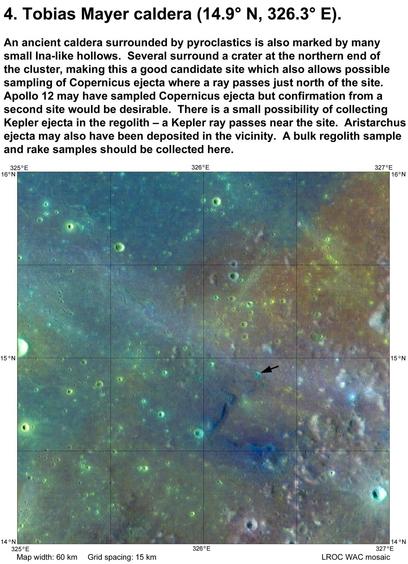
The next site from my Golden Spike landing site workshop poster is near the crater Tobias Mayer. This may not be familiar so it's worth looking at it in detail. First, here is a Clementine false colour map. Blue and orange hues are different lava flows, and blue patches at lower right are ash around the remnants of an old caldera. A whitish streak is a ray from Copernicus. The black arrow points to the odd feature we will see next.
#moon #goldenspike
#moon #goldenspike
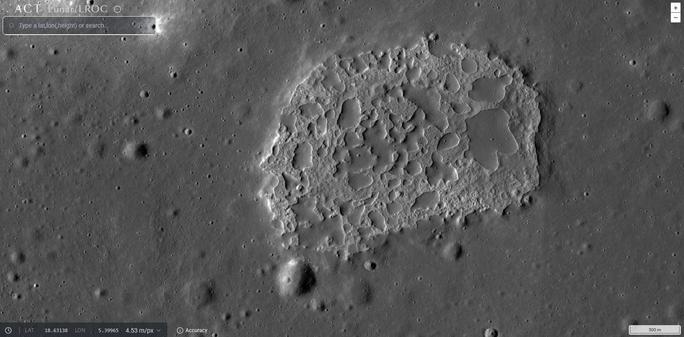
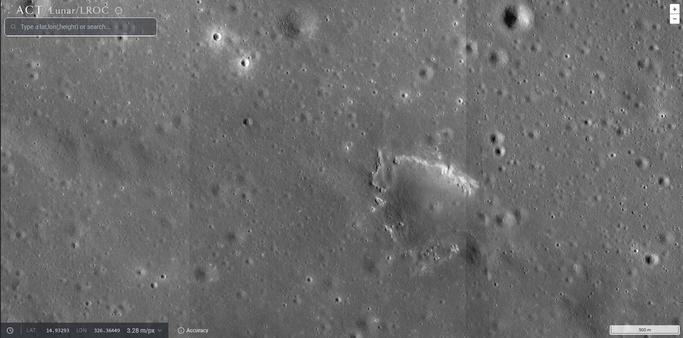
This is a Quickmap view of the feature indicated with an arrow in the previous post. An irregular depression is partly surrounded by small pits which look like tiny sections of Ina. Ina is the biggest and best developed of these things, this one is tiny, in my view an incipient or much less fully developed version of the same thing (there are many examples between these 2 end-members).
#moon #goldenspike
#moon #goldenspike
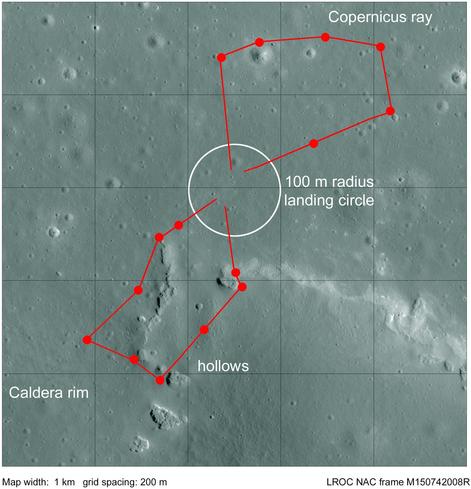
So here is my landing site with astronaut traverses. One goes south to sample the small pits - see the alt text. One goes north to sample the Copernicus ray. Rays from Copernicus, Aristarchus and Kepler overlap here and all three might provide material in a rake sample.
I think this gives a good idea of the kind of thing landing site planners look for. A nice smooth landing point with more than one geological target nearby.
#moon #goldenspike
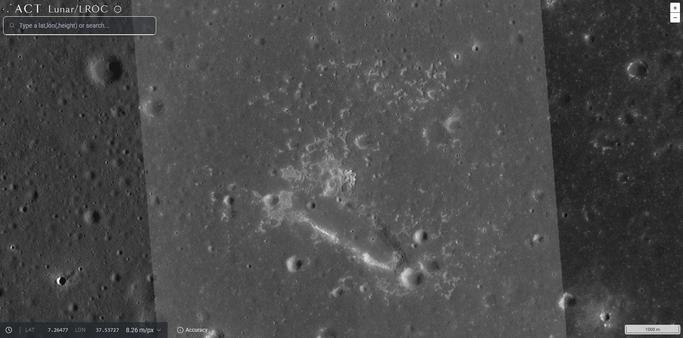
Next, a group of pits which might be said to be somewhere between Ina and the Tobias Mayer pits in complexity. This is Cauchy in Mare Tranquillitatis, and it's on top of a small volcanic dome, one of a cluster near Cauchy crater. This Quickmap view shows the form of the cluster - one big elongated hollow and lots of small pits. The gentle dome barely shows up here. We are getting a tour of some of the Moon's oddest features.
#moon #goldenspike
#moon #goldenspike
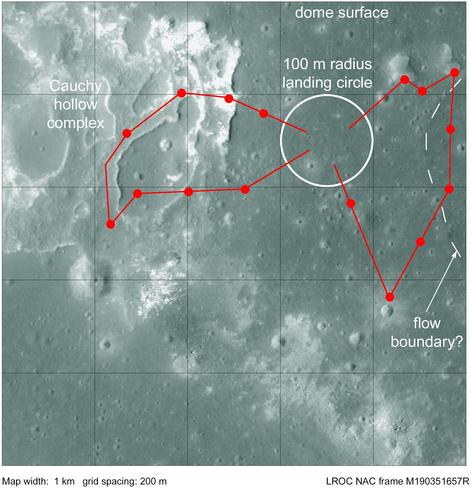
Here is my site with EVA routes. One of them explores the dome surface including a possible flow boundary. The other goes into the depression, with domes and a bright floor very much like Ina. The site would offer views out over the mare surface including the neighbouring domes, but they would be gently sloping, not dramatic. We saw one like it at the Firefly landing site in Mare Crisium last year - Mons Latreille - but it was easy to miss in the images.
#moon #goldenspike
#moon #goldenspike
Now for a look at the Hyginus site. It was in the abstract (with a different colour scheme), but here we can look at the context. First a map of the Hyginus structure itself. It looks like a tectonic valley with numerous pits along it - are they volcanic vents of collapse pits? Perhaps the latter works better. This is near the centre of the side of the Moon we see from Earth. Let's go closer in...
#moon #goldenspike
#moon #goldenspike
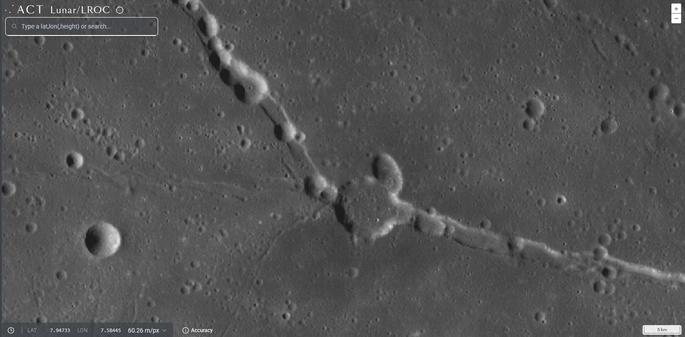
Here we are zooming in to the biggest depression, and on its floor are more of these odd little pits. They are not found anywhere else along the structure. A descending lander would have quite a view here. Look at the boulders clustered high on the walls of the depression, and some have rolled down to the floor - so the upper mare surface can be sampled on the floor via rocks which have rolled down.
#moon #goldenspike
#moon #goldenspike
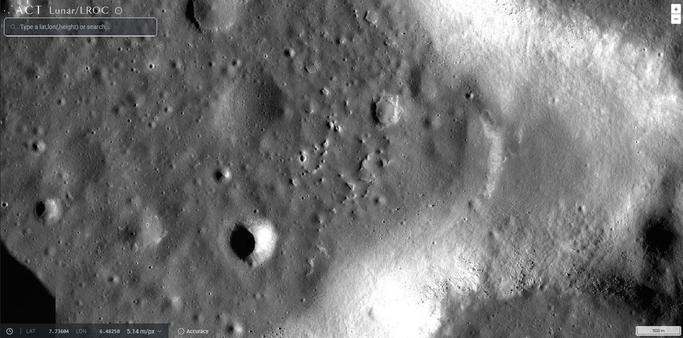
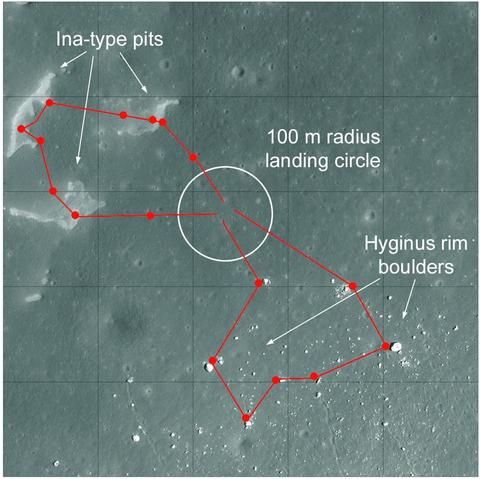
Here is my landing site. It lies between the nearest pits and the cluster of boulders which have rolled down the slope. I think this would be a cool landing site. My two EVAs visit the pits and the boulders, each with a walk of about 1000 m on fairly flat terrain. The map is 1000 m across. This would be like Apollo 12 EVA 2 but with better scenery.
#moon #goldenspike
#moon #goldenspike
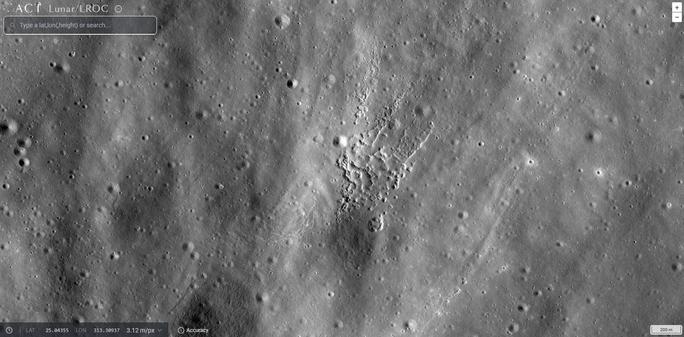
This is the last of my 5 Golden Spike landing site suggestions. The context image from Quickmap* shows the prominent ray crater Aristarchus, well known to any lunar observer. This is a geological wonderland, high on many lists of future landing sites. Modern crater counts on LRO images give an age of about 175 million years. We will zoom in on the white arrow.
*if you haven't played with Quickmap give it a try. It beats working.
https://quickmap.lroc.im-ldi.com
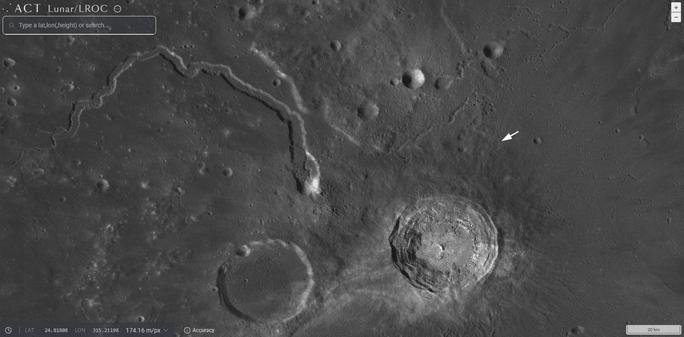
Context map number 2 zooms in to the feature I am interested in. It's another cluster of small pits, sharp-edged and obviously younger than the surrounding surface which is the continuous ejecta blanket of Aristarchus. The pits have to be younger than i75 million years - any older features in this area would be buried under the tsunami of rubble thrown out of the crater as it formed. So like Ina, these are young, however they formed.
#moon #goldenspike
#moon #goldenspike
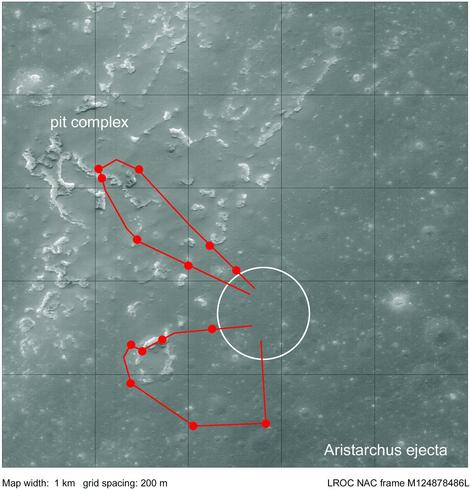
Here is the landing site with its 100 m radius landing circle. Two walking EVA routes are shown. One samples Aristarchus ejecta and a couple of pits. The other gets in among the pits with a chance to look at several of them and sample the smooth material between them.
OK, I have shown you what I did for the Golden Spike workshop. Next we will see some sites suggested by other people.
#moon #goldenspike
I should have said that the Golden Spike workshop abstracts can be seen here:
https://www.hou.usra.edu/meetings/gs2013/
Kirby Runyon had a poster proposing a site which exposed ancient regolith that could be searched for terrestrial samples delivered to the Moon as impact ejecta.
https://www.hou.usra.edu/meetings/gs2013/pdf/6020.pdf
Does that sound unlikely? There was a suggestion that an Earth rock had been found in an Apollo 14 sample, though this paper says it's not:
https://doi.org/10.1016/j.icarus.2020.113771
#moon #goldenspike
I don't know enough to pick a side in hat dispute. Runyon's idea was that samples of early Earth might contain evidence of very early biology otherwise lost on Earth and which would only survive on the Moon if buried for most of the intervening three billion years or more. Sub-mare paleo-regoliths excavated by a fresh impact in shallow basalt flows may be the best target, and the suggested location was 0.8° S, 63.0° W (correcting an error in the source).
#moon #goldenspike
#moon #goldenspike
Here is the site. To be fair - it's a long shot and many other potential craters might be substituted for this one, but remote sensing might help find a good candidate. Note that the latitude given in the abstract is incorrect.
We have meteorites from the Moon and Mars (and many asteroids) here on Earth, so things could potentially go the other way. Could we find bits of Mercury and Venus on Earth? People are considering it.
#moon #goldenspike