 Phil Stooke
Well-lit points at the south pole were suggested by Moon Express in 2011 as likely landing areas. Other customers might prefer different sites so this was not fixed in 2011. The hopper could operate through prolonged sunlight at one site and then jump to another sunlit location. Another option mentioned in 2011 was for the lander to deploy several small mini-hopper devices which could travel up to tens of km... a bit like Moonfall, in the news now.
#moon #GLXP
In November 2011 Moon Express described two mini-rovers named Arthur and Robert after Arthur C. Clarke and Robert A. Heinlein which could be deployed on the surface. Each two-wheeled rover would take images and video and collect scientific data. The International Lunar Observatory Association (ILOA) intended to fly a communication test package on MoonEx 1 and its observatory on MoonEx 2, and worked with Golden Spike on human missions to service its observatory.
#moon #GLXP
#moon #GLXP
Late in 2012 Moon Express described targets for its first two missions. MoonEx 1 in 2015 would go to the southern highlands, south of 60 S to reduce thermal stress on the lander, possibly near Surveyor 7. MoonEx 2 would land at a polar site, probably Malapert Mountain, with radio and optical telescopes for ILOA. Moon Express would use a small rover to scout for resources. A third mission in about 2020 might be a sample return. Paul Spudis suggested Rima Bode as a target.
#moon #GLXP
#moon #GLXP
We'll see that Bode site later. Meanwhile a small return vehicle was designed for the sample return mission. Analysis showed that the return vehicle could land on its own, so this ‘scout class’ lander would be used for the first mission. It would launch as a secondary payload on a commercial launcher, use an ion engine to reach the Moon and land before the end of 2015. The dates were delayed as the GLXP deadline retreated. A larger lander would be used later at the south pole.
#moon #GLXP
#moon #GLXP
There is quite a lot to say about Moon Express because they were very open and often to be seen at meetings like LPSC. Bob Richards was a good communicator and like all entrepreneurs always boldly promoting the company, often beyond what was reasonably possible at the time. But funding was always hard to find and things became very precarious. A move from Silicon Valley to the environs of KSC didn't make much difference.
#moon #GLXP
#moon #GLXP
Moon Express CEO Bob Richards said in a 2017 interview that the MX1 landing site would be equatorial. At the LEAG meeting in October 2017 Paul Spudis and Richards said that the first Moon Express mission would be an orbiter carrying an instrument for mapping water across the Moon, and the first lander would go to a pyroclastic deposit at Rima Bode (near the equator). Later the ILOA telescope would go to one of two sites on peaks near the south pole. Spudis died in 2018.
#moon #GLXP
#moon #GLXP
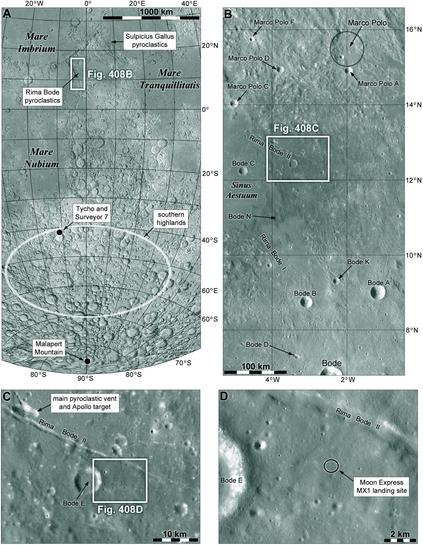
Paul Spudis and Bob Richards, at that 2017 LEAG meeting, identified a specific site at Rima Bode. This map shows (A) several sites mentioned by Moon Express at different times, and (B,C,D) a zoom in on the location they were interested in. Bode was of interest to Apollo, to many studies since, and is now a good candidate for an early Chinese crew landing. The volcanic ash deposit may have resource potential.
#moon #GLXP
#moon #GLXP
Moon Express ran out of money and laid off most staff. It had a brief apparent revival of fortunes when it was accepted as a potential CLPS mission provider. I don't know if they competed for any of the early missions but they certainly didn't get one and by 2020 they were effectively out of business. Last time I looked NASA was still listing them as a potential CLPS company but I don't think they really exist any more.
#moon #GLXP
#moon #GLXP
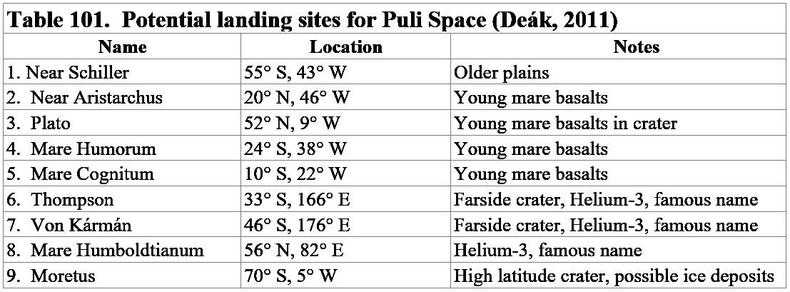
Two new teams joined the GLXP late in 2010. They were LUNARecon and Puli Space. LUNARecon was a restructured version of the previous team Lunatrex, headed again by Pete Bitar and featuring a rover called Sidewinder. It withdrew even before being officially listed on the GLXP website. Puli Space, from Hungary, had a more lasting presence. They presented a list of nine potential landing sites at the 42nd LPSC in March 2011. Puli is a small dog breed from Hungary.
#moon #GLXP
#moon #GLXP
Puli Space worked on a rover with interesting wheels (https://pulispace.com/). Each wheel consisted of five radial legs widening into a 'foot'. When this seemed out of reach they decided to fly a time capsule payload on Astrobotic's first mission (https://www.astrobotic.com/team-puli-space-is-the-third-google-lunar-xprize-team-to-reserve-a-ride-to-the-moon-with-astrobotic/)
These things didn't happen, but Puli survived the end of the GLXP and developed an instrument for detecting water in polar craters. One was mounted on the hopping vehicle...
#moon #GLXP

... carried on the Intuitive Machines Mission 2 lander in 2025. Another was on the same mission's rover. The lander fell on its side so only brief test telemetry was obtained - but Puli did get to the Moon. They have another chance soon on Astrolab's FLIP rover, and ESA has contracted to buy data from them.
#moon #GLXP
#moon #GLXP
The end of 2010 was the last time teams could join the GLXP, but several remaining teams filed the paperwork late enough in 2010 that they were only announced in February 2011. First was an Israeli team, SpaceIL, the last two letters being the internet country code for Israel. SpaceIL launched its Beresheet lander on 22 February 2019, after the competition had ended. It was the first GLXP team to launch, and its mission ended with a crash on 11 April 2019. Let's take a look.
#moon #GLXP
#moon #GLXP
SpaceIL's initial plan was for a small lander to go to a site selected by high school students as a national science project in 2012. Late in 2012 SpaceIL took over Odyssey Moon. The lander was first called Sparrow, but other suggested names were Hatikvah (‘hope’) and Ramon (for Israeli astronaut Ilan Ramon, who died in the Columbia shuttle accident on 1 February 2003). The team was supported by wealthy investors, solving one big problem for all teams.
#moon #GLXP
#moon #GLXP
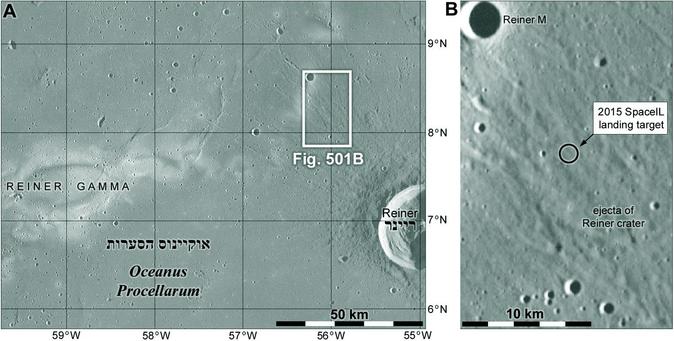
In November 2014 the team described a science goal for the mission. It would use a magnetometer to measure the lunar magnetic field during descent and on the surface before and after it hopped to a second location. This suggested that the site would be at or near one of the well-mapped magnetic anomalies, but a specific site was not described until 2015 - it was Reiner Gamma where a bright albedo 'swirl' coincides with a large magnetic anomaly. This would soon change.
#moon #GLXP
#moon #GLXP
A new site selection plan for SpaceIL appeared in 2017 (https://www.hou.usra.edu/meetings/lpsc2017/pdf/1914.pdf). Global maps of topography, rocks, albedo and roughness were used to find safe landing sites 15 km across (the landing ellipse would be 15 km long and its orientation was not yet known). The laser altimeter worked best in areas of intermediate albedo, excluding darker mare sites and fresh crater ejecta as at Tycho. Low latitudes including Reiner Gamma and regions within 20° of the limb were excluded.
#moon #GLXP
#moon #GLXP
Safe sites were compared with maps of magnetic anomalies to find suitable locations, which were certified with high resolution images. Three targets were identified near Berzelius, Nonius and Wöhler. A specific Berzelius site was shown 50 km NW of the crater at 37.8° N, 53.3° E, just south of Berzelius W. Sites at Nonius and Wöhler are shown at the centres of large circles from Grossman et al. and may not be the precise intended locations.
#moon #GLXP
#moon #GLXP
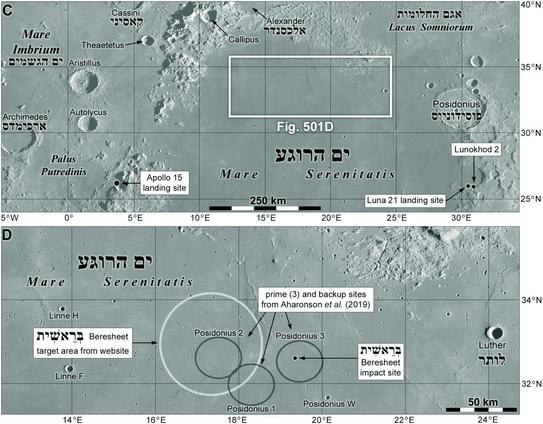
Other magnetic anomaly sites were available but these three (shown on this map) may have been preferred by this Israeli team for the Jewish heritage of the crater namesakes. In 2018 a new site was chosen in Mare Serenitatis. Team science advisor Oded Aharonson selected a site with a strong magnetic field. Further study of the problem ruled out the highland sites suggested earlier and mandated a mare site if its albedo was acceptable. A white box on the map shows the region.
#moon #GLXP
#moon #GLXP
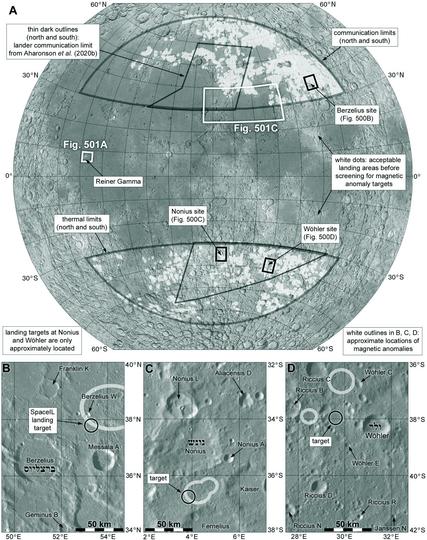
SpaceIL's new site is mapped here. The large circle is based on an image on the mission website in 2018. Aharonson et al. (2019) identified three 30 km circles provisionally named Posidonius 1, 2 and 3 after the large crater east of the landing area (https://www.hou.usra.edu/meetings/lpsc2019/pdf/2290.pdf). The relationship between the magnetic field and the nearby wrinkle ridges would be studied as the lander descended. The lander name Beresheet (= Genesis) was chosen in a public poll.
#moon #GLXP
#moon #GLXP
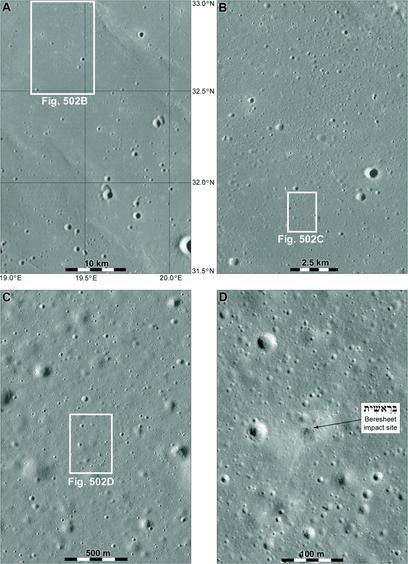
Beresheet launched on 22 February 2019 and arrived at the Moon on 4 April, taking a slow low-energy trajectory. It attempted a landing on 11 April but crashed. This set of maps zooms us in to the impact site. Magnetometer data collected during the orbit phase and descent were affected by interference from the spacecraft itself and could not be used. X Prize awarded them a $1 million prize for the attempt.
#moon #GLXP
#moon #GLXP
One payload was a digital time capsule with cultural, historic and educational items reflecting Israeli culture and history. Another digital archive called The Lunar Library Genesis Mission was provided by the Arch Mission Foundation. It contained image and digital data including the English version of the digital encyclopedia Wikipedia, 25000 digitized books from Project Gutenberg and other archives, linguistic data for 5000 languages and a key to its use.
#moon #GLXP
#moon #GLXP
This 'library' was intended to survive for zillions of years as an archive of human knowledge and culture. It also carried samples of human DNA and a cargo of dormant, dehydrated tardigrades, small aquatic creatures known to have survived exposure to the space environment in Earth orbit. They were inserted in the Archive, unannounced and unregulated, posing a challenge to the national oversight of space activities required by the Outer Space Treaty.
#moon #GLXP
#moon #GLXP
A follow-on Beresheet 2 mission with an orbiter and 2 mini-landers was under development for a few years until a worsening political situation caused the main funders to pull out, and SpaceIL ceased work on the mission in 2025. This was the closest to an actual moon mission which could reasonably be associated with the GLXP, even though the competition was over at this point.
Next: back to the Catalogue of Teams.
#moon #GLXP
Next: back to the Catalogue of Teams.
#moon #GLXP
The final GLXP teams were revealed on 18 February 2011, bringing the total team roster to 29 (though no more than 21 at any given time). A new mystery team followed the lead of Next Giant Leap by concealing its identity at first. It identified itself as Mystical Moon, based in an unspecified location, led by a person called 'Merlin' and planning a rover called Black Magic. It soon voiced objections to the competition rules and withdrew in August 2011.
#moon #GLXP
#moon #GLXP
A Canadian team, Plan B, suggested a landing similar to Luna 9, landing at sunrise. It would slow until just above the surface, the engine would be discarded and the spacecraft would fall to the ground, cushioned by airbags. A landing video would cover the entire braking phase from 4 minutes before landing to 1 minute after. If the landing occurred in darkness, LED lights would be turned on for the last few seconds before landing to record the airbag deployment.
#moon #GLXP
#moon #GLXP
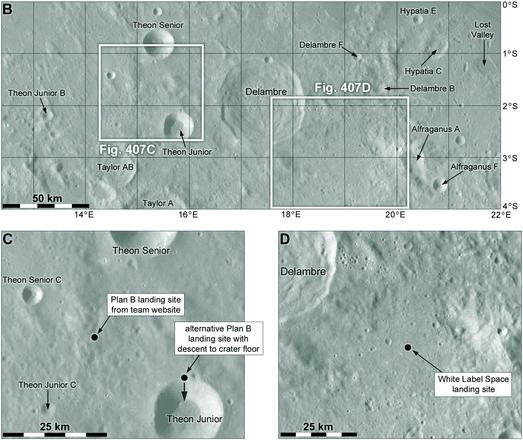
The Plan B site was at 2 S, 15 E, south of Mare Tranquillitatis, only 150 km from the White Label Space site. Two craters, Theon Junior and Theon Senior, lie within 30 km to the east, each about 18 km across and 3 km deep. If the landing site was moved to 2.1312 S, 15.7745 E on the rim of Theon Junior the rover might descend the inner slope, travelling about 5 km in as little as 8 minutes, taking video all the way to observe the geology from rim to floor and record the descent.
#moon #GLXP
#moon #GLXP
A GLXP team from Pennsylvania State University, 'Penn State Lunar Lion', would fly a lander called Lunar Lion (after the university sports teams). In 2012 they announced that their primary landing site was at Apollo 11 and a secondary site was Apollo 12. In 2014 this was refined to a point 30 km north of the Apollo 11 site, and the team hoped to image the Apollo 11 LM descent stage (during their descent?) to win the Heritage Prize. I don't know more about them.
#moon #GLXP
#moon #GLXP
Angelicum was from Argentina. Its small rover was called Dandelium for its open basket-style wheels which resembled a dandelion seed. In 2012 Angelicum signed an agreement to fly their rover as a payload on the Omega Envoy lander. After the lander released its own Sagan rover to win the GLXP, Dandelium would be released to win the second prize. Later the rover was referred to as Unity. In 2015 the team announced it would fly with Astrobotic. This did not happen.
#moon #GLXP
#moon #GLXP
Sorry - forgot to mention I would be off grid for a couple of days. We are nearing the end of our Catalogue of Teams for the Google Lunar X Prize. Today's team is Team Indus, and there is quite a lot to say about them, so this will go over several days. They were from Bangalore, an important hub for space in India. They first planned to deploy 2 or 3 small rovers from one lander, for the basic prize plus long range driving or night survival (secondary prizes).
#moon #GLXP
#moon #GLXP
A possible landing site from the team’s website early in the competition was in Sinus Medii at 0.50° N, 1.50° W, but this preceded any detailed analysis. A 2014 study described a lander carrying a UV telescope to a site at 38.336° N, 26.006° W in Mare Imbrium near Sinus Iridum (Figure 409A, B). This site was in the mid-latitudes to reduce thermal stress on the hardware, a common theme for lander planning in this period and used for all 4 Chinese landing sites so far.
#moon #GLXP
#moon #GLXP
A few more sites were considered for Team Indus in 2016-2019. A 2016 study mentioned landing at 35° N, 29° W in Mare Imbrium. The 2014 site was in a cluster of secondary craters and would not have been a desirable site, but the 2016 site followed the analysis of better images and is very smooth. Hakuto moved its small rover from Astrobotic to Team Indus in 2017, and a Hakuto presentation at a meeting of the Space Resources Roundtable in Montreal in May 2017...
#moon #GLXP
#moon #GLXP
... identified the landing site as 35.25° N, 29.23° W. The presenter suggested that China’s Chang’e 3 was originally intended to land at that location before moving to its actual site near Sinus Iridum. I've never seen that suggested anywhere else. This set of maps shows these various sites and leads us to a more detailed site study tomorrow. For details of these studies see my Moon Chronicle, part 8 (which now includes a few recent edits).
#moon #GLXP
#moon #GLXP
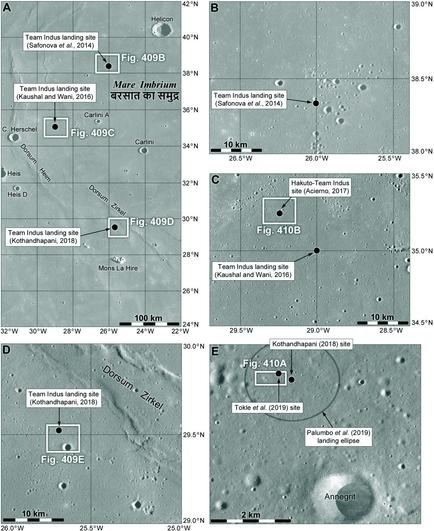
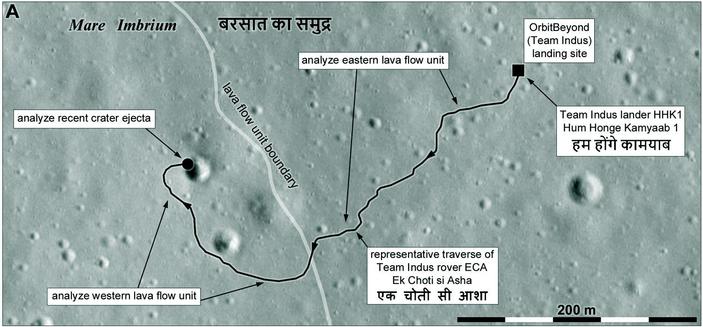
Further work on a Team Indus site used LRO high resolution elevation maps and so was limited to areas with NAC stereo at that time (2018). A NAC DEM (one of roughly 20 in the region) was one of 3 evaluated by Team Indus. The other two were at the Chang’e 3 site and near the Chang’e 5 site. A final landing site at 29.52° N, 25.68° W, near Annegrit crater in Mare Imbrium, was illustrated at a lunar landing site workshop at NASA Ames Research Center in January 2018.
#moon #GLXP
#moon #GLXP
The Team Indus rover was named ECA (Ek Choti si Asha, meaning ‘One Small Wish’). Hakuto was to fly its rover with Astrobotic, but when Astrobotic withdrew from GLXP Hakuto arranged a ride on the Indus lander. At the LEAG meeting in October 2017 it was said that their rover Sorato would operate for one lunar day, moving at least 500 m to win the GLXP. Then it would try a longer traverse, following a ‘flower petal’ pattern which returned to the lander at intervals to be imaged.
#moon #GLXP
#moon #GLXP
In March 2018 Team Indus described missions to the Moon each year tarting in 2019. The first would be to the vicinity of Annegrit crater in Mare Imbrium, landing within 1 km of the target point, carrying their ECA rover, Hakuto's Sorato rover and another from Synergy Moon. The second mission would go to the same place with 500 m accuracy and try to survive through the lunar night. The third mission would be to Shackleton crater (south pole) with 250 m accuracy to try sample return.
#moon #GLXP
#moon #GLXP
What about this landing site? What would team Indus actually do? They teamed up with Brown University's Apollo veteran Jim Head to develop a plan. The map (located in the previous map) shows their idea - analyze two different lava flows and a fresh crater's ejecta.
As the Google Lunar X Prize faded into oblivion a new opportunity arose: NASA's CLPS program. But foreign companies were unable to join it. Team Indus created Orbit Beyond in the USA to join it.
#moon #GLXP
OrbitBeyond was 1 of 3 teams given contracts to fly a CLPS mission in May 2019, and their first mission in September 2020, would be the first CLPS flight. There would have been a naming contest for the lander prior to flight. On 29 July 2019 OrbitBeyond withdrew from the contract after funding difficulties arose but (officially) remained in the running for future contracts. Here is their website: https://orbitbeyond.com/
#moon #GLXP
#moon #GLXP

Our last GLXP team, Phoenicia, was American. Their lander was 'Storming the High Heavens' and it targeted the south pole. The lander would use airbags to soften the landing. After driving far enough to win the GLXP their rover, named 'Victory at Pangaea' would spin up large flywheels to provide power during the lunar night. It would attempt a 5 km drive to win an additional prize. The team withdrew from the competition in July 2013 to work on arranging shared launches for others.
#moon #GLXP
#moon #GLXP
So there are our teams. The deadline for the prize was extended repeatedly but eventually it became apparent that nobody would be ready to fly in time. A few other groups signed letters of intent to register but did not follow through. Raising enough money was always the biggest problem, and the whole notion of prizes as a way to spur innovation lost some of its luster. The bravado of the space tech bros did not bear fruit. So what came out of the GLXP?
#moon #GLXP
#moon #GLXP
I don't want to suggest that the GLXP work was all wasted. We have seen several teams continue after the competition ended. Astrobotic got 2 CLPS awards and so far has flown one failed mission, but there's another one around the end of the year. SpaceIL flew to the Moon and crashed. Orbit Beyond won a CLPS award but had to abandon it - but still hopes for more. Puli Space developed an instrument which has flown twice on a bad landing, giving no data, but they have another...
#moon #GLXP
#moon #GLXP
... chance coming up. CLPS itself can be seen as a more serious follow-on to GLXP, funded by awards on the order of $100 million instead of the $20 million X Prize. Its results have been mixed so far but I think when we get through the difficult birth it will achieve something.
OK - where now? This sequence of posts is about commercial lunar exploration, not just the GLXP, so I think our next study will be of Golden Spike... Remember them?
#moon #GLXP
OK - where now? This sequence of posts is about commercial lunar exploration, not just the GLXP, so I think our next study will be of Golden Spike... Remember them?
#moon #GLXP
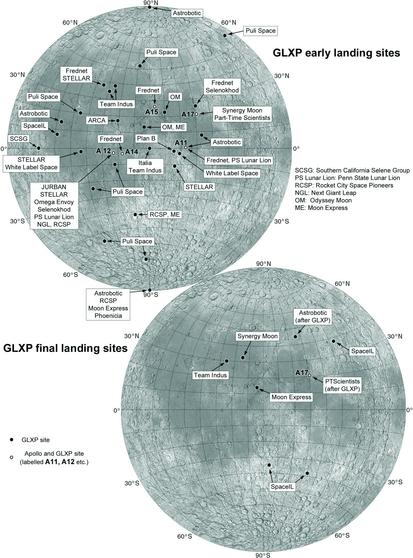
Oops, I forgot I had said I would provide a map of all GLXP sites, so here it is. First, all specific sites mentioned by the teams, and a second map showing the sites being considered at the end of the competition. If anybody knows of any other sites please let me know.
Golden Spike will start tomorrow.
Golden Spike... not the transcontinental railroad one but a space company begun by Gerry Griffin and Alan Stern. Griffin was a former Apollo Flight Director and JSC Director, and NOT the person Astrobotic's big lander is named after. Stern was a former NASA Associate Administrator for Science. Work began quietly in 2010 and it was publicly announced in 2012. I think this episode in lunar history is not as well known as GLXP so I will give more detail on it.
#moon #goldenspike
#moon #goldenspike
I am an optimist so I told Stern in 2012 that this was the best thing to happen to the Moon in a long time. But I was mistaken, as usual, and it fizzled out around the end of 2013. Its goal was to conduct private crewed lunar missions using hardware already existing or in development at that time. The first Golden Spike meeting at Telluride, CO in Aug. 2010 examined feasibility, and a 10 week study concluded it was possible. The company was set up in Delaware in Nov. 2010.
#moon #goldenspike
#moon #goldenspike
GS would use existing rockets and crew vehicles then being developed but needed a landing vehicle and EVA suits. Northrop Grumman designed a 2 crew lander nicknamed Pumpkin, with a very small return capsule taking off with small thrusters. A 2nd lander concept by ULA and Masten was called XEUS. GS designed a ‘GoldSEP’ ALSEP-like instrument package for some sites. It would work for at least 2 years powered by batteries recharged by solar panels on the lander.
#moon #goldenspike
#moon #goldenspike
Capabilities were intended to be comparable to Apollo 12 or Apollo 14, with a pinpoint landing capability and two walking EVAs which might last up to 7 hours. Two or three flights per year might be possible. The customers for these missions would mainly be national space agencies, possibly including NASA but also any other agencies around the world, but other wealthy institutions or even individuals might also purchase a mission. What would a flight look like?
#moon #goldenspike
#moon #goldenspike
Golden Spike flights were expected to cost about $1.5 billion each. At first 4 launches would be needed for each mission. 2 put the lander and an upper stage in low Earth orbit. They dock and the upper stage would send the lander to lunar orbit to wait for its crew. 2 more launches put the crew vehicle and an upper stage in orbit where they would dock and go to the Moon. The crew would dock with the lander and descend to the surface. After two Earth days on the Moon ....
#moon #goldenspike
#moon #goldenspike
...they would return to lunar orbit, dock with the crew vehicle and return to Earth. By 2013 studies showed that the 4 launches could be reduced to 2 using the Falcon Heavy or an upgraded Atlas 5. A flight test in about 2017 would check things out in Earth orbit. A second test would send a crew to lunar orbit. A third test would keep a crew in lunar orbit but send the lander down on its own, testing landing and return to orbit. The first revenue flight would be in c. 2020.
#moon #goldenspike
#moon #goldenspike
All Golden Spike landings were designed to be automated so the crew did not have to train to fly the lander. By October 2013 the plan had hardware procurement starting in 2015, test flights in 2018 and revenue flights in 2020.
After all that, let's get to the part that really interested me. As usual it was landing site selection. Tomorrow we will start to consider where these crews might go.
You found $1.5 billion under a couch cushion and purchased a Golden Spike flight. Where are you going to go? You get to choose - landing sites would be chosen by each customer, but Golden Spike initiated discussion through a crowdfunding exercise on Indiegogo.com in the spring of 2013, not to fund lunar missions but for outreach and public participation. The goal was to raise $240,000 US ($1 per mile to the Moon) but only $19,450 was collected. We call this foreshadowing!
#moon #goldenspike
#moon #goldenspike
One reward for participating in the Indiegogo event was to choose a landing area from a list of eight: Aristarchus, Copernicus, Davy crater chain, Marius Hills, Schröter’s Valley, Tycho, Plato and Dionysius, and the winner was Aristarchus. I don't know how the list was compiled.
Stern said at LPSC in 2013 that a Russian response to the Golden Spike concept had been that they could land by one of their old landers, and NASA suggested the same later.
#moon #goldenspike
Stern also said that the initial capability would be to land at nearside sites up to 75° latitude in either hemisphere, with longer stays and polar and farside site capabilities added later.
A more serious effort commenced with a workshop held at LPI in October 2013. I attended it, with a poster. It happened during one of those periodic US government shutdowns so some folk were only on screen. Lots of sites were discussed.
#moon #goldenspike
David Kring of LPI suggested numerous areas for Golden Spike landings. The dates of the youngest and oldest impact basins needed refining, so the eastern edge of the Orientale basin and older basins such as Smythii and Nectaris would be good sites. Rima Bode would provide pyroclastic samples, and Flamsteed would have some of the youngest lava flows. Impact melt from craters of various ages (e.g. Eratosthenes, Aristarchus, Copernicus, and Tycho) would date younger events.
#moon #goldenspike
#moon #goldenspike
These sound like good targets but they are not specific landing sites - careful mapping would be needed to select the best sites in those areas. Some other examples from Clive Neal were Ina, Hansteen Alpha, Reiner Gamma, and the need to sample KREEP and the youngest lava flows. He also emphasized the desirability of extending the existing laser reflector network, and attempting some in situ resource utilization experiments such as extracting oxygen from regolith.
#moon #goldenspike
#moon #goldenspike
Bill McKinnon also mentioned the anomalous volcanism at Compton-Belkovich (but it is on the far side so not an early site) and spectacular ejecta blocks on the NE rim and walls of Aristarchus which consisted of layered basalts, which conveniently allowed multiple layers to be sampled without drilling. Here are some images of those blocks:
https://lroc.im-ldi.com/images/291
Next we will look at some actual sites with astronaut EVA routes... from my poster.
#moon #goldenspike