 Phil Stooke
... chance coming up. CLPS itself can be seen as a more serious follow-on to GLXP, funded by awards on the order of $100 million instead of the $20 million X Prize. Its results have been mixed so far but I think when we get through the difficult birth it will achieve something.
OK - where now? This sequence of posts is about commercial lunar exploration, not just the GLXP, so I think our next study will be of Golden Spike... Remember them?
#moon #GLXP
I don't want to suggest that the GLXP work was all wasted. We have seen several teams continue after the competition ended. Astrobotic got 2 CLPS awards and so far has flown one failed mission, but there's another one around the end of the year. SpaceIL flew to the Moon and crashed. Orbit Beyond won a CLPS award but had to abandon it - but still hopes for more. Puli Space developed an instrument which has flown twice on a bad landing, giving no data, but they have another...
#moon #GLXP
#moon #GLXP
So there are our teams. The deadline for the prize was extended repeatedly but eventually it became apparent that nobody would be ready to fly in time. A few other groups signed letters of intent to register but did not follow through. Raising enough money was always the biggest problem, and the whole notion of prizes as a way to spur innovation lost some of its luster. The bravado of the space tech bros did not bear fruit. So what came out of the GLXP?
#moon #GLXP
#moon #GLXP
Our last GLXP team, Phoenicia, was American. Their lander was 'Storming the High Heavens' and it targeted the south pole. The lander would use airbags to soften the landing. After driving far enough to win the GLXP their rover, named 'Victory at Pangaea' would spin up large flywheels to provide power during the lunar night. It would attempt a 5 km drive to win an additional prize. The team withdrew from the competition in July 2013 to work on arranging shared launches for others.
#moon #GLXP
#moon #GLXP
OrbitBeyond was 1 of 3 teams given contracts to fly a CLPS mission in May 2019, and their first mission in September 2020, would be the first CLPS flight. There would have been a naming contest for the lander prior to flight. On 29 July 2019 OrbitBeyond withdrew from the contract after funding difficulties arose but (officially) remained in the running for future contracts. Here is their website: https://orbitbeyond.com/
#moon #GLXP
#moon #GLXP

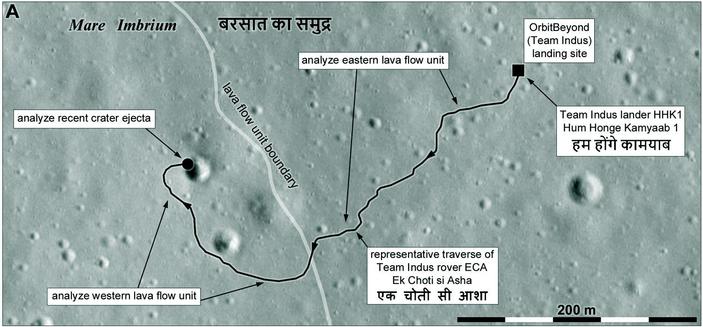
What about this landing site? What would team Indus actually do? They teamed up with Brown University's Apollo veteran Jim Head to develop a plan. The map (located in the previous map) shows their idea - analyze two different lava flows and a fresh crater's ejecta.
As the Google Lunar X Prize faded into oblivion a new opportunity arose: NASA's CLPS program. But foreign companies were unable to join it. Team Indus created Orbit Beyond in the USA to join it.
#moon #GLXP
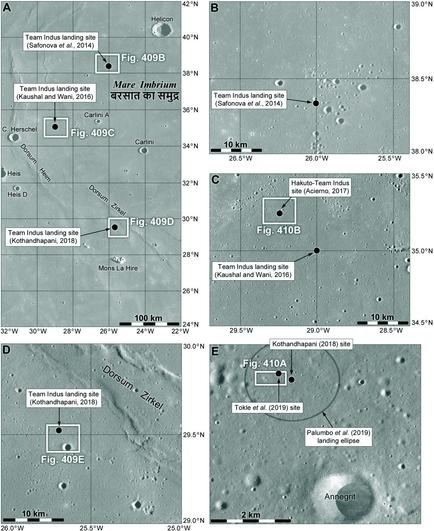
In March 2018 Team Indus described missions to the Moon each year tarting in 2019. The first would be to the vicinity of Annegrit crater in Mare Imbrium, landing within 1 km of the target point, carrying their ECA rover, Hakuto's Sorato rover and another from Synergy Moon. The second mission would go to the same place with 500 m accuracy and try to survive through the lunar night. The third mission would be to Shackleton crater (south pole) with 250 m accuracy to try sample return.
#moon #GLXP
#moon #GLXP
The Team Indus rover was named ECA (Ek Choti si Asha, meaning ‘One Small Wish’). Hakuto was to fly its rover with Astrobotic, but when Astrobotic withdrew from GLXP Hakuto arranged a ride on the Indus lander. At the LEAG meeting in October 2017 it was said that their rover Sorato would operate for one lunar day, moving at least 500 m to win the GLXP. Then it would try a longer traverse, following a ‘flower petal’ pattern which returned to the lander at intervals to be imaged.
#moon #GLXP
#moon #GLXP
Further work on a Team Indus site used LRO high resolution elevation maps and so was limited to areas with NAC stereo at that time (2018). A NAC DEM (one of roughly 20 in the region) was one of 3 evaluated by Team Indus. The other two were at the Chang’e 3 site and near the Chang’e 5 site. A final landing site at 29.52° N, 25.68° W, near Annegrit crater in Mare Imbrium, was illustrated at a lunar landing site workshop at NASA Ames Research Center in January 2018.
#moon #GLXP
#moon #GLXP
... identified the landing site as 35.25° N, 29.23° W. The presenter suggested that China’s Chang’e 3 was originally intended to land at that location before moving to its actual site near Sinus Iridum. I've never seen that suggested anywhere else. This set of maps shows these various sites and leads us to a more detailed site study tomorrow. For details of these studies see my Moon Chronicle, part 8 (which now includes a few recent edits).
#moon #GLXP
#moon #GLXP