The proceedings of the Bridges Math Art conference were published online a couple of days ago: https://archive.bridgesmathart.org/2026/

This is always a highlight of the year for me; but especially so this year, because they contain a paper that I co-wrote!

So I thought I would say a bit about it here, and over the next few days as I find time to add bits & pieces.

The title, and the topic of the paper, is Caltrops: https://archive.bridgesmathart.org/2026/bridges2026-165.html

But what, I hear you cry, is a caltrop‽

(1/?)
The Bridges Archive: 2026

Here is one!

Traditionally a caltrop is a cluster of four spikes, arranged like the vertices of a regular tetrahedron.

It's a defensive weapon. A defending army can litter the ground with these spikes, which will slow down any attacking force.

The caltrop is a weapon that is quick and easy to deploy, thanks to its crucial geometric property: however it rests, one of the spikes always points vertically upwards. So you can scatter them willy-nilly: they don't have to be placed carefully.

(2/n)

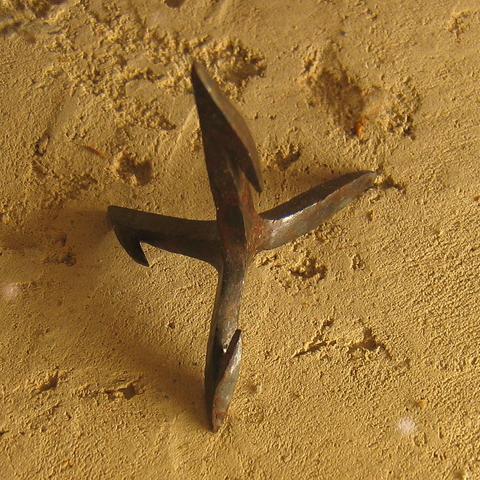
Caltrops have been used since at least Roman times. This picture shows a Roman caltrop, from Wikimedia Commons at https://commons.wikimedia.org/wiki/File:Roman_caltrop.jpg

In those days they would presumably have been used to slow a cavalry attack: a charging war horse would have second thoughts if it impaled its hoof on an iron spike.

Caltrops are still used in war zones today, because driving over an iron spike with an inflatable tyre is at least as inconvenient as stepping on one with your hoof.

(3/?)

The geometric question we consider in the paper is: what other arrangements of spikes, other than a regular tetrahedron, still have the property that there is always a spike pointing vertically upwards however the cluster rests on a horizontal surface.

In particular we considered such clusters in which all the spikes radiate out from a single central point. (So there's a natural generalisation ripe for the picking.)

(4/?)

It turns out that even the case of tetrahedra is interesting.

Not only regular tetrahedra are caltrops, but there are many others. One is shown in this video.

Such tetrahedra have been studied since the 18th century, and are known as Orthocentric: https://en.wikipedia.org/wiki/Orthocentric_tetrahedron

(5/?)

If you will indulge me, I will run through the theory of orthocentric tetrahedra quickly. It is elementary, but not (I think) quite obvious.

To start with, suppose we have vectors a, b, c, d representing the four spikes of a tetrahedral caltrop. The caltrop property says that a must be orthogonal to the plane containing b, c, d; or in terms of the dot product that

a · (b - c) = 0

and

a · (c - d) = 0

(which implies a · (b - d) = 0 by linearity)

Expanding and rearranging, that gives a · b = a · c = a · d.

And of course the same is true of all four spikes, so all six of the inner products of two different vectors have to be equal:

a·b = a·c = a·d = b·c = b·d = c·d.

And implicitly the value of this dot product has to be negative, or else all four spikes would point in the same hemisphere and the tetrahedron with vertices at a, b, c, d would not contain the origin.

(So if we wanted to, we could rescale the tetrahedron uniformly to make this dot product equal to -1.)

(6/?)

The key properties of orthocentric tetrahedra follow pretty easily once you have this.

For example, to see that opposite edges are orthogonal, expand (a - b) · (c - d) and observe that everything cancels.

Or, to see that the sum of squares of lengths of opposite sides is constant, expand (a - b)² + (c - d)² and see that the result is symmetrical in a, b, c, d.

(7/?)

Ok, but what about the other direction?

Suppose we have a tetrahedron whose opposite edges are orthogonal, or where the squared lengths of opposite edges sum to a constant. How do we know such a tetrahedron is orthocentric, which is to say a caltrop?

This is an existential question. We must prove that there exists a ‘middle’ point inside the tetrahedron such that, if we form a spike from this middle point to each of the vertices, each such spike is perpendicular to the plane of the face opposite.

Let’s say we have a tetrahedron whose opposite edges are perpendicular to each other. Let one vertex be the origin, and the other three be a, b, c. The edge from the origin to a must be perpendicular to the edge from b to c, which is to say a · (b - c) = 0 or a·b = a·c; and likewise for the other pairs of edges, so that a·b = a·c = b·c (= k, say).

Now let the vector m – this is going to be the middle point – be the solution to the equations

m·a = k
m·b = k
m·c = k

Then you can easily verify that all the pairwise dot products of 0-m, (a-m), (b-m), (c-m) are equal to m·m - k, so in particular they’re all equal to each other.

(8/?)

So much for tetrahedra! What other arrangements of spikes might satisfy the caltrop property?

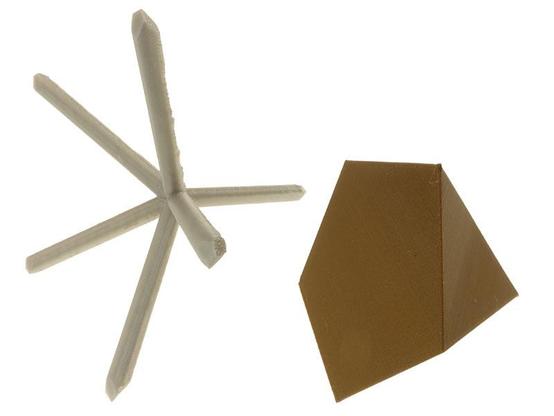
Here’s one: it’s a regular pentagonal pyramid.

You can probably see how we can do something like this with a pyramid over any regular polygon that has an odd number of sides.

(9/?)

One more post before bed: all the examples I’ve shown so far are what I call _perfect_ caltrops, where every spike has the opportunity to point up.

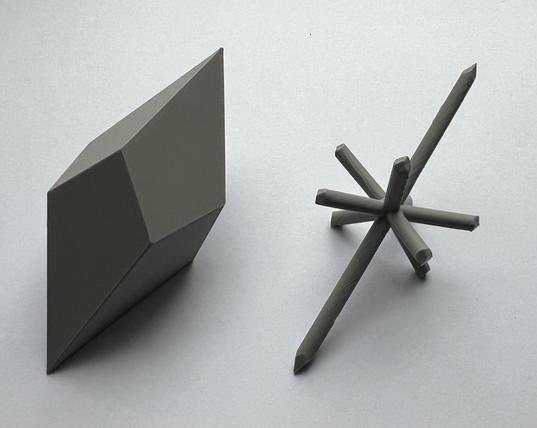
Imperfect caltrops also exist. This picture shows one based on the tetragonal trapezohedron: the long axial spikes will never point up; but it is still a caltrop, because however it rests there is always one spike pointing vertically up.

(10/?)

I noticed that you can turn this into a perfect caltrop by snapping off one of the long spikes.

At the time we wrote the paper, we didn’t know very many examples of imperfect caltrops, so I asked whether perhaps _all_ imperfect caltrops might be like this.

I now know that the answer is no! I will post an example in a few hours, but perhaps you can find one in the mean time.

We want an imperfect caltrop such that no subset of its spikes forms a perfect caltrop.

(11/?)

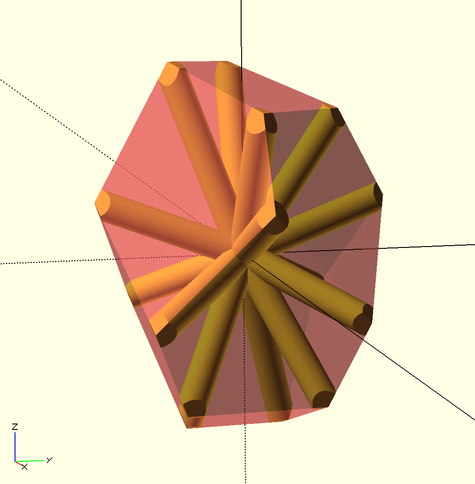
Okay! Sorry, busy day. I don’t yet have a 3d printed model of this one, but here is a rendered 3d model: https://skfb.ly/pLtLQ

I suspect this can’t be made perfect by snapping off spikes. (If it can it’s in a sort of cheating way that turns it into something totally different.)

It’s a routine matter to actually check that properly, I just haven’t got round to it yet.

If you will permit me a little foreshadowing, this example also stands in contradistinction to the main family of perfect caltrops I haven’t told you about yet, in that it is not a canonical polyhedron – and if you make it into one, it ceases to be a caltrop.

So I think this is an honest imperfect caltrop that isn’t just a tweak to a perfect one, but a fundamentally different sort of thing,

(12/?)

Imperfectible caltrop (?) - Download Free 3D model by robinhouston

An imperfect caltrop that I suspect cannot be made perfect by snapping off spikes. - Imperfectible caltrop (?) - Download Free 3D model by robinhouston

Sketchfab

Actually, that model is probably quite hard to understand without some explanation. You can think of it as the result of truncating both the pointy vertices of the tetragonal trapezohedron at an angle. So it has eight pentagonal faces, and two trapezia.

The angles of the truncations are chosen to make the new quadrilateral faces orthogonal to one of the opposite spikes.

(13/?)

@robinhouston presumably there's an extension here to any (n+1)-hedron in n-dimensional space? (enthusiast here, not professional)
@darkuncle Presumably! It's a natural question. We haven't thought about it though.

@robinhouston ... really? the tetrahedron in 3-space is the one we all know, but it seems like that would naturally extend to other spaces. Is it possible this is a unique property of 3-space?

Now I'm gonna have to go digging and see who's investigated this before :)

@robinhouston ooh this does sound interesting! Thanks!
@robinhouston They have caltrops for tanks too!
@robinhouston One is surely more likely to cry out upon standing on it, than before.