Random electrical engineering question. I am looking at building an RIAA preamp (for a record turntable), and most of the circuits out there use a NE5532 dual low noise opamp.

However, I have a LOT OF 4741 opamps (a lot). Originally destined for the L1011 aircraft, lol.

My analog design skills having significantly atrophied since college (cough cough), what specifications on an opamp (aside from noise) are important for this stuff? I suspect I have to re-calculate gain and values for a different opamp? (also, bandwidth on the 4741 is 2.5Mhz... NE5532 is 12Mhz... so I assume they aren't going to be equivalent).

#electronics #opamp #amplifier

@ai6yr God god man how come you never ask about the effects of say milrinone on preload, afterload, heart rate, and contractility???

I'm just a nurse much like any nurse would would find in greek mythology... lol

@ai6yr I have no idea what the answer is, but if you can make it work, that be a fun side business!
@ColesStreetPothole LOL, I should know this, except that part of going to school studying electrical engineering has not yet awakened in my brain. Considering I forgot to roll out the recycling bin to the curb for trash pickup last night, I don't have high hopes for the analog design neurons working so quickly πŸ€ͺ
@ai6yr πŸ˜† It's garbage night here and spouse had to remind me. Eventually, it would come back to you, but who has time for that? 🀣
@ai6yr posted this question to my dad. Electrical Engineer (retired). He did enough stuff with 70s stereo systems in his hobby days he might have something. Will update accordingly.

@ai6yr my old man surprised me when he said use chatGPT. The noun is getting close to being a verb...

The RIAA spec is extremely well documented, as well as the op-amp that's paired with it.

Then he pulled a move more becoming of him, there are open source circuit simulators, that likely have this same circuit as a template, that somebody can play in like Ng-spice. And breadboarding.

Sounds like he's filled up with projects at the moment 🀷

@ai6yr look at the schematic and get a sense for the gains being used. Look over the gain bandwidth plot and make sure it has some headroom. If the gains are low enough it'll work. Call the extra noise "color" and sell it for twice as much ;) . Keep an eye on the supply voltage range. Watch for amps that need to swing to a rail (iirc the 5532 swing didn't include the rails so it's probably fine). What else...
@DeweyOxberger Thanks, I'll have to go shake those neurons loose, lol. I remember doing that learning analog circuits back in the stone ages, ha ha.
@ai6yr I tend to start with the power rails, range, single supply, dual supply, then check output range, then input range, offset, drift.

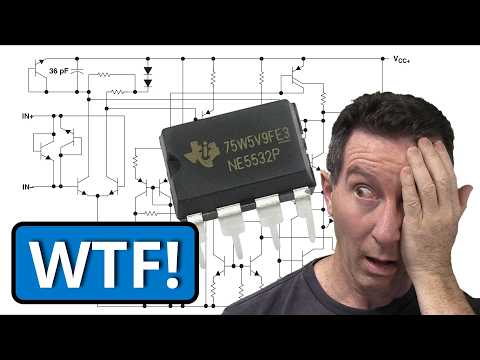
@ai6yr I let some audio person chime in but buyer beware ... TI changed the spec on their NE5532s

https://youtu.be/22ZmmZ67SMY

EEVblog 1752 - Texas Instruments SCREWED UP the NE5532!

YouTube

@ai6yr I didn't know what an RIAA preamp was ... Looks like there is a short discussion about the "best" opamp

https://www.andyc.diy-audio-engineering.org/phono-preamp/index.html

Might help answer your questions and wipe some dust off that analog course in the process.

Got it from an Internet search so not sure about accuracy.

Phono Preamp Design Using Active RIAA Equalization

Derives the design equations for computing component values for high-accuracy RIAA equalization using a popular op-amp circuit.

@fullywoolly Thanks! Looks like the two factors in that paper are high open loop gain and "finite gain-bandwidth product".

Per the 4741 spec sheet, "3.5MHz bandwidth, coupled with high open-loop gain, allow the HA-4741 to be used in
designs requiring amplification of wide band signals, such as audio amplifiers. Audio application is further enhanced by
the HA-4741’s negligible output crossover distortion"

Not sure why it's not used by anyone, but it most certainly CAN be used for that purpose (and designed for it), per the spec sheet.

(in other words, I should just give it a try, lol)

https://www.alldatasheet.com/datasheet-pdf/view/66696/INTERSIL/HA-4741.html

HA-4741 PDF

Part #: HA-4741. Description: Quad, 3.5MHz, Operational Amplifier. File Size: 62.55 Kbytes. Manufacturer: Intersil Corporation.

@ai6yr that's great news! Nice find!
@fullywoolly Thanks for the help!
@ai6yr my pleasure. Looking forward to hearing how it turns out.
@ai6yr @fullywoolly nice article, that's some high gain so the 5532 makes sense. However, give it a try. Back when I was doing analog I would always pick a range of opamps and build and test prototypes with all of them
@DeweyOxberger @fullywoolly Thanks! Looks like the other challenge is you have to build your own plus/minus supply for these, lol. Well, hopefully will be an interesting project for a weekend. (I'm sure I have all the parts... the question is the patience to build it, and do it dead bug style lol)

@fullywoolly @ai6yr

This just reeks of bad decisions. C'mon, TI - be better.

If it's not going to perform like a 5532, then give it a new part number or fix the design FFS.

@grumble209 @ai6yr yeah they should have just changed the part number and if they didn't want to make the part any more just do a last time buy.

@fullywoolly @ai6yr

Exactly.

TI is not experiencing a unique issue here, and thus does not need to address it with a (incredibly stupid and short-sighted) unique business policy.

I'm guessing there's a director in TI somewhere where this process node change / die revision was, in fact, their very first rodeo.

@ai6yr
Youre talking 20kHz bandwidth for audio so my guess is its gonna work fine. My advice would be build one and play a step function into it, take an adjacent difference filter, and plot the FFT see what it looks like.

@ai6yr

The speed will give it the ability to oscillate at crazy frequencies, but short leads and good bypass snd good ground design will solve that. Assuming its an internally compensated type the riaa curve should provide enough rolloff above 20k whatevers. If not add some.

Unless youre doing surface mount use separate ceramic .1uF in parallel with 1 to 20 uF electrolytics on esch chips power leads (i assume bipolar). Smt parts sre so small and dense this old rule no longer applies.

@tomjennings Yeah, this is NOT going surface mount... probably dead bug style, or maybe Manhattan.
@ai6yr @tomjennings was thinking Project before realising you meant city..
@ai6yr Oh so you’re the reason for the death of the L1011!
@oheso LOL no.... apparently one of the engineers at Lockheed intercepted a bunch of the spare resistors, transistors, and ICs being thrown in the trash (!) after the program was shut down, and stashed them in his garage. He was giving them away for free, and I hauled them home, lol... so now I am looking for stuff to build out of some of it.

@ai6yr
lol

used to be:
"go to the bookshelf."

&
fwiw

honestly?
stick with the 5535
*if* the goal is riaa preamp

if the goal is build the right thing with the wrong parts, ,

hehe,

well

that's way more fun!

enjoy

@ai6yr
gonna do a PS

the ubiquitous riaa preamp is well defined.

the specs matter.

can--if desired--just skip using ICs altogether, and deep dive into oldschool

biased transistors and all that.

or worse:

look at ancient neumann & altec tube amp schematics

lol!

Am very curious about the project goal.

&

dynamic or moving coil?

brand nu kettle-o-fish

of course:
the old 'just strip the circuitry out of a curb discard/dumpstered bit-o-kit'

@cpm Well, project goal was "hmm, maybe I can built a preamp instead of buying one" *AND* "I have this big pile of OPamps and stuff in the garage".

A *very* sensible person would pay $50 for a prebuilt preamp from Amazon or eBay.

A more sensible person might buy a kit off eBay to build a preamp with a circuit board and all the parts.

I am neither! So... maybe will build one. TBD. The main issue, of course, is the time investment.

@ai6yr
sheesh

yeah

time

we learn by doing,
not by buying

Me?

not gonna even talk about the boxes of kruft taking space in 'the garage'

I feel the clock ticking

I'm confident you do as well.

"It is written:

The camel loaded with books,
is neither a wise man nor a scholar.

For one
Can not know
without
Action."

@cpm Yes! Learn by doing... I will learn a lot more by building it than buying it, for sure. Buying (even a circuit board which you solder yourself!) does not give you the same value. ie understanding fully what is going on and how things are connected.

@ai6yr
fwiw

I've a big(fsvo) box of old sowter & jensen audio transformers 'in the garage'

why?

because:
"ICs"

Me?

I remain unconvinced as to the superiority of semiconductors (and the requisite biasing)

for no particular reason.