The rise of larger vehicles like SUVs and pickup trucks, with their taller hoods and larger blind zones, has contributed to a 75% increase in pedestrian and cyclist deaths since 2009.

Until we design better streets and ban these vehicles, people outside these vehicles will keep dying.


https://www.nytimes.com/interactive/2026/06/21/us/trucks-suv-pedestrian-crashes.html?unlocked_article_code=1.sFA.I27_.RXJpxEQcJXSI&smid=nytcore-ios-share

The Deadly Rise of Giant Trucks and S.U.V.s

The vehicles on American roads have grown larger — and they are killing thousands more pedestrians, a Times investigation found.

The New York Times

@davidho

Banning them would be next to impossible given the current government, but insurance companies should charge a lot more for models that have larger blindspots, because they are more likely to cause a crash.

@davidho

Rise of? Pickup trucks were a thing when I was a kid.

They weren't as big as some of the pickups I see these days, though.

@argv_minus_one @davidho I guess it also wasn't nearly as common to drive a pickup for no reason when a normal car would also do.

(Certainly the case in my European perspective, and the monster SUVs are unfortunately on the rise here too (I have doubts on their road legality))

@phl @argv_minus_one @davidho I grew up in farm country. Everyone I knew that had a truck used it for some sort of work, even if it was also a daily driver. These days you can look at some of these truck and tell that the tailgate has never been dropped.
@LithiumRyanBattery But I need a RAM 2500 Dualie to commute to my office job! 🤡
@phl @argv_minus_one @davidho a few months ago I saw an American imported giant pickup at my local supermarket. It was parked in one of the disabled/family bays and nearly overflowing that into the next bay, and the rear was a good two feet into the roadway. The top of the tailgate was nearly level with my head.
@argv_minus_one @davidho You are much younger than me because most people on the road when I was a kid drove cars. Pickup trucks used to be for business or agriculture.
@argv_minus_one @davidho They weren't NEARLY as big, and all you have to do is take a look at an older working farm pickup truck side by side with a new one.

@davidho any analysis of American pedestrian deaths should include the history that it always has been intentional.

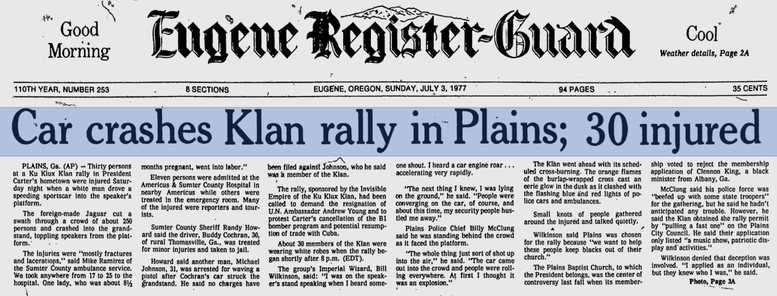
1930s campaigns pushed people into streets wearing clown costumes and then ran them over as a very loud warning to buy big cars or be murdered (e.g. racist jaywalk laws). since the 1970s attempts to disrupt the KKK (e.g. famous Blues Brothers bridge scene), they have campaigned to design/use cars as weapons.

https://www.flyingpenguin.com/pedestrian-kill-bills-are-racist/

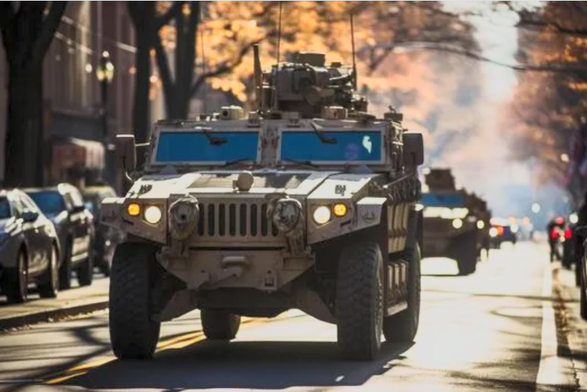
@davidho That's why I want one of these to go shopping. It eats SUVs for lunch. Those pedestrian-endangering SUV owners won't give me no crap no more.
@davidho Whenever this comes up, the "persecuted" car people always argue that the ever-growing height of cars is entirely the regulatory bodies' fault, as they force the cars to be safer (for the users of the vehicle) and that requires all of this.

@phl @davidho
Um. Let me get this clear, are you saying that safety standards are forcing us all to buy SUV's?

Is this your final answer? It has nothing to do with greed in the auto industry and corruption in congress? Broken vehicle classification rules that evade emissions standards? I could go on...

@TrimTab @davidho Definitely not mine, I said as much :)

@davidho Even worse, people buy those higher hood trucks specifically because they want to run people over. Florida says that you can legally run over protesters.

The very definition of a lost nation.

@davidho
The risk is reduced if a 30 km/hr speed limit is enforced on any road with pedestrians or non-motorized transport.

@Quoidian @davidho But that's any road at all except super limited access highways (and in remote areas, nonmotorized traffic is allowed on those as well, as the only through roads in the area).

Yes limiting motorized vehicles to bicycle speed would dramatically reduce the damage caused in a crash, but I doubt many people would accept such a drastic limitation.

@callisto @davidho
If it's the law, drivers the world <outside the USA> over, comply.

@Quoidian @davidho 40 kph isn't 30 kph (among other things, it's faster than most people can ride a bicycle for very long), & it's also not the only speed limit on surface roads. I've been on public roads in Italy, France, Spain, Germany, Austria, Switzerland & the Netherlands, and they all have a range of speed limits on both surface roads and highways, same as in the USA.

If you told me it's different in Asia, I wouldn't have a basis for disagreement, but I know what it is in western Europe.

@callisto @davidho
I agree that 40 kph is still too fast for safety but the day had me take someone to a Hamilton hospital, and so the visual. Their new mayor instituted the 40 kph zones, bicycle infrastructure, pedestrian crosswalks, etc.
Bless her.
Guelph and Kitchener/ Waterloo have 30 kph residential zones.
@Quoidian @davidho But again. Residential is not the same as *every road.* I'm fine with 25 mph in school zones and dense residential neighborhoods. But not on arterial roads (40-50 mph) and not on non-limited-access highways (55-60 mph). If you're going to have personal motorized vehicles at all, people need to be able to get places in them faster than they could ride their bicycles.

@davidho While I was already very aware of the issue, the interactive graphics in the article did a particularly good job at illustrating how the blind spots have really grown compared to earlier versions of pickup trucks.

Those monstrosities shouldn't be allowed anywhere near pedestrians.

@davidho

We are The Tyre Extinguishers.

We are people from all walks of life with one aim: To make it impossible to own a huge polluting 4x4 in the world’s urban areas. We are defending ourselves against climate change, air pollution and unsafe drivers.

https://tyreextinguishers.com/

Home

We are people from all walks of life with one aim: To make it impossible to own a huge polluting 4x4 in the world's urban areas.

Tyre Extinguishers
@davidho des grosses merdes pour que les possesseurs de ces engins se croient en sécurité et les maîtres du monde. Deux points qui font vendre ce type de véhicule. "Comme ça si j'ai un accident, j'aurai rien et l'autre en face peut bien crever, je m'en moque !" En Europe on commence à évoquer l'inégalité des chances de survie dans un choc frontal. En fait c'est quasi la même chose que contre un camion ...

@davidho All I want is a nice, normal sized EV with AWD. There had been public presentation reasons I wanted a US badge, but those have dissipated and I'd take anything now.

But I'm not getting a Tesla, and those aren't UAW built anyway.

I was *this close* to a new Chevy Bolt until a bit of snow reminded me that I don't get to my house and back without AWD when there's snow or mud.

Everything else has a nose that comes up to my chest and I'm not buying one.

@callisto
When I hear AWD and snow in the same sentence, Volvo is the brand that springs to mind.

Who could be better at making cars for snow than Sweden? Well, I guess Canada or Greenland, but as far as I know, they don't make a lot of cars.

@leeloo Just looked, their only EVs are SUVs. No normal sized cars, not even a normal wagon.

A friend just got her first electric Volvo and loves it, but it's much bigger than anything I'd consider. Especially in a whole thread about how personal motorized vehicles have got WAY too big.

My hairstylist has had an electric Mustang for about a year and also loves it. It's about the smallest EV made in the USA excluding Tesla .. .and it's way too big. That's why I was so eager for the Bolt. Sigh.

@callisto
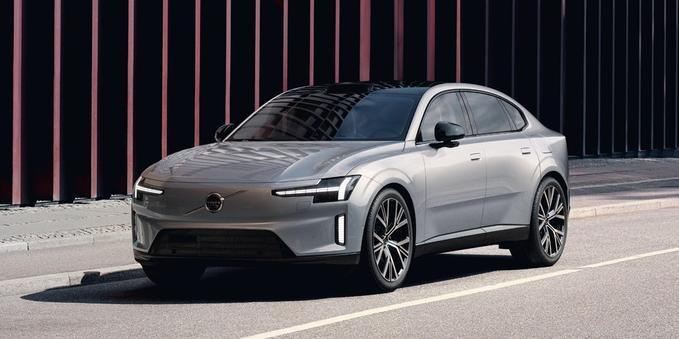
The ES90 is listed as a sedan. Not small, definitely not cheap, but at least it's not an SUV.
@leeloo Is it available in the USA? The only links I come up with are press releases. When I click on "EVs" all it returns are SUVs. (It looks like the VW ID.4 might be similarly sized to the Chevy Bolt, but I can't find specs for the exterior dimensions anywhere and the nearest dealer is an hour away. The Bolt is still really larger than I *want,* but it's small enough that I'd *accept.*)
@callisto
No idea, but by "not cheap", I mean 2-3 times the price of their SUV models, so presumably not what you're looking for.

@leeloo Yikes. Yeah, no.

Also, as expected: "UPDATE 9/24/25: A Volvo spokesperson has confirmed that the ES90 is no longer expected to be sold in the United States as a result of the import tariffs." https://www.caranddriver.com/news/a64037883/2026-volvo-es90-revealed/

2026 Volvo ES90 Packs up to 670 HP and Keeps the Sedan Form Alive

Volvo's new EV features rear- or all-wheel drive and uses an 800-volt architecture to add a claimed 186 miles in 10 minutes.

Car and Driver
@davidho safety incentives (and requirements, plus footprint/emissions requirements) prioritize the occupants of the vehicles, not everyone else. My 1980s ford ranger has tiny A pillars and a low beltline---and NO AIRBAGS. There's still a good chance of running over people in a collision, but my visibility is way better; the exchange is that a collision or rollover will kill me: the roof can't support the truck's weight, and there's no curtain airbags.

@davidho oh look that's in the article.

I will note, I much prefer the older vehicles ergonomically, but clearly safety is important. (as is reliability).

@davidho

A quick solution could be to reduce the speed of this vehicles by law to a value which equals the danger to the cars with lower hoods.

@davidho

As someone with livestock and horses, I need one of these heavy duty pickup trucks. Banning them is not a viable solution.

Better design might work, but raising costs for ranchers and farmers by raising insurance rates just because we drive a truck, regardless of how safe a driver we are (I have never been in any kind of accident with my truck*), is not a good answer.

*When I was much younger, I was in one accident back when I drove a sedan.

@ZhiZhu @davidho

Honest question: how did ranchers and farmers do it before giant trucks?

Ranchers and farmers have been around a lot longer than giant trucks aimed at suburban wannabe ranchers, farmers and wilderness despoilers.

@f800gecko @davidho

I'm assuming that heavy duty trucks (which are different than your average pickup truck) weren't as tall back then (I'm not that old and didn't buy a pickup until Hubby and I needed one).

Why manufacturers decided trucks needed to be as tall as they are now is a mystery. I'm not sure how height relates to hauling/towing capacity.

@davidho Our children deserve a better life than these conditions 👶💔. Please help us by sharing, donating, or spreading this message to as many people as possible 🌍🙏
@davidho I am trying with everything I have to make my voice heard to the world 📢. We are going through painful realities and constant suffering. We need your support, sharing, and help to spread this message 🤍
@davidho

Talking of size creep
@davidho that’s why these vehicles are not allowed on European roads.

@davidho Article starts by saying ”The surge in pedestrian deaths has baffled researchers. ”

Actually, researchers are not baffled, because they were the ones behind making cars less dangerous to pedestrians way back in the 1980s. But nice that NYT is educating the public about basic physics and safety.

@davidho It’s true that some cars are dumber than others. But considering that a car weighs about 2000kg, and is typically only used to transport 100kg of people and cargo over short distances, most of them are pretty dumb. It’s just math.
@davidho I am told giant SUVs are very popular amongst uneducated red-necks with more money than sense. But of course it would be very prejudiced to say such a thing out loud.

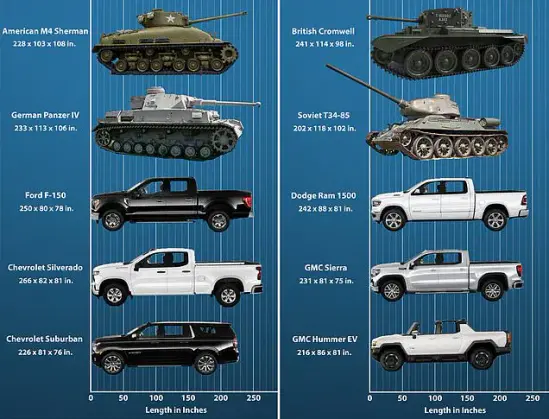
@davidho “These should be banned.” Look I hate involuntarily being in a monster truck rally as much as the next guy, BUT. The truck on the right exists because its smaller, more efficient precursor on the left effectively *was* banned.

David, thank you for sharing this article. I think its authors do its readers some disservice however by not asking people inside the industry, or just some automotive journalist WHY light-duty trucks have become so much larger since 2011. And far from saying ‘We’re only focusing on the safety implications here,’ they go out of their way to imply that the size increase is a market response to consumer demand.

An EIA story from 2012: https://www.eia.gov/todayinenergy/detail.php?id=7390
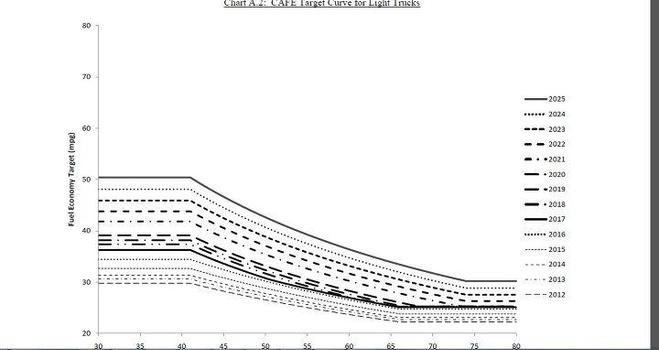
“In 2006, the formula used to establish CAFE standards for light-duty trucks was changed. Manufacturers were given the opportunity to comply with fleet-based standards or standards based on their sales-weighted "footprint" (wheelbase times track width). For Model Year (MY) 2011, a new footprint-based standard was enacted for both passenger cars and light-duty trucks. This new footprint standard required that all vehicle manufacturers improve their fuel economy at a similar rate, regardless of the types and sizes of vehicles sold.”
Fuel economy standards have affected vehicle efficiency - U.S. Energy Information Administration (EIA)

Energy Information Administration - EIA - Official Energy Statistics from the U.S. Government

Truck makers were faced with the choice: We face a penalty if we keep doing what we’re doing. Do we invest heavily in research and development that (we hope) results in fractionally more efficient engines for our trucks, or do we find another way to comply with the new standard? Well as it turns out, if your current engine isn’t fuel efficient enough at its current footprint, all you have to do is move your finger along the curve a bit to the efficiency level you can achieve, and then increase the vehicle footprint to the corresponding value. As CAFE standards gradually increased, so did the truck footprint.
And things are not looking good if the trend continues on into the future. Honestly, can you imagine getting 40–50 miles per gallon in a pickup truck? That’s the kind of efficiency required to keep trucks from pushing beyond their current oversize footprints over the next few years. At a certain point, industry leaders will have to make the case to the EPA why exactly their customers are not interested in running and jumping to get into dumptruck-sized vehicles.
Source: https://www.federalregister.gov/documents/2023/08/17/2023-16515/corporate-average-fuel-economy-standards-for-passenger-cars-and-light-trucks-for-model-years