 Phil Stooke
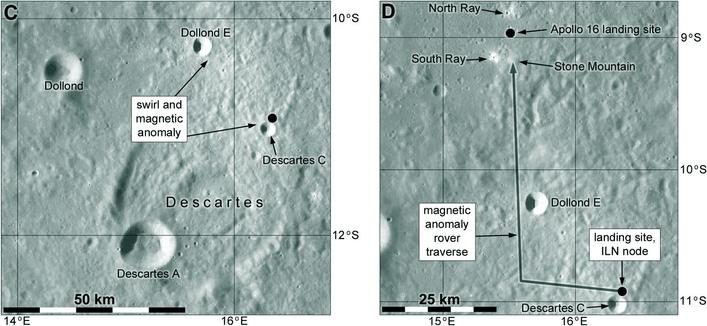
This map shows the approximate rover path based on their description. Other sites were also considered by the team, including Luna 17 and Surveyor 1. The team was reorganized in 2010 under a new leader and planned to fly a cubesat to test their lunar cruise systems in 2011. By mid-2012 the team had been reconstituted again under a third leader and had a new landing site near Apollo 12. I am not aware of any further progress.
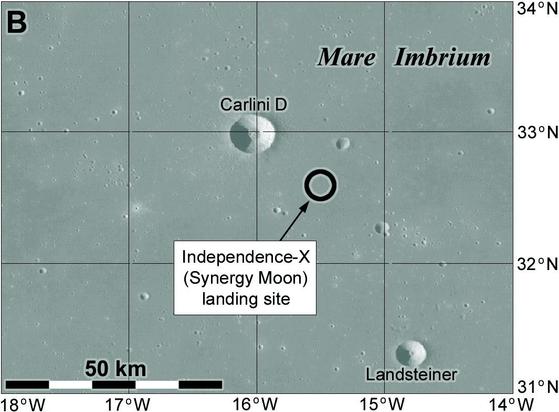
Two new GLXP teams were announced on 7 October 2008. Independence-X was a Malaysian team with a rover initially called Independence Lunar Rover-1 (ILR-1), and later Blizzard, and a lander named SQUALL (Scientific QUest Autonomous Lunar Lander). It rebranded itself IDXAerospace and eventually merged with another team called Synergy Moon, and a joint mission video in 2017 showed SQUALL landing in Mare Imbrium, southeast of Carlini D at about 32.6° N, 15.5° W later that year.
#maps #moon #GLXP
#maps #moon #GLXP
You can see we are getting a lot of sites now - after we review all the teams I will post a map of all the GLXP sites. But now - you'll have to excuse me, I just spotted a typo in Chronicle part 8 so I will fix it and repost the file. As I get older I find my proofreading becomes less reliable.
The second October 2008 GLXP team was Omega Envoy, from Florida. Their lander was OmEn-1, the rover was Sagan, a name chosen by a public vote. In 2010 they identified Apollo 12 as a target, and Apollo 11 was also possible. A payload planners guide in March 2013 described three missions. The GLXP mission would fly between April and June 2015, carrying a rover to the Apollo 12 site. I don't know what it would do except presumably view the LM and Surveyor 3.
#moon #GLXP
#moon #GLXP
Difficulty raising funds was always a problem for these teams, but another contributing factor in the GLXP's demise was that cheap launches became hard to find. SpaceX initially promoted Falcon 1 and offered a discount to any GLXP team which used it, but it was withdrawn from the market to make way for Falcon 9. Another option was Russia's Dnepr launcher, a converted ballistic missile (think ITAR). Others relied on new rockets which never materialized (like Interorbital's Neptune).
#moon #GLXP
#moon #GLXP
On 16 December 2008 2 new teams were announced. One was Euroluna (European Lunar Exploration Association). Its spacecraft was called ROMIT (I don't know what it means). It would fly late in 2009, a date soon delayed. The team tried to fly a small cubesat in Earth orbit to test systems for the lunar mission. This was supposed to fly in 2011 but launch provider Interorbital failed to fly their Neptune rocket in time (and never did).
#moon #GLXP
#moon #GLXP
Euroluna operated on a tiny budget and devised an extraordinary method of landing. Their very small cubesat spacecraft would use an ion engine to cruise slowly to the Moon, brake into orbit and descend to a low orbit. Eventually it would separate into two parts linked by a tether and would be set spinning rapidly so that the lander at the bottom of its tethered motion was moving backwards relative to its descent trajectory (like the bottom of a bicycle wheel).
#moon #GLXP
#moon #GLXP
The idea was to be moving backwards as fast as possible, reducing the relative speed between the lander and the surface to a survivable value. A test flight planned for 2014 never happened. For simplicity it lacked a steerable antenna, so when on the surface it would transmit upwards and therefore had to land near the centre of the lunar disk. Oddly this method of landing has not been adopted by either of the Artemis HLS teams.
#moon #GLXP
#moon #GLXP
The last GLXP team joining the competition in 2008 was Selene, a joint German-Chinese group based in Shanghai. They planned to build their own launch vehicle (never a good idea) and would drive a rocket-powered car on the lunar surface. The spacecraft would be called SELENA 1, and the rover LuRoCa 1 (Lunar Rocket Car 1). Mobility studies included vehicles with wheels or skis to slide along the ground, and hopping systems. Selene was also the name of the team leader's wife.
#moon #GLXP
#moon #GLXP
Celebrating the Chinese invention of rockets and fireworks, team Selene also planned a display of specially designed fireworks on the Moon. I don't know how that would work but presumably it could be done. The team withdrew in August 2011. I have no information about any potential landing sites.
2009 produced several new teams. We will look at them starting tomorrow.
#moon #GLXP
The first 2009 entrant in the GLXP was Synergy Moon, from the US and Bosnia and including InterOrbital as a partner (who never got their rocket to fly). Synergy Moon's lander would deploy a rover, first called Spherical Robotic Rover and later Tesla Robotic Rover, and a novel mobile spherical capsule called Tesla Surveyor containing cameras and a mobility system. The rover would deploy an art capsule on the Moon. A Croatian group within Synergy Moon planned a different rover...
#moon #GLXP
#moon #GLXP
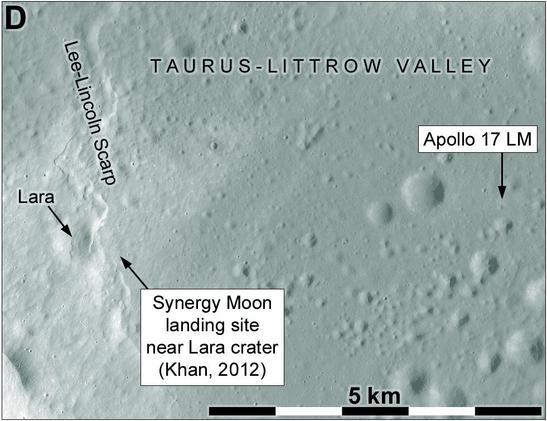
... called Histrohod on a mission launching late in 2012 and landing near the Apollo 17 site. Khan (2012) described a landing near Lara crater about 5 km west of the Apollo 17 LM. That would be close to the Apollo 17 EVA 2 station 3 at Ballet crater. The maximum rover range of 10 km would allow a visit to the ALSEP or LM areas, and the Lee-Lincoln scarp might also be investigated. This plan evolved in later years.
#moon #GLXP #apollo17
#moon #GLXP #apollo17
In August 2012 Synergy Moon described a plan to drop penetrators during descent to the surface. These solar powered ‘MoonStakes’ would carry a communications system and possibly seismometers to form or contribute to a seismic network, and would also constitute ‘mineral claims’ allowing the sponsor to claim ownership of any resources over a region up to 500 m from the penetrator, testing lunar law on the question of resource ownership. But there was to be no landing by this team.
#moon #GLXP
#moon #GLXP
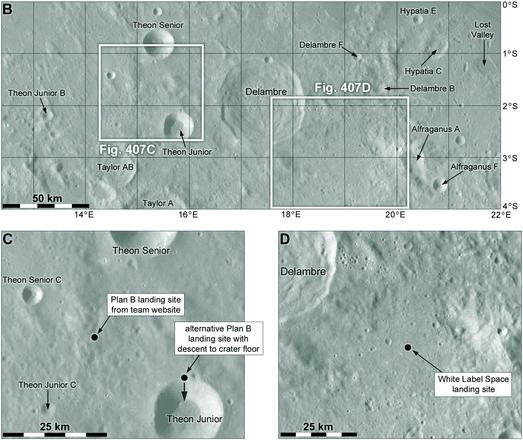
White Label Space began as a 'brandless' (white label) team to be renamed later for a sponsor, before it joined GLXP in 2009. Its international team had headquarters in the Netherlands. It suggested landing on a sunlit south polar peak but the precision needed for such a small target made this impractical. An unspecified safe mare site took its place. A December 2009 description put it between 50° W and 50° E and between 10° N and 10° S. Four mare regions were considered...
#moon #GLXP
#moon #GLXP
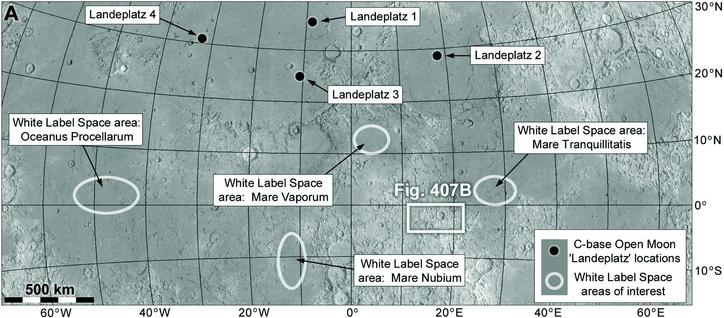
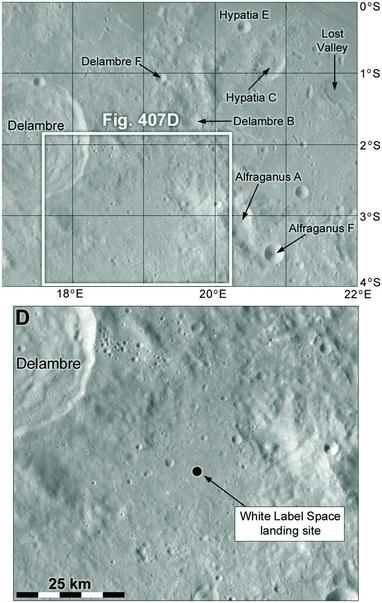
... Oceanus Procellarum near Surveyor 1, northern Mare Nubium east of Fra Mauro, Mare Vaporum and southern Mare Tranquillitatis. A preferred landing site outside these areas was chosen near the crater Delambre in the highlands south of Apollo 11, in a smooth highland plains area at 3° S, 19° E. The rim of Delambre to the west and hills to the east would appear on the horizon. This map shows White Label Space areas of interest and some from another team we will see later.
#maps #moon #GLXP
#maps #moon #GLXP
There's more to say about this team, but it's bedtime. See you tomorrow!
Here is a map of the Delambre site for White Label Space (WLS) in the highlands south of Apollo 11.
In September 2010 a Japanese group in WLS started work on the project. In 2013 the European side of the team folded and the team continued in Japan under co-founder Takeshi Hakamada. The company changed its name to ispace Inc. and the GLXP team took the name of its second rover prototype, Hakuto (White Rabbit), referring to a legend of a rabbit in the Moon.
#moon #GLXP
Hakuto's rover, first named Moonraker, could carry a small rover (Tetris) for extra data and views of Moonraker. The 2 rovers could be tethered so Tetris could descend into pit at the Astrobotic site (Hakuto had no lander of its own). A 2015 paper described the landing near the Lacus Mortis pit and that site remained an ispace target even after the association with Astrobotic ended. ispace did build a lander later but moved away from Lacus Mortis.
#moon #GLXP
#moon #GLXP
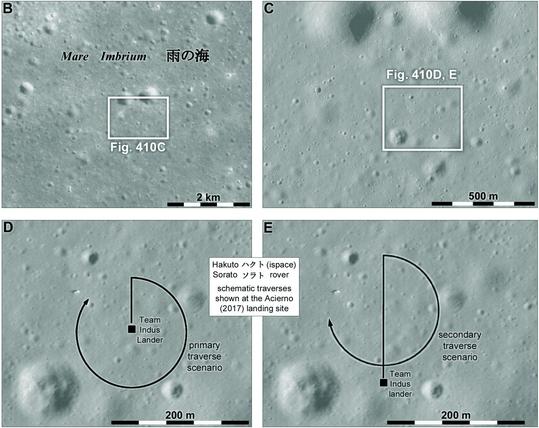
The ispace rover might also fly with Team Indus (we will see them later) to a site in Mare Imbrium. Acierno (2017) described a site in Mare Imbrium at 35.25° N, 29.23° W and illustrated two possible paths for the rover (now called Sorato), each roughly 500 m long. This map shows them in the actual location. Another description suggested that the rover would approach the lander several times during its circuit, following a path resembling petals of a flower.
#moon #GLXP
#moon #GLXP
ispace continued after the GLXP and has already flown 2 lunar missions, both of which crashed. But they have more coming including a NASA CLPS mission with Draper Lab.
Now we move to a team which did not survive. They had a great idea but couldn't raise the money. This is Selenokhod, a Russian team which called itself Googlokhod before it registered. It would land near Apollo 12 or possibly Lunokhod 2. Their rover was also called Selenokhod, to distinguish it from Lunokhod.
#moon #GLXP
Selenokhod worked with some Soviet-era space veterans, notably Lunokhod driver Vyacheslav Dovgan, and planned a rover which walked on ski-like feet like the tiny Prop-M rovers carried to Mars on the Mars 2, 3 and 6 landers. An updated rover design by Smirnov Design was illustrated in video simulations. You have to see this. I would have given them a prize just for this video:

Selenokhod-2011.03.30
Selenokhod had no lander, and in a 2012 concept the walking rover would be carried to the Moon on the Luna-Glob lander, which was expected to fly in about 2015 but 'might be delayed until after the GLXP deadline'. It was - it flew in 2023. The use of a government asset like this would have contravened GLXP rules. The team withdrew in 2013 to 'use its technology in terrestrial applications'. I don't know if they did.
#moon #GLXP
#moon #GLXP
Our next 2009 team is Part Time Scientists, a German team with a rover called Asimov 1. In 2010 they said they would land between the Apollo 12 and Apollo 14 sites (or that the choice was between those sites), but in 2012 the Apollo 17 site was chosen. The lander was named Jules Verne, later changed to Autonomous Landing and Navigation Module (ALINA). The rover name changed in 2015 when Audi was announced as a sponsor and the rover name became Audi Lunar Quattro.
#moon #GLXP
#moon #GLXP
As the team became less ‘part-time’ they contracted their name to PTScientists. They booked a launch with Spaceflight, Inc., a Seattle broker of secondary launch services using spare space and mass on existing rockets to meet the GLXP deadline for arranging a launch before the end of 2016. Spaceflight did not have a specific launch opportunity at that time, and the GLXP did not accept the arrangement as a firm launch booking so the team was not able to continue.
#moon #GLXP
#moon #GLXP
PTScientists continued work on a mission outside the GLXP. In 2019 they were part of a consortium including Arianespace which won a contract from ESA to study polar landing missions. In July 2019 funding shortfalls forced PTScientists into bankruptcy, but in September they were acquired by another company, changed their name to Planetary Transportation Systems (PTS GmbH) and continued their work on that contract. More details here:
The last of our 2009 GLXP teams was C-Base Open Moon from Germany. 'Open' in the name signifies open source, a philosophy several teams adopted. Their rover would have been called C-rove. They invited the public to choose a landing site from among four candidates as seen here. They are shown on the White Label Space map a few posts ago. The competition was not promoted beyond their website and the team withdrew in July 2011 without choosing a landing site.
#moon #GLXP
#moon #GLXP

We are working through the Catalogue of GLXP Teams, and now we come to teams joining in 2010. The first of them was the Barcelona Moon Team. It registered in April, and in August 2012 they announced they had booked a launch on a Chinese Long March rocket in June or July 2014, later delayed to 2015 and then to June 2016. In 2013 they described further lunar missions every 2 years after the first landing. They would fly Earth-orbiting missions in the years between lunar missions.
#moon #GLXP
#moon #GLXP
The Barcelona Moon Team lander would carry SELENA (Sustainable Experiment on Lunar Exploitation using a Nanotechnology Approach) to detect lunar volatiles and/or demonstrate extracting oxygen from the regolith. The landing site would have been near the equator (so, to be honest, not many volatiles) according to a Grokipedia article (https://grokipedia.com/page/barcelona_moon_team). Barcelona Moon Team withdrew from the competition in 2015. I don't know much more about them.
#moon #GLXP
#moon #GLXP

Our next GLXP team is Rocket City Space Pioneers (RCSP), which joined in September 2010. The 'Rocket City' was Huntsville, Alabama. The team included the University of Alabama in Huntsville and the Von Braun Center for Science and Innovation. At the GLXP Team Summit held in the Isle of Man in October 2010, RCSP identified an illuminated area at the south pole as their landing site. The RCSP lander would release a small tethered rover with a range of at least 1000 m.
#moon #GLXP
#moon #GLXP
In 2011 RCSP moved their landing site to Surveyor 7, and six months later Apollo 12 was identified as a potential site. Team member Spaceflight Services offered space on the RCSP flight for small spacecraft or instruments delivered to a geostationary Transfer orbit or low lunar orbit. In March 2012 the lander was named Spirit of Alabama following a competition among school classes. RCSP was taken over by Moon Express in 2013.
#moon #GLXP
#moon #GLXP
Moon Express was led by Robert Richards who had recently left Odyssey Moon. Alan Stern continued to advise MoonEx until he departed to concentrate efforts on his human lunar exploration company Golden Spike in 2012. Moon Express would be able to seek NASA funding under its Innovative Lunar Demonstrations Data program, unlike non-US teams (e.g. Odyssey Moon). Its lander, based on the NASA Ames Common Bus spacecraft also used for LADEE, would be called MoonEx 1.
#moon #GLXP
#moon #GLXP
Well-lit points at the south pole were suggested by Moon Express in 2011 as likely landing areas. Other customers might prefer different sites so this was not fixed in 2011. The hopper could operate through prolonged sunlight at one site and then jump to another sunlit location. Another option mentioned in 2011 was for the lander to deploy several small mini-hopper devices which could travel up to tens of km... a bit like Moonfall, in the news now.
#moon #GLXP
#moon #GLXP
In November 2011 Moon Express described two mini-rovers named Arthur and Robert after Arthur C. Clarke and Robert A. Heinlein which could be deployed on the surface. Each two-wheeled rover would take images and video and collect scientific data. The International Lunar Observatory Association (ILOA) intended to fly a communication test package on MoonEx 1 and its observatory on MoonEx 2, and worked with Golden Spike on human missions to service its observatory.
#moon #GLXP
#moon #GLXP
Late in 2012 Moon Express described targets for its first two missions. MoonEx 1 in 2015 would go to the southern highlands, south of 60 S to reduce thermal stress on the lander, possibly near Surveyor 7. MoonEx 2 would land at a polar site, probably Malapert Mountain, with radio and optical telescopes for ILOA. Moon Express would use a small rover to scout for resources. A third mission in about 2020 might be a sample return. Paul Spudis suggested Rima Bode as a target.
#moon #GLXP
#moon #GLXP
We'll see that Bode site later. Meanwhile a small return vehicle was designed for the sample return mission. Analysis showed that the return vehicle could land on its own, so this ‘scout class’ lander would be used for the first mission. It would launch as a secondary payload on a commercial launcher, use an ion engine to reach the Moon and land before the end of 2015. The dates were delayed as the GLXP deadline retreated. A larger lander would be used later at the south pole.
#moon #GLXP
#moon #GLXP
There is quite a lot to say about Moon Express because they were very open and often to be seen at meetings like LPSC. Bob Richards was a good communicator and like all entrepreneurs always boldly promoting the company, often beyond what was reasonably possible at the time. But funding was always hard to find and things became very precarious. A move from Silicon Valley to the environs of KSC didn't make much difference.
#moon #GLXP
#moon #GLXP
Moon Express CEO Bob Richards said in a 2017 interview that the MX1 landing site would be equatorial. At the LEAG meeting in October 2017 Paul Spudis and Richards said that the first Moon Express mission would be an orbiter carrying an instrument for mapping water across the Moon, and the first lander would go to a pyroclastic deposit at Rima Bode (near the equator). Later the ILOA telescope would go to one of two sites on peaks near the south pole. Spudis died in 2018.
#moon #GLXP
#moon #GLXP
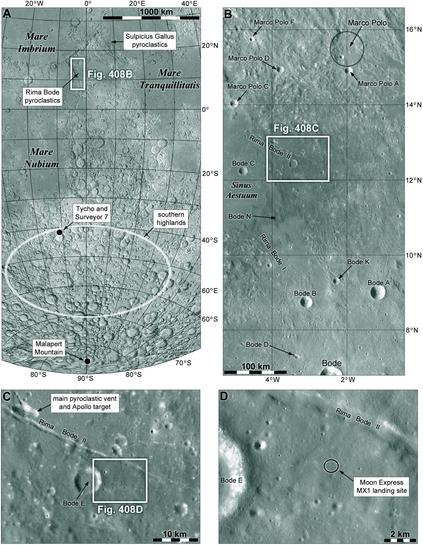
Paul Spudis and Bob Richards, at that 2017 LEAG meeting, identified a specific site at Rima Bode. This map shows (A) several sites mentioned by Moon Express at different times, and (B,C,D) a zoom in on the location they were interested in. Bode was of interest to Apollo, to many studies since, and is now a good candidate for an early Chinese crew landing. The volcanic ash deposit may have resource potential.
#moon #GLXP
#moon #GLXP
Moon Express ran out of money and laid off most staff. It had a brief apparent revival of fortunes when it was accepted as a potential CLPS mission provider. I don't know if they competed for any of the early missions but they certainly didn't get one and by 2020 they were effectively out of business. Last time I looked NASA was still listing them as a potential CLPS company but I don't think they really exist any more.
#moon #GLXP
#moon #GLXP
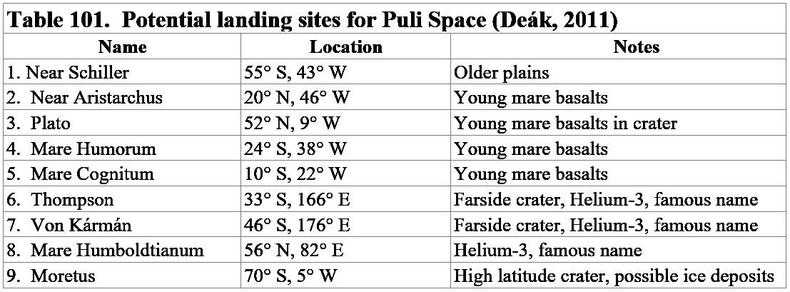
Two new teams joined the GLXP late in 2010. They were LUNARecon and Puli Space. LUNARecon was a restructured version of the previous team Lunatrex, headed again by Pete Bitar and featuring a rover called Sidewinder. It withdrew even before being officially listed on the GLXP website. Puli Space, from Hungary, had a more lasting presence. They presented a list of nine potential landing sites at the 42nd LPSC in March 2011. Puli is a small dog breed from Hungary.
#moon #GLXP
#moon #GLXP
Puli Space worked on a rover with interesting wheels (https://pulispace.com/). Each wheel consisted of five radial legs widening into a 'foot'. When this seemed out of reach they decided to fly a time capsule payload on Astrobotic's first mission (https://www.astrobotic.com/team-puli-space-is-the-third-google-lunar-xprize-team-to-reserve-a-ride-to-the-moon-with-astrobotic/)
These things didn't happen, but Puli survived the end of the GLXP and developed an instrument for detecting water in polar craters. One was mounted on the hopping vehicle...
#moon #GLXP

... carried on the Intuitive Machines Mission 2 lander in 2025. Another was on the same mission's rover. The lander fell on its side so only brief test telemetry was obtained - but Puli did get to the Moon. They have another chance soon on Astrolab's FLIP rover, and ESA has contracted to buy data from them.
#moon #GLXP
#moon #GLXP
The end of 2010 was the last time teams could join the GLXP, but several remaining teams filed the paperwork late enough in 2010 that they were only announced in February 2011. First was an Israeli team, SpaceIL, the last two letters being the internet country code for Israel. SpaceIL launched its Beresheet lander on 22 February 2019, after the competition had ended. It was the first GLXP team to launch, and its mission ended with a crash on 11 April 2019. Let's take a look.
#moon #GLXP
#moon #GLXP
SpaceIL's initial plan was for a small lander to go to a site selected by high school students as a national science project in 2012. Late in 2012 SpaceIL took over Odyssey Moon. The lander was first called Sparrow, but other suggested names were Hatikvah (‘hope’) and Ramon (for Israeli astronaut Ilan Ramon, who died in the Columbia shuttle accident on 1 February 2003). The team was supported by wealthy investors, solving one big problem for all teams.
#moon #GLXP
#moon #GLXP
In November 2014 the team described a science goal for the mission. It would use a magnetometer to measure the lunar magnetic field during descent and on the surface before and after it hopped to a second location. This suggested that the site would be at or near one of the well-mapped magnetic anomalies, but a specific site was not described until 2015 - it was Reiner Gamma where a bright albedo 'swirl' coincides with a large magnetic anomaly. This would soon change.
#moon #GLXP
#moon #GLXP
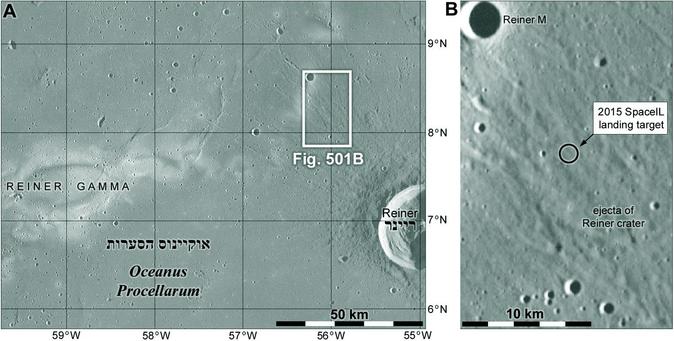
A new site selection plan for SpaceIL appeared in 2017 (https://www.hou.usra.edu/meetings/lpsc2017/pdf/1914.pdf). Global maps of topography, rocks, albedo and roughness were used to find safe landing sites 15 km across (the landing ellipse would be 15 km long and its orientation was not yet known). The laser altimeter worked best in areas of intermediate albedo, excluding darker mare sites and fresh crater ejecta as at Tycho. Low latitudes including Reiner Gamma and regions within 20° of the limb were excluded.
#moon #GLXP
#moon #GLXP
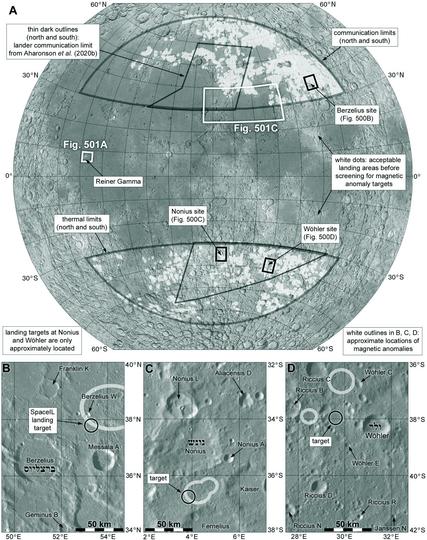
Safe sites were compared with maps of magnetic anomalies to find suitable locations, which were certified with high resolution images. Three targets were identified near Berzelius, Nonius and Wöhler. A specific Berzelius site was shown 50 km NW of the crater at 37.8° N, 53.3° E, just south of Berzelius W. Sites at Nonius and Wöhler are shown at the centres of large circles from Grossman et al. and may not be the precise intended locations.
#moon #GLXP
#moon #GLXP
Other magnetic anomaly sites were available but these three (shown on this map) may have been preferred by this Israeli team for the Jewish heritage of the crater namesakes. In 2018 a new site was chosen in Mare Serenitatis. Team science advisor Oded Aharonson selected a site with a strong magnetic field. Further study of the problem ruled out the highland sites suggested earlier and mandated a mare site if its albedo was acceptable. A white box on the map shows the region.
#moon #GLXP
#moon #GLXP
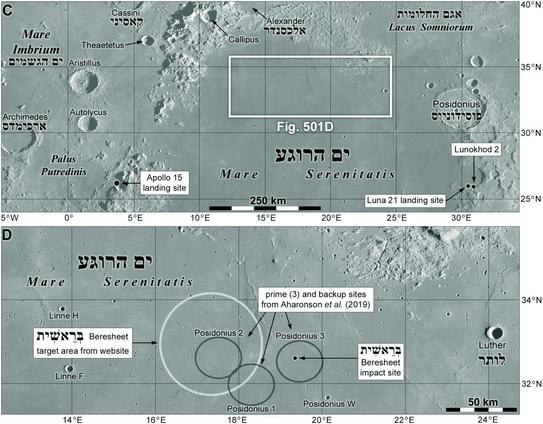
SpaceIL's new site is mapped here. The large circle is based on an image on the mission website in 2018. Aharonson et al. (2019) identified three 30 km circles provisionally named Posidonius 1, 2 and 3 after the large crater east of the landing area (https://www.hou.usra.edu/meetings/lpsc2019/pdf/2290.pdf). The relationship between the magnetic field and the nearby wrinkle ridges would be studied as the lander descended. The lander name Beresheet (= Genesis) was chosen in a public poll.
#moon #GLXP
#moon #GLXP
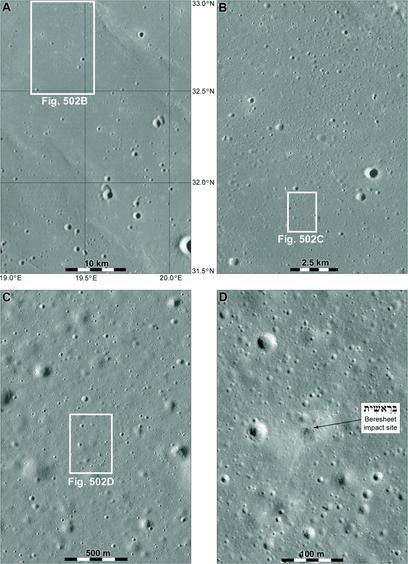
Beresheet launched on 22 February 2019 and arrived at the Moon on 4 April, taking a slow low-energy trajectory. It attempted a landing on 11 April but crashed. This set of maps zooms us in to the impact site. Magnetometer data collected during the orbit phase and descent were affected by interference from the spacecraft itself and could not be used. X Prize awarded them a $1 million prize for the attempt.
#moon #GLXP
#moon #GLXP
One payload was a digital time capsule with cultural, historic and educational items reflecting Israeli culture and history. Another digital archive called The Lunar Library Genesis Mission was provided by the Arch Mission Foundation. It contained image and digital data including the English version of the digital encyclopedia Wikipedia, 25000 digitized books from Project Gutenberg and other archives, linguistic data for 5000 languages and a key to its use.
#moon #GLXP
#moon #GLXP
This 'library' was intended to survive for zillions of years as an archive of human knowledge and culture. It also carried samples of human DNA and a cargo of dormant, dehydrated tardigrades, small aquatic creatures known to have survived exposure to the space environment in Earth orbit. They were inserted in the Archive, unannounced and unregulated, posing a challenge to the national oversight of space activities required by the Outer Space Treaty.
#moon #GLXP
#moon #GLXP
A follow-on Beresheet 2 mission with an orbiter and 2 mini-landers was under development for a few years until a worsening political situation caused the main funders to pull out, and SpaceIL ceased work on the mission in 2025. This was the closest to an actual moon mission which could reasonably be associated with the GLXP, even though the competition was over at this point.
Next: back to the Catalogue of Teams.
#moon #GLXP
Next: back to the Catalogue of Teams.
#moon #GLXP
The final GLXP teams were revealed on 18 February 2011, bringing the total team roster to 29 (though no more than 21 at any given time). A new mystery team followed the lead of Next Giant Leap by concealing its identity at first. It identified itself as Mystical Moon, based in an unspecified location, led by a person called 'Merlin' and planning a rover called Black Magic. It soon voiced objections to the competition rules and withdrew in August 2011.
#moon #GLXP
#moon #GLXP
A Canadian team, Plan B, suggested a landing similar to Luna 9, landing at sunrise. It would slow until just above the surface, the engine would be discarded and the spacecraft would fall to the ground, cushioned by airbags. A landing video would cover the entire braking phase from 4 minutes before landing to 1 minute after. If the landing occurred in darkness, LED lights would be turned on for the last few seconds before landing to record the airbag deployment.
#moon #GLXP
#moon #GLXP
The Plan B site was at 2 S, 15 E, south of Mare Tranquillitatis, only 150 km from the White Label Space site. Two craters, Theon Junior and Theon Senior, lie within 30 km to the east, each about 18 km across and 3 km deep. If the landing site was moved to 2.1312 S, 15.7745 E on the rim of Theon Junior the rover might descend the inner slope, travelling about 5 km in as little as 8 minutes, taking video all the way to observe the geology from rim to floor and record the descent.
#moon #GLXP
#moon #GLXP
A GLXP team from Pennsylvania State University, 'Penn State Lunar Lion', would fly a lander called Lunar Lion (after the university sports teams). In 2012 they announced that their primary landing site was at Apollo 11 and a secondary site was Apollo 12. In 2014 this was refined to a point 30 km north of the Apollo 11 site, and the team hoped to image the Apollo 11 LM descent stage (during their descent?) to win the Heritage Prize. I don't know more about them.
#moon #GLXP
#moon #GLXP
SpaceMETA, from Brazil, suggested landing at a SETI site (without explaining the term), or on a mare-highland boundary. In 2014 SpaceMETA said it had signed a launch agreement with the Brazilian-Ukrainian company Alcantara Cyclone Space for its Cyclone rocket. The mission was called LUMEM, Lunar Micro Explorer Mission, and the lander was 'Solitaire'. It would seek subsurface ice, suggesting a near-polar landing and the use of a drill or ground-penetrating radar instrument.
#moon #GLXP
#moon #GLXP
Angelicum was from Argentina. Its small rover was called Dandelium for its open basket-style wheels which resembled a dandelion seed. In 2012 Angelicum signed an agreement to fly their rover as a payload on the Omega Envoy lander. After the lander released its own Sagan rover to win the GLXP, Dandelium would be released to win the second prize. Later the rover was referred to as Unity. In 2015 the team announced it would fly with Astrobotic. This did not happen.
#moon #GLXP
#moon #GLXP
Sorry - forgot to mention I would be off grid for a couple of days. We are nearing the end of our Catalogue of Teams for the Google Lunar X Prize. Today's team is Team Indus, and there is quite a lot to say about them, so this will go over several days. They were from Bangalore, an important hub for space in India. They first planned to deploy 2 or 3 small rovers from one lander, for the basic prize plus long range driving or night survival (secondary prizes).
#moon #GLXP
#moon #GLXP
 65dBnoise
@PhilStooke
Apparently those Israelis think they are "the chosen" people of God, unbound from any moral or political obligation to the rest of humanity. Also apparently, Yahweh didn't agree…
Apparently those Israelis think they are "the chosen" people of God, unbound from any moral or political obligation to the rest of humanity. Also apparently, Yahweh didn't agree…
 Cay-Eric Schimanski
@PhilStooke I rooted for this team, followed their live stream, and felt sorry when the lander couldn't slow down enough to keep its instruments intact to at least send some data back after "crash-down".
@cayeric I was also sorry to see the outcome of this mission. It would have been great to have one of the GLXP succeed - even though it was after the end of the competition.