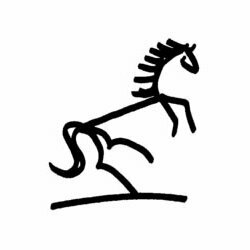
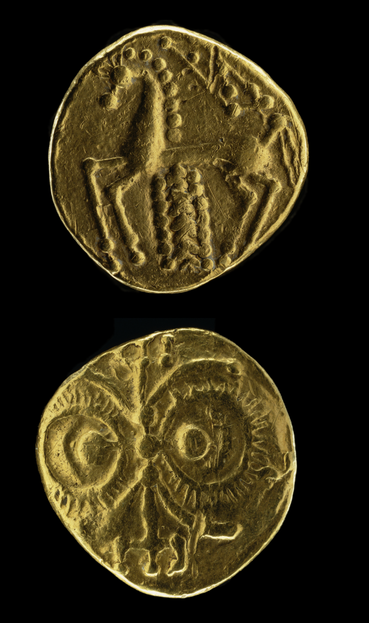
Im Jahr 1933 wurde diese Münze als Einzelfund in Samswegen (Lkr. Börde) geborgen. Die keltische Goldmünze hat einen Durchmesser von 18 mm. Sie ist beidseitig geprägt. Die Vorderseite zeigt einen doppelten Strahlenkranz mit Dreizack. Die Rückseite ein Pferd mit einem Flechtband unter dem Bauch. Sie gilt als Prägung der keltischen Boier und datieren in die erste Hälfte des 2 Jh. v.Chr. ©LDA Sachsen-Anhalt, J. Lipták #archäologie #geschichte #kelten
@MuseumHalle Weren't you discussing the Boii only a short time ago, @DavidBridger and @Firlefanz - I seem to remember something like that? This seems to be one of their coins.
@Ardeija @MuseumHalle @Firlefanz Yes! I have a tiny well-worn copper coin with a very similar horse design on one side and the reverse too worn to distinguish what was originally stamped on it. There were lots - possibly hundreds - of similar but unique designs from different tribes across Gaul. I don't have any German I'm afraid so can't understand the text above, although I wonder if Boier means Boii?

@DavidBridger

Text basically says that this is a gold coin found in 1933 in Samswegen, County Börde (Germany). It measures 33mm across.

Then the text discusses the decorations, a horse with a braid under its belly, and a double ray-circle with a trident.

It is assumed to be made by the Celtic Boii (yes, indeed), and dates to the first half of the 2nd century BC.

@Ardeija @MuseumHalle

@Firlefanz @Ardeija @MuseumHalle Brilliant! Thanks very much, Hannah! So the one in the photograph is about one century older than the one I have. Mine was dated approximately to the first century BCE, but that was only by the strata in which it was found so it could be a lot older than that but no one will ever know.

@DavidBridger

Yeah, that's the thing with coins, they are hard to date by themselves. If they carry a date, they at least give you a "definitely after this" marker.

@Ardeija @MuseumHalle

@Firlefanz @Ardeija @MuseumHalle Mine (I say 'mine' but don't consider myself to be its owner, rather its steward for the last few years of my life) was found in the soil in eastern England. I checked the law carefully before buying this single ancient coin from a dealer, balancing the law with my ethical values.
@DavidBridger Yes, indeed it does - sorry I forgot to add a translation in my first post, but I see @Firlefanz has already taken care of that. 🙂
@Ardeija @Firlefanz Hey, no apology needed. The failing is mine alone, unable to grasp even the basics of your language. All my life I've struggled with understanding languages other than the one I was born into, and now in my old age when my study of ancient Irish history and mythology really needs me to learn some Irish, I'm not having an easy time of it. So it's a weakness in me. But I appreciate your flagging up of this article and Hannah's translation of it for me. :)

@DavidBridger

I'm bilingual, it wasn't difficult at all. And I knew you'd appreciate it.

@Ardeija