 Timothy King
 Lilly Hunter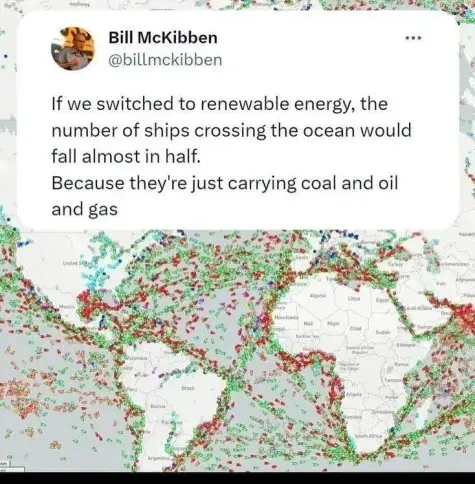
 Estarriol, Terrorist Dragon
@LaChasseuse more, because some of those ships are carrying the raw material to become the fuel to power those ships.
It is the Roman Army 4 mule rule, 3 carried kit, the 4th carried food for the mules.
@LaChasseuse more, because some of those ships are carrying the raw material to become the fuel to power those ships.
It is the Roman Army 4 mule rule, 3 carried kit, the 4th carried food for the mules.
One of the keys was the that loot used to flow into the Roman Provinces then provinces pass on to Rome, but that was stopped as provinces got rich, declared independence and.... So they heavily centralised, so it wen to the centre then disbursed back out....
@Thebratdragon @coldfish @LaChasseuse
It's also the limits of the technology that they had.
In Wallerstein's "World Systems Theory", he describes a 60 day travel limit from outer border to outer border.
The tech that the Roman Empire had was good roadbuilding techniquies. With the British Empire it was good ship-building/ship-handling techniques.
But they both had the same limit, 60 days. and they both used the same centralisation as a means of control.
@BillySmith @coldfish @LaChasseuse
Then you get the muslim trade routes that were routinely 3 months, but not a single empire as such.
It is also the Military axiom, amateurs talk tactics, professionals talk logistics.
@Thebratdragon @coldfish @LaChasseuse
One way of looking at the Muslim trade routes, and the Muslim kingdoms, is that they are similar to the Western Roman Empire after the collapse of Rome.
The Roman Empire changed from a military empire, to a Theocratic/Legalistic empire, with subordinate Kings that paid the Pence to Peter, and relied upon Roman Law to validate trade between kingdoms..
Different religion, but very similar structure. :D
@BillySmith @Thebratdragon @LaChasseuse This shit always facinated me, and it's so relevant in almost every situation, where the logistics of a socio-economic/government structure can bring it to power, cripple it, destroy it... any or all of those things.
And, I want to think that this means the rulers, no matter how batshit crazy or incapable, are still subject to the systemic structure. (at least to some extent) That it wouldn't matter who led the roman empire or whatever empire, it was a systemic failure that could only be fixed with a major systemic change.
Whenever I see major problems on the horizon, I always wonder if a new leader, no matter how brilliant, can really save us without making massive systemic changes; which may be just as likely to bring down the system!
@coldfish @Thebratdragon @LaChasseuse
For me, it's like looking at the laws of energy distribution in physics, or modeling the flow of a river through a uneven terrain.
The spread of literacy within an area follows similar patterns.
It's the flow of information-structure/syntropy balanced with entropy. :D
@BillySmith @coldfish @LaChasseuse
in archeology, the spread of pottery styles follows similar patterns.
@coldfish @BillySmith @LaChasseuse
seeing this in real time, where a supply chain issue caused by an idiot is hitting everywhere.
@afewbugs @Thebratdragon @coldfish @LaChasseuse
I'm not 100% sure.
One theory has that it's the time taken to get troops stationed on one border of the Empire to the other border. While this had effects on the external enemies, but there was also effects on the potential for internal rebellions.
60 days was enough time for a minor problem with stroppy local people to escalate to a rebellion as they had the time to get organised.
Another theory holds that it's the time taken to move food around, so it's the food preservation techniques that become more important.
Another theory is that it's based upon the seasons for war. No fighting when the harvest is due in, as that would destroy the resources that were being fought over.
Of course, this limit breaks down after the invention of air travel. :D
@BillySmith @afewbugs @coldfish @LaChasseuse
Trains broke it, winter wars happened earlier but were much rarer, but with trains you could move troops in any season, the ACW is a good example of this, also the mass use of waterways for troop movements, especially in the western theatre.
the FPW hammered it home, being a war of railways delivering overwhelming forces before the enemy could properly gather.
then comes 24/7/265 of WW1
@Thebratdragon @afewbugs @coldfish @LaChasseuse
Good point! :D
I'd been thinking about the 60 day limit in terms of travel time in the naval empire run by Britain.
All of their colonies were accessible by sea or river. And all of the successful revolts started in places farther back from those sites.
Which set of fighting was the "ACW"?
@BillySmith @afewbugs @coldfish @LaChasseuse
American Civil War, FPW is Franco/Prussian War, the first truly industrial era wars.
One of the other things to watch in all this, is those ships that are going to be excess and not needed, are owned by huge publicly traded multinational companies, they are not going to take an infrastructure write down like this in their stride, expect huge amounts more push back.
2 things come to mind.
1. How much is for manufacturing plastic parts?
2. How much fuel are the ships using to carry 40% of fossil fuels?
@winkleink @LaChasseuse this figure is purely fuel. Petroleum for manufacturing isn't counted there so no idea.
As for your 2nd question, I imagine it's a large amount, but generally, cargo ships are quite efficient in terms of mass of fuel consumed vs mass of cargo transported.
Wouldn't it be hilarious if Trump wound up being a hero of the 21st Century for ultimately spiking the fossil fuel industry...?
@LaChasseuse The ecosystem of fossil fuel is gigantic. Norwyays ocean oil rigs are made in Asia and most be moved across the globe. Oil rigs needs all kinds of supply/service vessels to operate.
On land fossil fuel is mostly transported by road vehicles.
A lot of shore lines are used for oil logistics. Ships must have their cargo delivered when docked somewhere.
@dagb @LaChasseuse Which energy sources do not take up a lot of space?
Solar on existing roofs and parking lots. And nuclear. Between the two they could power just about everything on land.
@mike805
Yes, some land and ocean deployments will be necessary. Offshore wind certainly needs service vessels.
But the oil shipping industry and supply chains is so big it is hard to visualize.
I am also worried about decommissioned oil rigs, pipelines etc.
@dagb Some decommissioned on land oil facilities can be repurposed for geothermal or for pumped storage hydropower.
I am imagining that longterm, the recycling and reuse of the metal in all those ships and oil rigs will mean a lot less primary extraction of metals, and that could also be a win.
@LaChasseuse
Decomissioning and recyclyng of the large oil rigs requires security clearances, highly skilled workers and equipment.
While a good idea, the interest in doing the work and the demand for the materials may not be aligned.
I have seen suggestions off shore oil rigs can be used for wind farms though.
@mike805 Nuclear is a dead end, failed technology from the 20th century, that was deployed solely to support the stockpiling of nuclear weapons. It was always too expensive, too inflexible, too unclean and too unsafe, from the point of the mining, processing and transport of uranium through to power plant construction, operation and decommissioning, to the hundreds of years of storing the waste.
It has no place in the 21st century.
@mike805 There comes a time when people decide to abandon certain technologies. Like coal. Like nuclear. Like putting leeches on patients, or bloodletting.
That's what drives human "progress" - knowing when enough is enough. What to get rid of, what to keep, sometimes what to return to.
You have no idea how bone-tired I am of nuke heads always moaning "thorium" or "fusion" or "SMRs" because they are invested in the wrong thing and just can't let go.
@LaChasseuse @dagb Leeches and bloodletting are still used in medicine. Bad examples.
Now they are not seen as cure-alls like they once were, but they do still have use cases. So does nuclear IMHO.
I might as well mention the IFR while I'm at it. It did work, and would be the best way to burn up the stockpile of nasty stuff we have accumulated, even if we intend to stop when that is gone.
Nuclear is the densest energy source. That matters. Yes it has hazards.
@mike805 I am tempted to quip that nuke heads are the densest social media users!
Uses of radiation in medicine will be (and already are beginning to be) phased out as we get gentler and smarter cancer cures.
The future will look back at the second half of the 20th century and wonder how in the world we could have been so dumb.
@LaChasseuse @dagb If you are talking about the mushroom cloud era of the 1940s to 1960s, yes I agree with you. That was insane.
But for advanced power, China is doing it even if we won't.
James Watt considered high pressure steam power dangerous. It was, but it was also a lot more powerful. It was adopted.
Thomas Edison considered high voltage AC distribution dangerous. It was dangerous, but we figured it out because it was much more powerful.
Someone will do that with nuclear as well.
@mike805 Well I have not seen or leaned of that someone that last 80 years.
We have solutions that wlll solve most energy demands without coal, oil, gas and nuclear. So why should we wait for someone to make nuclear safe?
@mike805 the steam engine was adopted...and then abandoned.
China is well-known for building out things and just as quickly abandoning them. It's an experiment-friendly culture, leaves all kinds of things by the wayside.
I think you'll see that their enormous strides in PV manufacture and deployment, as well as wind and batteries, will render the more expensive and clunky nuclear obsolete and just as much as so many other things in China it will be left by the wayside.
@LaChasseuse @dagb The steam engine is the basis of all thermal power generation. The Titanic and the Lusitania both had steam turbines very similar to the ones in modern power plants.
The piston steam engine was replaced by the turbine for higher power density.
Where the steam engine was abandoned entirely, it was for something with even higher power density - the gas turbine. However, the most efficient thermal power plant uses a gas turbine's exhaust to run a steam turbine. 1/2
@LaChasseuse @dagb Yes, China is doing it right. They are mass producing solar and batteries. Building light-water nuclear. Developing fast reactors and thorium reactors. And they built a hell of a lot of coal power just in case they need more power fast.
They are doing what we did with the Manhattan Project: pursue all avenues in parallel. Whatever wins, they are fine. USA and Europe, not so much.
And if they need to run AI, they will fire up all those coal furnaces, planet be damned. 2/2
@mike805 For what it's worth, I personally do not think China is "doing it right". China is doing China. It's like a frenzied ant hill. There is a lot of waste and a lot of fatal errors. They rush-build cities that either no one moves to or where the buildings literally fall over as they are not correctly constructed.
We can't (smaller populace, greater democracy) and we do not need to do that. We must build it right from the start. And that means NO NUCLEAR.
@LaChasseuse Also would be awfully nice if we reverted cargo to sailing ships! With modern weather forecasting & naval architecture, would be pretty sweet.
Would require acceptance of longer shipping times & more labor with more smaller ships… dynamics true of many ways of going to negative net CO2 emissions
 Dan Morris
 Billy Smith
 su_liam
 Jules she/her
 fraggle
 MarjorieR
 fliegerjohn
 KrazyKat
 MartinF
 Howard Chu @ Symas
 Albert Hickey
 bouriquet
 Cavyherd
 Dag
Dag mike805
 salguod, man 🍂🍁 lazysupper
 dummzeuch
 Simplicator