
RE: https://ottawa.place/@Cassandra/116682485584524974

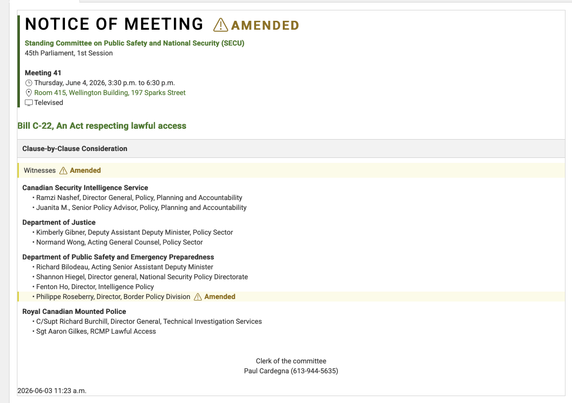
Clause-by-clause on Bill #C22 at SECU starts in five hours (3:30 Eastern Canada). Televised. https://www.ourcommons.ca/DocumentViewer/en/45-1/SECU/meeting-41/notice

The committee has given itself three hours. Witnesses are senior people from CSIS, Justice, Public Safety and the RCMP. I would expect questions to these witnesses to be limited to things like what the bill changes and how it would operate. They are obviously not people who are inclined to identify problems at clause-by-clause when the House wants to rise for the summer and they want these surveillance powers themselves. But also procedurally: clause-by-clause is about the text of the bill, not new evidence.

But also again: opposition members will try to derail through procedure. Points of order, points of privilege, motions, voice votes, whatever. It will waste time but ultimately they don't have the numbers to overturn the chair's rulings, as incorrect as they may be. Majority government rules.

Zero percent chance the clerk will have his ringer on.

https://www.ourcommons.ca/DocumentViewer/en/45-1/SECU/meeting-41/notice
#FediLaw #CanPoli

"Bill C-22 builds the blanket model of data retention that the European courts have consistently rejected, as it would require providers to retain, for up to a year, the date, time, duration, origin of communications, and location of the devices involved. The result is a surveillance map of the movements and communications practices of virtually all Canadians for a year, the very opposite of what recognizing privacy as a fundamental right envisions." From @mgeist.

https://mas.to/@mgeist/116691913037603373

#C22 #FediLaw #CanPoli

Michael Geist (@[email protected])

Attached: 1 image As the AI strategy launches today, the disconnect is dizzying: my post on how the government cannot claim privacy as a fundamental right in the morning and then rush through mandatory metadata retention that overrides it in Bill C-22 in the afternoon. https://www.michaelgeist.ca/2026/06/new-privacy-rights-in-the-morning-mandatory-metadata-retention-in-the-afternoon-how-bill-c-22-undercuts-the-ai-strategy-before-it-launches/

mas.to

Do I want to inflict clause-by-clause on myself? It's a miserable experience at the best of times, trying to figure out what an amendment to a bill that amends an act actually does.

https://parlvu.parl.gc.ca/Harmony/en/PowerBrowser/PowerBrowserV2/20260604/-1/45519

SECU Meeting No. 41

Meeting No. 41 SECU - Standing Committee on Public Safety and National Security

Jenny Kwan proposes the first amendment, despite not being a regular member of the committee (because the NDP doesn't have enough MPs to merit a permanent spot).

And then immediately into a Conservative point of order on briefs that have yet to be distributed. The Liberal Chair evades a direct answer. A different Conservative asks if the (non-partisan) Clerk has a ballpark answer on how many briefs are outstanding. The Chair declines to let the Clerk take the mic.

Gross. So gross.

Some discussion of the difference between storing information on one’s phone versus the cloud. Negative a hundred points to the DoJ for assuming a hypothetical judge is necessarily a "he.”

Discussion of amendments getting slightly derailed because the witness didn't have copies of the amendments. Good thing we're rushing this shit.

The Bloc points out that the witnesses are specifically there from the pro-surveillance camp, not the privacy camp. Every answer from their perspective is “your proposed amendments to Bill C-22 as the government drafted it would make it harder for police.”

First voice vote fails (on an amendment apparently recommended by the Privacy Commissioner). 6 no, 5 yes. C'est comme ça.

Conservative echoing the Bloc that the witnesses are here to "give more access to law enforcement," not to balance that with Canadians' Charter right to privacy.

I think we're still (after an hour and a half) on clause 4. The bill has 48 clauses. The most controversial is 41. Seems unlikely they'll get through by 6:30.

"So far you've been very good at giving me clear answers" says the Liberal MP to the witness who agreed with his hypothetical about Karla Homolka getting photographs of abuse developed at a photo store decades ago.
100% of government witnesses agree: they could not possibly speculate on why the Privacy Commissioner recommended amending Bill C-22.
Conservatives looking to introduce a motion to invite the privacy commissioner. The (Liberal) Chair said they're not allowed, because of a previous decision of the committee, which he declined to pinpoint. The (non-partisan) Clerk whose literal job is procedure made what looked to me like a skeptical face and moved out of frame.
Okay, that's enough for me for now. They for sure won't be done by 6:30 but I don't know if they'll keep going or come back another day.

Sunday morning, currently no indication on the SECU website of when the next clause-by-clause meeting on #C22 will be held (parl.ca/secu). (Probably Tuesday.)

The most recent meeting for which there are published minutes and a transcript is May 7, a month ago. This means they're doing clause-by-clause without minutes, without transcripts, and without submitted briefs and objections.

I'm musing about a letter to whatever Senate Committee ends up studying this, pointing out that they don't have to legitimize this farce. They can, this chamber of sober second thought, insist on a bare minimum Parliamentary standard of democracy and respect for official languages and Charter rights. Apparently it's as easy as splitting the bill.

What fun that would be for historians, if the independent senators declined to endorse a police state. At the very least they could slow it down a bit.

Ah, the blessing of having friends you can send questions to like "are you able to spit up examples of the Senate splitting a bill"?

Yup! C-103 from 1998 (the Atlantic Canada Opportunities Agency / Enterprise Cape Breton Corporation) and C-10 from 2002 (firearms / cruelty to animals).

Procedurally it looks like a motion that happens when the bill gets referred from the Senate to committee for study. It could be that if the bill gets sent to committee whole then a motion to split the bill *at* committee would be considered out of order. So that helps establish timeline.

If anybody wants to watch FOUR hours of clause-by-clause on Bill C-22 today: https://www.ourcommons.ca/Committees/en/SECU
SECU - Home - House of Commons of Canada

The Standing Committee on Public Safety and National Security reviews legislation policies, programs and expenditure plans of government departments and agencies responsible for public safety and national security, policing and law enforcement, corrections and conditional release of federal offenders, emergency management, crime prevention and the protection of Canada's borders.

I didn't inflict any more of clause-by-clause of Bill C-22 on myself yesterday but I just checked out the last few minutes of the televised meeting and it looks like they're up to clause 6 (of 40 something). So that's dragging on.
@Cassandra I tuned in. There was in-depth discussion about different evidentiary standards that I'm too ignorant to fully grasp. They declined to hear from DDG and Nord VPN as well, I think

@cargot_robbie Reasonable grounds to suspect versus reasonable grounds to believe? It's... yeah. A distinction in law.

I would say it's not unusual to decline to hear from more witnesses when they've reached clause-by-clause already. (The witnesses that are at the table now are supposed to help with understanding the bill, not give new evidence.)

@Cassandra ah that makes sense about the witnesses then. Caputo kept referencing prima fascie (sp?) which is what really lost me. They did some explaining of RG To Suspect vs RG To Believe, but if they ever explained that one I must have missed it.

I gathered enough to know that the bill as written adopted quite a low standard of evidence for Use Of Service Confirmations, and they debated raising it. I can't recall if that amendment was adopted 🥱☕

@cargot_robbie Huh. In case it's helpful, a law school explains: https://www.law.cornell.edu/wex/prima_facie

It's not immediately apparent to me why that would be a topic of discussion yesterday.

On suspect vs. believe, this looks promising: https://www.canlii.org/en/commentary/doc/2016CanLIIDocs120

prima facie

LII / Legal Information Institute