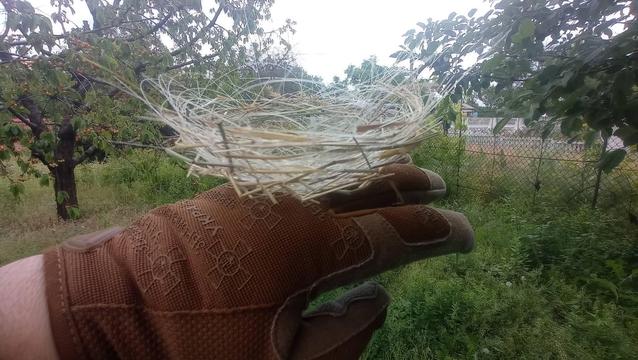
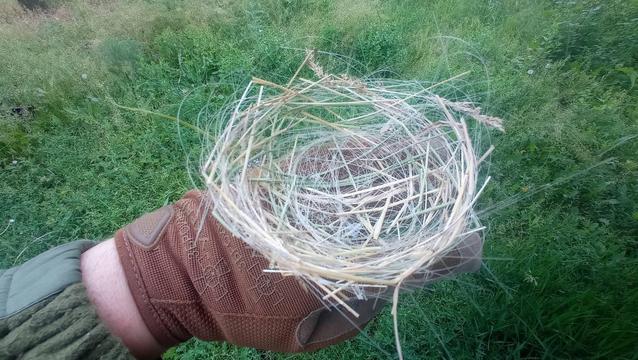
The war in Ukraine has now gone on for so long that, birds in the Donbas region have adapted and are using strains of Drone control fiber optic cables to build their nests.

A post from Ukraine claims that this half-finished nest was found after a tree fell during a Russian glide bomb bombing.

Let us make it our goal, that our children will inherit a world in which birds once again build nests out of twigs and stalks.

@randahl it also shows that nature always adapts and finds a way, regardless the fibre pollution we have to clean up

@ErikJonker
So true! In the treeless wastelands of Australia eagles make nests out of barbed wire & site them on the top of electricity poles. Sad that these & Ukrainian birds have had to adapt but they do. 😐

@randahl

@Su_G @ErikJonker @randahl In contrast to barbed wire or the laundry hangers used by Japanese crows, I fear the risk of ingestion is much larger here. Nevertheless, the image shows the masterly skilfulness birds apply when building their nests.
@randahl If the birds discover the fibres make nests that last a lifetime they might start digging up our internet fibre cables 😱

@randahl

I wonder if this is real. If it is, it's sad.

@pascaline @randahl The damages to the environment caused by russia will take decades to clean.
Just think of mining: Ukraine has the equivalent of 2x the size of Portugal mined.
Here's to me hoping justice will prevail, and muscovy will also pay for this.

@fanchig

It's a terrible strain on the environment, yes. The bombs, drones, all the materials and resources needed to create what's required for warfare. It's terrible. The cities and buildings that were destroyed also mean a lot needs to be cleaned up. The devastation is enormous. I truly admire the spirit of those who stay to fight for their country!

@randahl

@randahl Unfortunately, this building material does not protect the birds from Russian bombs.
@randahl looks like fishing string tbh. Any fiber line I've seen for data has outer insulation to keep outside light out and inside light in.
@randahl @terminhell I'd say that most important thing is range and insulation would be heavy...

@terminhell
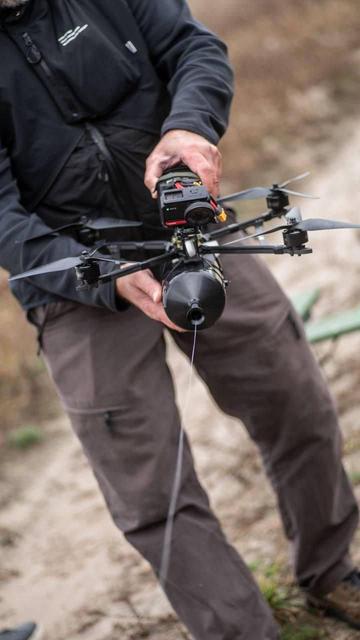
Drone fiber is no ordinary FTTH or FTTD fiber though, built & insulated for years of use in pipes or under desks. Drone fiber is one-use, one-way fiber, fire and forget. A drone carries a spool of this fiber which unwinds and is left behind as the drone flies. Insulation would add unnecessary weight to the fiber and thus limit the usage of the drone. I guess (haven't found much detail) the drone light diode tech makes somehow up for the lack of insulation.

@randahl

@musevg @randahl FBW in older tech like missiles used thin copper iirc. But I've not kept up on my killer drone tech, so if true, TIL.

@terminhell
Yes, I remember (copper-) wire-steered rockets from the 80s. Unfortunately I have only limited information on the protocols and tech being used on todays fiber-optics drones made in Ukraine.

@randahl

@musevg @terminhell @randahl
Yup. My guess would be that it's not really high bandwidth that they need for this. S few commands one way, video feed the other way. Not a whole lot, compared to modern fiber capabilities.
They probably just use pretty powerful light sources, crude & powerful, just enough to get the job done.
@terminhell drone control fiber optic cables are thin like human hair and they do not have plastic coating. The goal is not to protect the cable. The goal is for the cable to be light enough that the drone can carry several kilometers of fiber optic cable with as little effort as possible, thereby increasing drone range.

@randahl https://www.gl-fibercable.com/products/single-mode-bare-optical-fiber-spool-g.657a2-optical-fiber-for-fpv-drone.html

So it is insulated, just different than typical fiber. Otherwise the signal loss and interference would make this all useless. Indeed, TIL'd

@randahl

Alt text

The back of a left hand wearing a brown glove supports a bird's nest made of thin, white-ish fibre optic cable, which makes the curvature of the nest. The nest is seen from a side view Within the nest there are also some straight, light beige pieces, about 50-mm long (2 inches), 5-mm wide (25/128 inches) and 1-mm thick (5/128 inches). The uniformity of the light beige pieces suggests that they are part of the fabricated cable. What appears to be green grass in the top view is not obvious Tall grass, trees, and a dark wire chain-link fence are in the background.

Alt text
The palm of a right hand wearing a brown glove holds a bird's nest made of thin, white-ish fibre optic cable, which makes the curvature of the nest. The nest is seen from a top view. the nest there are also some straight, light beige pieces, about 50-mm long (2 inches), 5-mm wide (25/128 inches) and 1-mm thick (5/128 inches). The uniformity of the light beige pieces suggests that they are part of the fabricated cable. The top view reveals what might be some strands of green grass and a thinness which suggests that the nest is still under construction. Tall grass is in the background.

@RuthODay2 @randahl

Thank you for the alt text and adding #alttext to your post will make it more visible to people who search for that tag.

@Ralph @RuthODay2

Added. Thank you.

@randahl @Ralph @RuthODay2 Isn't it on the back of the left hand, rather than on the palm of the right hand?
@randahl this makes ne sad. sadder.
@randahl
I appreciate that nature is finding a use for our refuse which is much less likely to get into animal feed.

@randahl

Does anyone know if this fiber is strong enough that animals can get tangled up in it? If it got wrapped around a bird’s foot or neck, would the bird be able to break free?

@djembro @randahl Absolutely not bird/animal friendly. This is not the first occurrence of birds building with man-made materials incorporated into a nest.
Fiber optic cables comprise many glass tubes (fibers) that let light pass through carrying data - no matter the position of the cable that surrounds it (unless kinked or bent/crushed).