 flamingos-cant (hopepunk arc)
Necessity is the mother of invention
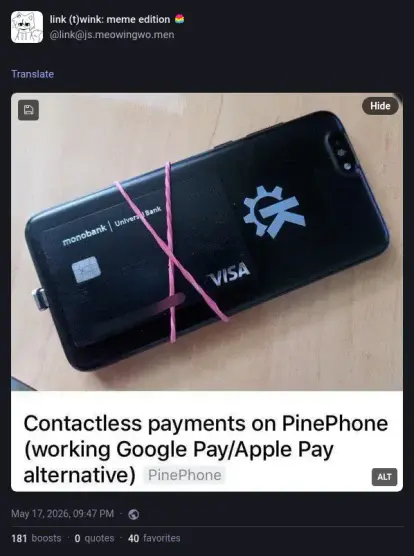
Take that Android! This works even with the phone off! It works even without the phone at all!
Wait…
I’ll do one better:
My payment card was just a bit too wide to fit in my cellphone’s cover. The phone’s own NFC antenna is at the top - and I use it all the time - so the card had to be at the bottom of the cover to avoid triggering the phone all the time, in portrait orientation so-to-speak.
So I dissolved the card in acetone to extract the NFC chip and its antenna, then carefully reshaped one end of the antenna so it’s a bit less wide (and since I couldn’t modify the length of the wire or the number of turns in any way to avoid de-tuning the antenna too much, I sort of accordioned one side of the rectangle to accommodate the extra wire).
Then I set the new shape of the antenna permanently by carefully applying a piece of packing tape over it, flipped it over, taped over the other side to seal everything, then carefully cut around the new, ultra-thin, stubbier contactless payment “card”.
Now it fits really smartly in my cellphone cover!
I dissolved the card in acetone to extract the NFC chip and its antenna,
Wouldn’t the acetone also dissolve the insulation around the antenna wire? So when it touches itself, it shorts itself out, and – electrically speaking – you only have one turn of thicker wire?
Only one way to find out, good thing that these don’t cost any money and you can just ask for a new one.
Maybe take some cash out first to cover any payments you may need to make it it breaks in some way.
Wire that thin is usually insulated with an enamel coating. I’d guess it’s either unaffected by acetone, or just tougher to breakdown. Allow the card to dissolve, but remove and dry asap, don’t let it linger longer than necessary.
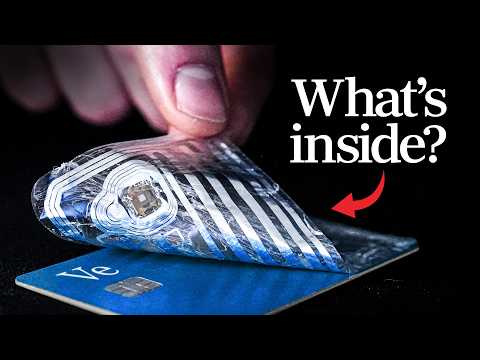
Veritasium demoed this a few weeks ago while discussing tap-to-pay security and a vulnerability with apple pay+visa.
I was thinking about this, and there are two easy workarounds, I think:
But, in either case, I do think you might run into a different issue: automated fraud detection sometimes requires me to chip+PIN, even for transcribed below the tap limit. This has happened to me when traveling. I don’t think there would be any way around that, and if you then fail to authenticate with chip+PIN, it’s reasonable to think that the bank would lock your card for contactless payments until you successfully authenticate the card again with chip+PIN. (To be clear: this is only speculation; not sure if that would be an issue in practice.)
So, I suspect that whether this would work or not might depend on your institution (or maybe jurisdiction?)
Have you ever run into difficulty with needing to authenticate with chip+PIN? Like while traveling?
That would be my big with with this; it would make it very difficult to pass a PIN check, to say the least!
Super cool idea. I might just try it myself and see if I run into issues.
What I modified was in fact a contactless payment token. It had the form factor of a payment card, but it only does NFC.
I have another card for chip+pin.But I almost never use it where I live, because all limits were lifted on contactless payments a few years ago. If I try to pay something really expensive contactless, it will ask me for the pin - which is specific to the payment token.
Do you mind if I ask what bank issued those? Why? Does the chip+pin also tap or are they features on totally separate cards?
I’ve never heard of a separate tap to pay token (outside of perhaps transit passes or like, arcade cards), and never a card based tap transaction that asks for a pin.
Payment tokens are very common. Usually they’re sold as keychains, wristbands or rings, and they’re provisioned to work with the myriad of payment processors out there - which aren’t banks.
in my case, it’s a token from iCard. The way it works is, it’s connected to a regular bank account number with an IBAN number, and you transfer money to it that you can then spend with the contactless token. The nice thing is, if you lose it, you can’t lose anymore money than you put on it.
 kibblebits
 Artwork
 Darkassassin07
 Hazel
Hazel terraquad
 ExtremeDullard
 pankuleczkapl
 gedfromgont
 Ricky Rigatoni
 SeductiveTortoise
 hoshikarakitaridia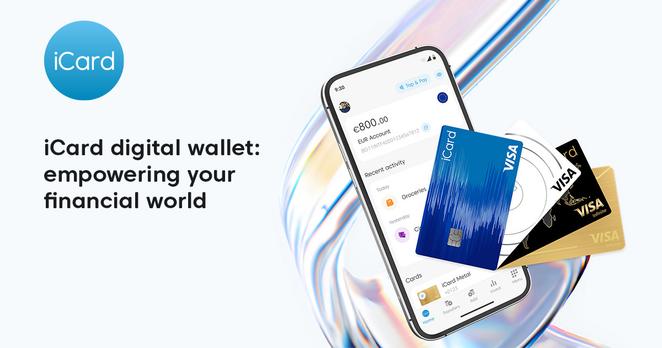
 PerogiBoi