 franco_vazza
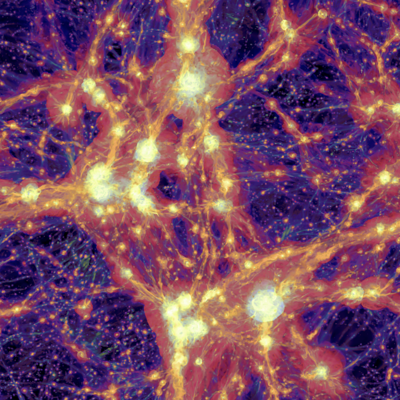
The wonderful variety (and regularity, as well) of thousands of radio galaxies in the RADIOGALAXYNET catalog by CSIRO (https://data.csiro.au/collection/csiro:61068) which I combined in this animated gif, each radio galaxy is at the very centre of the image, while all the rest around it's mostly bg galaxies
 Nick Appleyard
@franco_vazza
New #screensaver, thanks!
Trying to figure out what I’m looking at here. The barbell shapes are pairs of jets, right? And now and again there are concentric ripples going a long way out - what are we looking at there?
New #screensaver, thanks!
Trying to figure out what I’m looking at here. The barbell shapes are pairs of jets, right? And now and again there are concentric ripples going a long way out - what are we looking at there?
@nick_appleyard mostly it's pairs of jets ("Fanaroff-Riley type II " radio galaxies), while the concentric ripples are instead residual errors from the data reduction process (sometime they end up even in final data release, but every expert radio astronomer would recognise them on the spot)

Calibration artefacts in radio interferometry. I. Ghost sources in WSRT data
This work investigates a particular class of artefacts, or ghost sources, in radio interferometric images. Earlier observations with (and simulations of) the Westerbork Synthesis Radio Telescope (WSRT) suggested that these were due to calibration with incomplete sky models. A theoretical framework is derived that validates this suggestion, and provides predictions of ghost formation in a two-source scenario. The predictions are found to accurately match the result of simulations, and qualitatively reproduce the ghosts previously seen in observational data. The theory also provides explanations for many previously puzzling features of these artefacts (regular geometry, PSF-like sidelobes, seeming independence on model flux), and shows that the observed phenomenon of flux suppression affecting unmodelled sources is due to the same mechanism. We demonstrate that this ghost formation mechanism is a fundamental feature of calibration, and exhibits a particularly strong and localized signature due to array redundancy. To some extent this mechanism will affect all observations (including those with non-redundant arrays), though in most cases the ghosts remain hidden below the noise or masked by other instrumental artefacts. The implications of such errors on future deep observations are discussed.
@franco_vazza
Huh. Thanks (I think) for the flashbacks to courses on Fourier analysis and optics. Back when maths was something we did with a pencil.
Huh. Thanks (I think) for the flashbacks to courses on Fourier analysis and optics. Back when maths was something we did with a pencil.